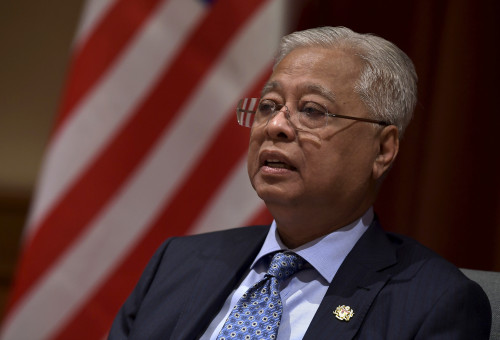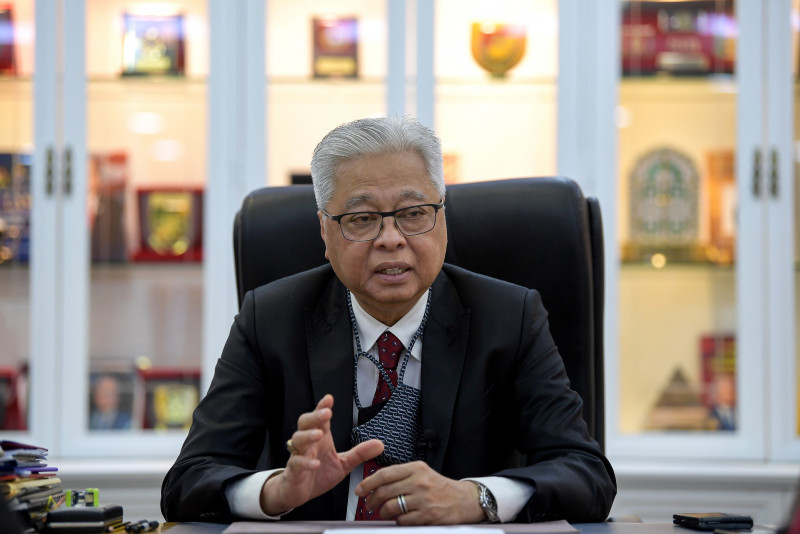
KUALA LUMPUR – The proclamation of emergency to curb the Covid-19 pandemic should not be politicised, and the context of its importance should be understood, said Senior Minister (Security Cluster) Datuk Seri Ismail Sabri Yaakob.
He said that the proclamation was made to facilitate and strengthen all government actions in controlling the spread of the virus by introducing new ordinances without the need to go through the legislative process in Parliament, which takes time.
“When we declare an emergency, we can promulgate laws under the emergency ordinance to increase a compound. For example, fines may be imposed on companies that violate the rules, and the matter is being reviewed by the Attorney-General’s Chambers (AGC).
“This law also aims to prevent the recurrence of offences. If the amount of a fine is increased, perhaps individuals or companies will be afraid to repeat the same offence,” he said in an exclusive interview with Bernama recently.
On January 12, Istana Negara in a statement announced that the Yang di-Pertuan Agong Al-Sultan Abdullah Ri’ayatuddin Al-Mustafa Billah Shah consents to the proclamation of emergency to be implemented nationwide until August 1 as a proactive measure in curbing the Covid-19 pandemic.
Prime Minister Tan Sri Muhyiddin Yassin, in a special address in conjunction with the proclamation of the emergency on the same day, explained that the cabinet had advised the king to issue a proclamation of emergency for the whole country in accordance with Article 150 (1) of the federal constitution, effective from January 11 until August 1 this year.
Article 150 (1), among others, provides that the king can declare a state of emergency if he is satisfied that a grave emergency is taking place, causing security or economic life or public order in the federation to be threatened.
The government will continue to function as usual at the federal and state levels throughout the period of emergency, even the administrative machinery of the federal and state governments will not be disturbed by the declaration.
Ismail said the preparation of the draft ordinance by the AGC is running smoothly, and it is expected to be announced in the near future. Once announced, the enforcement of the ordinance would be final and immediate.
“The attorney-general will draft a proposal (of law) and present it to the National Security Council (special session). If the ordinance is agreed to, it will be presented to the king. Once approved, it will become law,” he said, explaining the draft ordinance process.
The ordinance enables the Prevention and Control of Infectious Diseases Act 1988 (Act 342) to be amended to increase its effectiveness including increased penalties for anyone who violates relevant laws and regulations, and is effective during the emergency period only.
Ismail said the AGC is also reviewing the implementation of the law under the Workers’ Minimum Standards of Housing and Amenities Act 1990 (Act 446), which is to provide accommodation to foreign workers in compliance with certain specifications.
“Many cases of Covid-19 are reported among factory workers due to overcrowded housing and easy (transmission of) infections. Companies want big profits but the welfare of employees is not emphasised.
“Under this ordinance, we will probably issue conditions or instructions to provide comfortable housing, and action will be taken if they (employers) fail to do so,” he said.
Currently, as a measure to reduce Covid-19 infection, the government requires employers to ensure that their foreign workers undergo screening, starting January 1.
“Thus far, more than 100,000 foreign workers in the manufacturing sector have undergone screening, and the Human Resources Ministry has a target for 880,000 foreign workers in this sector to get tested,” he said.
Ismail, who is also chairman for the Cabinet Committee on Foreign Workers, was previously reported to have said that the certificate of accommodation will be a prerequisite for employers who intend to hire new foreign workers as at Jul 1, 2021.
He said that before the employer submits an application to bring in foreign workers, the employer must obtain a certificate of accommodation from the Human Resources Ministry to enable the Immigration Department to issue a visa. – Bernama, January 26, 2021