
KUALA LUMPUR – Malaysians are warned that a drop in the number of daily Covid-19 cases will not translate into a lower infection rate.
Clinical Research Centre Malaysia medical officer Dr Arvinder-Singh HS said the country’s attempts to curb the pandemic should consider several other variables – the rate of positive cases, number of intensive care unit (ICU) cases, those requiring respiratory assistance, and deaths due to the virus – to better tackle the problem.
Dr Arvinder said these are the indicators that all parties need to look at in anticipating the end of the pandemic.
“Actually, what we need to see is the number of positive cases out of the number of people that have been tested.
“This allows us to see how many people have been infected from a community or cluster.
“For example, 10 positive cases out of 100 tested indicate that 10% of the people in the community or cluster are infected with Covid-19.
“The World Health Organisation (WHO) recommends more than 5% in large-scale screening tests be done to address community transmission concerns,” he said in a series of tweets on Tuesday.
Citing research he conducted recently, Dr Arvinder said the positive rate on his graph was at 6.2% on Monday with a seven-day average of 5.9%.
“Although the number of new infections yesterday (Monday) has decreased, the positive rate is still more than 5%.”
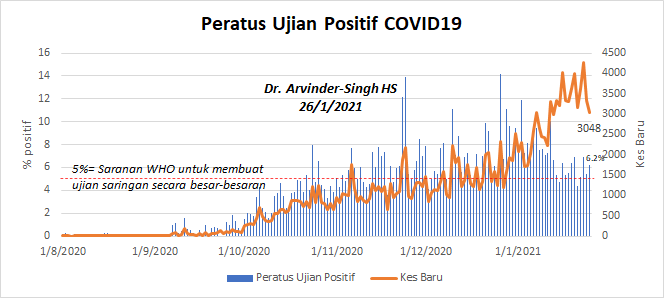
He said among the reasons for this occurrence is how the rate of Covid-19 testing has decreased, which means fewer people getting tested, which in turn equates to lower detection of positive cases.
He pointed out that the percentage rate of infections in the country has been the same since January 16.
As such, he opined that using the rate of positive patients among the population, instead of the total number recorded, to measure the outbreak situation is inaccurate.
“Positive infection rates give a clearer picture of the situation. More tests will result in more positive cases that can be detected (especially Level 1 cases), and the process of isolating patients and identifying close contacts via contact tracing can be done quickly.
“This will prevent patients from deteriorating to a detrimental stage.”
Cannot afford to take matter lightly
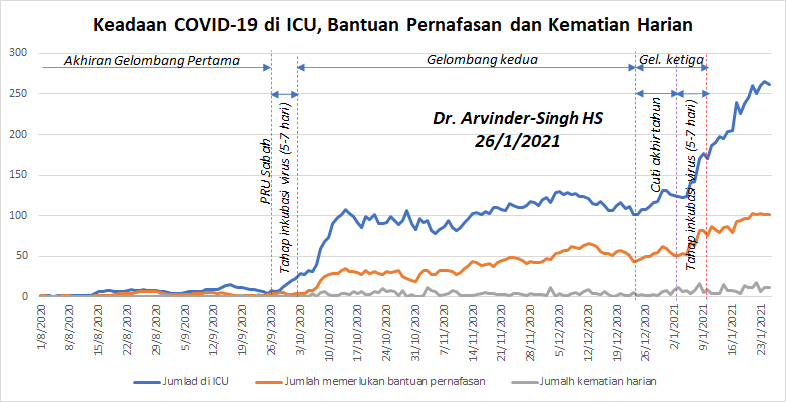
Dr Arvinder also pointed out that the actual target to tackle the pandemic is not to reduce the number of positive cases, but to reduce the number of patients admitted to ICUs, requiring respiratory assistance, and deaths, which occur at Categories 4 and 5.
“Based on the research graph, with data compiled from the Covid-19 outbreak since January last year, we can see the rate of cases in ICUs and and those that require respiratory assistance, as well as deaths, against the timeline of events.”
He noted that the second wave occurred after the Sabah election in September, and the third wave after the year-end holidays in November and December. Despite fluctuating positive case numbers, the death toll now is often more than five people a day compared with the situation in August, when there was almost zero deaths a day.
“Although cases are declining, death rates are seen to be increasing.”
Advising the people to not take things lightly if they notice symptoms, Dr Arvinder said the present situation reflects the possibility that there are more positive cases in the community, with those infected slow to receive immediate treatment. This is especially so among people in the high-risk category.
“One of the reasons for the increase in cases is due to unrestricted movement during the Sabah election and school holidays, especially at ferry ports heading to holiday destinations.
“Therefore, compliance with standard operating procedures should continue to be prioritised, especially in crowded, cramped places and during close (proximity) conversations.”
By doing so, Dr Arvinder hopes that, in the long run, the rate of positive cases will go down, together with the number of ICU cases, those requiring respiratory assistance, and deaths. – The Vibes, January 27, 2021