


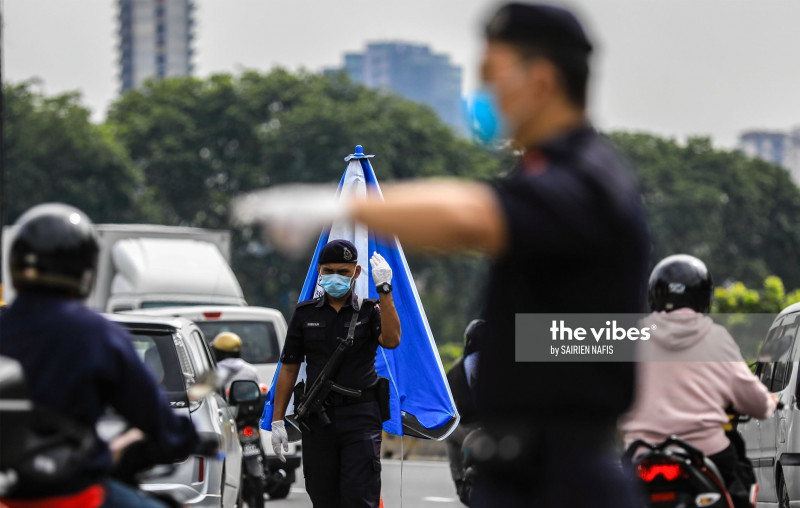
KUALA LUMPUR – “MCO, but not like MCO.”
This is the general perception of the second movement control order (MCO), which is in force nationwide except for Sarawak.
The movement controls this time around are said to be less effective than last year’s lockdown in reducing Covid-19 transmission, with the daily caseload having breached 5,000 twice this week.
Many have said the MCO is not being strictly enforced as it is, leading to concerns that should it be lifted, the coronavirus crisis will only worsen.
For Malaysian Public Health Physicians’ Association president Datuk Dr Zainal Ariffin Omar, what is of utmost importance is to tighten the standard operating procedures.
“People are angry now because even though the MCO is in place, the SOPs are not being fully complied with. It is as if there is no MCO,” he told Bernama.
“In fact, even if there is no MCO, it is alright, but the SOPs are necessary, and compliance is vital to flatten the Covid-19 curve.”
On Monday, Health Director-General Tan Sri Dr Noor Hisham Abdullah said the MCO, which is scheduled to end on February 4, will not be extended, so as to prevent further negative effects to the economy.
The following day, Senior Minister Datuk Seri Ismail Sabri Yaakob said the decision on whether to enforce a stricter MCO, or return to the conditional MCO (CMCO), depends on the National Security Council.
Dr Zainal Ariffin said if the CMCO is implemented, social and other large gatherings, as well as interstate travel, should still be barred.
“Any event held indoors, such as feasts and birthday celebrations that involve many people, should not be allowed. Do like what is done in other countries, for example in Singapore, where a maximum of five people are allowed at a social event.
“Apart from that, make mask-wearing mandatory, that is, when you leave the house, you must automatically wear a mask, or face action. Physical distancing should also be a priority. If there are many people in shops or offices, take action.”
He said the government must act against manufacturers, including closing their factories, if there are reports of workers infected with Covid-19.
“For factories that have recorded cases, the government needs to be more stern. Previously, they were ordered closed only when there were thousands of new cases, but now, if a factory records even one or two cases, they should be ordered shut.”
Putrajaya should let the people know about its strategies against the pandemic, he said, citing United States President Joe Biden’s release of a 200-page document on his administration’s methods to combat the virus, on his first day in office.
Dr Zainal Ariffin said the government could also impose a targeted MCO by “closing” only states with high caseloads, such as Kuala Lumpur, Selangor and Johor.
Whatever is decided with regard to movement curbs, he said, the estimated number of infections will not drop for 10 to 14 days at least, due to the virus’ incubation period.
Universiti Sains Malaysia virologist Associate Prof Yahya Mat Arip agrees, saying a targeted, not nationwide, MCO is needed.
“We are aware of the impact of the MCO on society, especially in terms of the economy, but at the same time, we need to deal with Covid-19… there is a need to balance the two.
“The authorities have identified several sectors as Covid-19 hotspots, so it is possible for the MCO to be targeted at these sectors.”
He said the ideal lockdown period is two weeks.
Regardless of the kind of movement controls imposed, he said, efforts to curb the virus will be futile if public compliance with the SOPs is low.
“We need to look at New Zealand’s compliance with their SOPs, and their success. A deeper understanding of the importance of complying with the SOPs is key.” – Bernama, January 31, 2021












.jpg)
