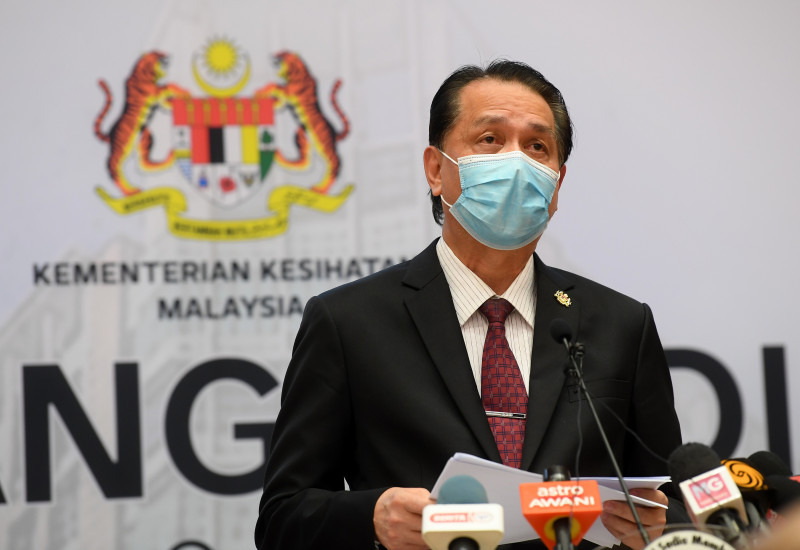
KUALA TERENGGANU – Malaysia is expected to receive the first batch of the Pfizer-BioNTech coronavirus vaccine on February 26, said Health Director-General Tan Sri Dr Noor Hisham Abdullah.
He said that upon arrival, the vaccines will be distributed in stages to each state within a week or two.
Dr Noor Hisham said this after participating in the Covid-19 Emergency Management Technical Committee meeting at the Menteri Besar’s Office at Wisma Darul Iman here today.
Also present was Terengganu Menteri Besar Datuk Seri Ahmad Samsuri Mokhtar.
Malaysia was previously reported to have purchased 12.8 million doses of Pfizer-BioNTech coronavirus vaccine and has subsequently committed to purchasing an additional 12.2 million doses of the same vaccine.
In the meantime, he said that to date, a total of 141 volunteers have received injections in the phase 3 clinical trials for the vaccine developed and sponsored by China’s Institute of Medical Biology Chinese Academy of Medical Sciences.
They are among 3,000 volunteers, aged 18 and above, who were selected based on set criteria.
“We only wanted 3,000 volunteers but the number of applicants was more than that, so there was a selection process,” he said.
Meanwhile, Dr Noor Hisham also hoped the late reporting of cases to the Health Ministry’s National Crisis Preparedness and Emergency Response Centre (CPRC), including from private facilities, can be resolved within a week.
He also hoped that registered private facilities such as private clinics and hospitals can report positive cases as soon as possible or before 12pm every day to the CPRC in their respective states.
“Private laboratories have to enter virus test results into the public health information system, so if there is a delay in the task, we will receive the data late,” he said.
Yesterday Dr Noor Hisham, in a statement, said that the sharp increase in the number of daily cases, exceeding 5,000 on three consecutive days, was due to the late reporting of cases to the CPRC, including positive cases detected in 2020.
This sharp increase in cases is due to targeted workplace screening, close contact screening and high-risk group screening conducted on a large scale in several states. – Bernama, February 1, 2021
















.jpg)