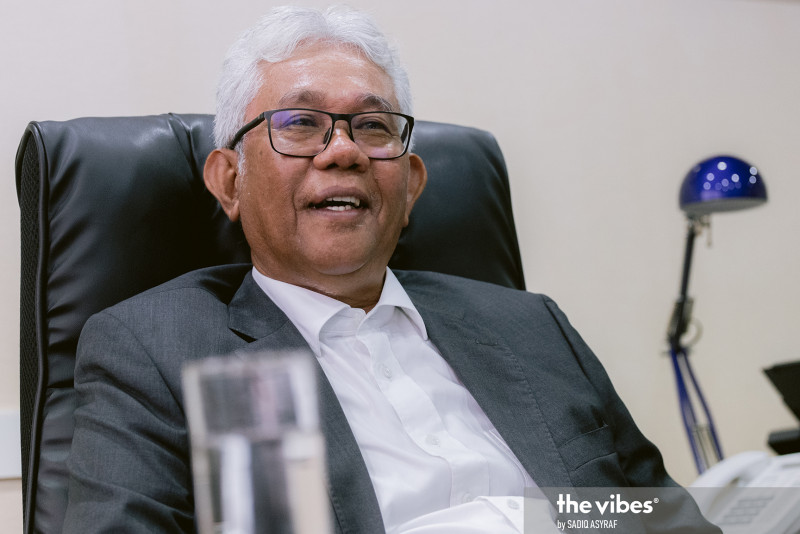

KUALA LUMPUR – Former appellate court president Tan Sri Zulkefli Ahmad Makinudin has fulfilled his childhood dream of being admitted as a lawyer to the High Court of Malaya.
The 70-year-old, who also served as chief judge of Malaya between 2011 and 2018, was admitted and enrolled before high court judge Mariana Yahya, who was once his subordinate.
Speaking to The Vibes after the ceremony, Zulkefli said despite his long career in the judiciary, he never took earlier opportunities to be called to the Malaysian Bar.
“Although there was an occasion when I could have done it earlier, even during my tenure as officer in the Attorney-General’s Chambers, to be called to the Bar, I did not take the opportunity.
“I was in the judicial legal service throughout as deputy public prosecutor and officer in various departments, and then, I was elevated as a judge, so I was not a lawyer in that sense, a practising lawyer.
“So, after my retirement, only then did I give it a thought, because it was always my ambition to be a practising lawyer.”
The Bar exempted Zulkefli from the usual nine months of chambering. Instead, the father of five was under the pupillage of Wan Azmir Wan Majid from law firm Hafarizam Wan and Aishah Mubarak for three months.
Lawyer Datuk Mohd Hafarizam Harun moved Zulkefli’s call, which was conducted virtually due to the Covid-19 pandemic.
Zulkefli said he intends to act as a legal consultant rather than face his peers in court.

“Let me be clear here. My intention to be called to the Bar is not to appear in court or to appear before my peers, unlike some ex-judges you know, like Datuk Seri Gopal Sri Ram, who, after his retirement, carried on his duties as a lawyer.
“But for me, whatever cases that I am involved in, I will be so by way of consultancy. That is what I intend to do. Consulting. Giving my view. My advice, my opinion.
“I shall not appear in court. I have made up my mind (and) my resolve.”
Asked about his memorable moments as a judge, he described the case involving the Al-Ma’unah extremist group.
“I would say that is the one case I treasure the most. One that I will not forget. That was a case in which there were more than one accused person.
“There were 28, plus the leader, who were charged in the armed insurgency.
“In my capacity as a judge, I went through over a year to complete the case. Because there were 29 accused persons in that case, I think the court had to build a special dock.
“Normally, you have one to four accused persons, so for this case, a special, bigger dock was designed for all 29 to appear. That was in the old courthouse in Kuala Lumpur, more than 20 years ago.”
He said the trial was the first of its kind in the country under the Penal Code, with the charge being waging war against the Yang di-Pertuan Agong.

“It was considered a high-security case. It involved the insurgency, the way they carried weapons and attacked the army. Because of that, maximum security was given to the judge, which was me.
“I was escorted from my house with two outriders throughout the trial. But later on, as the trial progressed, I told police after one to two months that they didn’t need to send their security detail for my protection.
“That’s why I said, among all my cases in court, that’s the one case I shall treasure throughout my life, and also during my tenure as a judge of the high court, presiding over the case.”
He recalled his Federal Court stint, during which he led a five-member bench in January 2018 that allowed M. Indira Gandhi’s appeal with regard to the need for the consent of both parents in the conversion of underage children, when either parent converts to Islam.
The Ipoh-born Zulkefli attended St Michael’s Institution and the Royal Military College in Kuala Lumpur before proceeding to study law at Universiti Malaya. He graduated in 1976 among the Law Faculty’s first batch.
His career began as DPP, and he continued to serve in various capacities, including as federal counsel at the Inland Revenue Board, Selangor legal adviser, and chairman of the advisory board in the Prime Minister’s Department.
He was appointed judicial commissioner in November 1994 and high court judge in January 1996, before being promoted as Court of Appeal justice in June 2005. – The Vibes, March 13, 2021