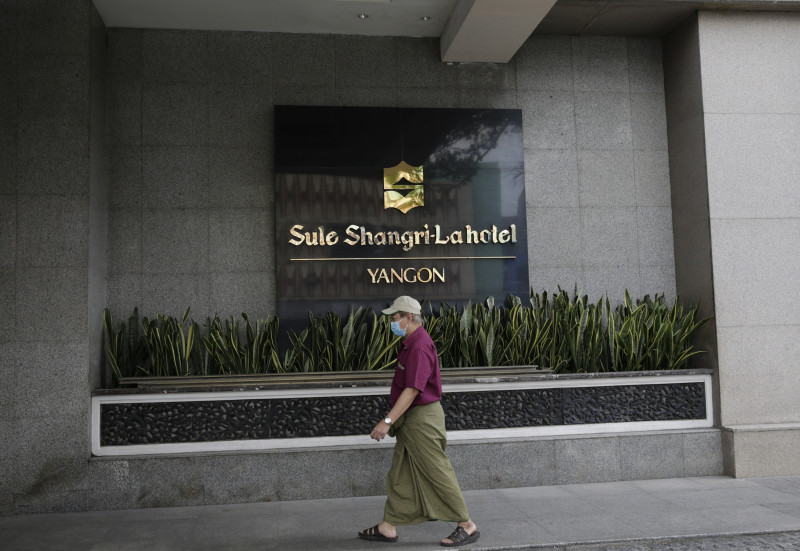

KUALA LUMPUR – The alleged continued business ties between Tan Sri Robert Kuok’s Shangri-La Asia Limited and Myanmar’s military junta, which has drawn criticism from certain quarters, has raised the larger question about Malaysian companies’ dealings in the military-held state and whether they should cease their operations there.
Many claim that companies should exercise stronger ethical practices and corporate responsibility by boycotting and withdrawing their operations in view of the coup d’état on February 1 and subsequent violence against protestors.
However, a policy expert said such a move makes little “business sense”, and will come at the expense of countless jobs.
Speaking to The Vibes, Tan Sri Ramon Navaratnam, chairman of the Centre for Public Policy Studies under the Asian Strategy and Leadership Institute (Asli), said that, by their nature, businessmen are committed to undertaking trade for profit – under any circumstances.
Pulling out investments now would be like “cutting off the nose to spite the face”, he said, adding that companies typically do not stop doing business unless there are no longer trade opportunities or if sanctions are imposed by either government.
“If they are to withdraw their businesses on grounds of principle, then who will compensate them for their losses? They could be looking at millions of ringgit in losses,” he said.
“Additionally, this might even hurt Myanmar’s economy and the people as a whole. What is to happen to their citizens who are currently employed by Malaysian companies then?”
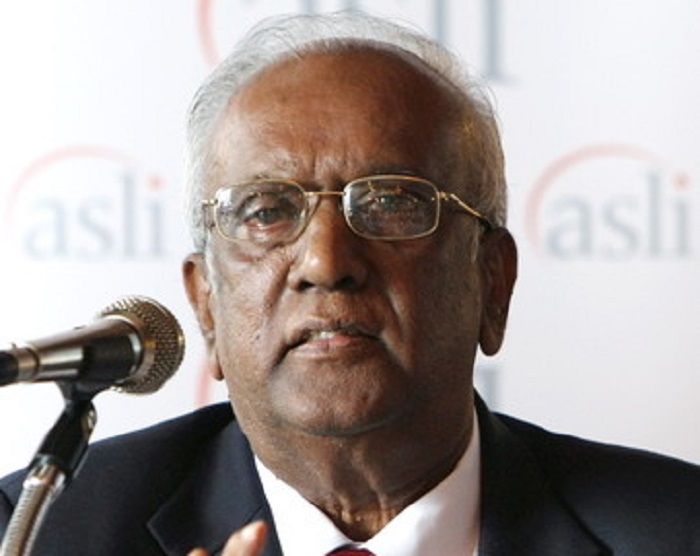
On whether he believes the Malaysian government should enforce sanctions against the Myanmar junta to protest its attacks on the people, Ramon said this would only lead to counter-sanctions, which are unwise and counter-productive.
“No one wins by war, but more will be gained by peace. Don’t use power, use persuasion instead,” he said.
Ramon’s remarks come just days after the Justice for Myanmar NGO criticised the alleged ties between Shangri-La Asia and the junta.
It called for action to be taken against Kuok’s hospitality group, which allegedly leases land from the army’s quartermaster general’s office for its five-star Sule Square complex in Yangon.
One of the NGO’s activists, Yadanar Maung, alleged that Shangri-La Asia has failed to respond to recommendations from the United Nations (UN) fact-finding mission to sever ties with the military.
‘Show displeasure by holding off investments’
Several others The Vibes spoke to, however, believe Malaysian firms and investors should take the high road and move their businesses elsewhere, so as not be seen as legitimising the junta government.
Klang MP Charles Santiago, who chairs the Asean Parliamentarians for Human Rights, said the general call globally is for every party, including local firms, to play a role in showing their objections to the coup d’état.
“They can do this by holding off their investments until the legitimate, democratically elected government is reinstated,” he said.

Santiago said this should especially be the case for larger companies that are signatories of the UN environmental, social and governance (ESG) criteria, which are a set of standards for a company’s operations that socially conscious investors use to screen potential investments.
“Companies that sign up to this are also signing up for a better world. And, you would think that this (ESG) would be used to stop firms from investing in this particular junta-held country,” he said.
Pressure by boycott
Human rights activist Muhammad Sha’ani Abdullah, who is also Sustainable Development Network Malaysia chairman, said any ethical business would withdraw from dealings with the military government in a mark of protest against the killings of citizens there.
“There is no reason to justify their presence there. They must pull out their businesses and investments. Otherwise, you will be seen to be in cahoots with criminals,” he said.
Sha’ani, who is also Malaysian Digital Economy Consumers Associations secretary-general, said the Malaysian public should also play a role by boycotting local companies that have any dealings in Myanmar to pressure them into withdrawing.
“Just look at the proposed European Super League,” he said. “Millions around the continent protested the move and, finally, the clubs that were supposed to join were pressured into quitting. This shows the power consumers have on businesses; they can make a difference.
“Similarly, in this case, they can pressure the companies because, at the end of the day, money talks. And when their products and services are boycotted, they will have no choice but to listen to the public,” he said.
‘New investors should stay away’
Transparency International Malaysia president Muhammad Mohan opined that while companies that have already invested in Myanmar might not want to pull out due to business reasons, prospective and new investors should reconsider any plans temporarily.
“For one, investing there right now would be very risky for any business, especially with the entire population up against the military government. You can only imagine their anger if you legitimise this junta.
“Secondly, it would not be ethical to do business in a country where there are a lot of human rights violations, and where countrymen are being killed by their own military,” he said.
Like Ramon, Muhammad said that, for companies that already have bases set up in Myanmar, moving their business out now would not be morally or ethically right as many locals may risk losing their jobs. – The Vibes, April 24, 2021