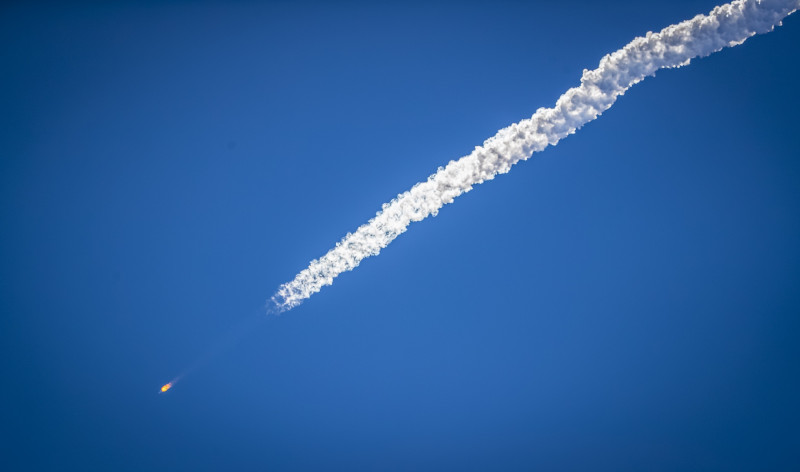
KUALA LUMPUR – The public are being advised not to worry over reports of a Chinese-owned rocket, known as the Long March 5B, expected to crash down on Earth this weekend, as the probability of its debris harming humans, damaging buildings, or even hitting Malaysia, is very low.
According to the Malaysian Space Agency (MYSA), the prediction is based on the fact that 70% of the Earth’s surface comprises water, apart from Malaysia’s small size in relation to the Earth’s surface area.
MYSA said where exactly the rocket debris will crash upon re-entry has not been accurately predicted, and that it will give updates on developments from time to time. According to media reports, most of the debris will be from the main segment of the rocket.
“The latest prediction of the Long March 5B rocket debris falling to Earth is today between 9.34am and 3.34pm Malaysian time. The debris from the rocket is still orbiting and descending, approaching the re-entry zone,” MYSA said in a statement today.
According to MYSA, most rocket launches usually leave behind debris, depending on the size of the rocket launched, and because the Long March 5B is quite large, the debris set to crash to Earth will also likely be large.
However, MYSA said most of rocket will burn up in the atmosphere and shatter into small fragments.
As such, MYSA advised the public not to touch or pick up any suspicious objects or inhale vapours emitted from suspected debris from rocket crash.
MYSA also advised the public to call the 999 emergency line or MYSA at 03-26972570 and lodge a report if they witness any incidents or record them.
The Long March 5B is not the largest object to fall into the Earth’s atmosphere, with the previous record involving the Russian-owned Mir space station with a capacity of 120,000kg on March 23, 2001.
In comparison, the residual weight of the Long March 5B rocket is expected to be in the 21,000kg range and is only one-fifth of the weight of the Mir space station.
The Long March 5B rocket was launched on April 29 to send the core module of China’s Tianhe space station weighing 22,600kg into operational orbit in space. – Bernama, May 8, 2021