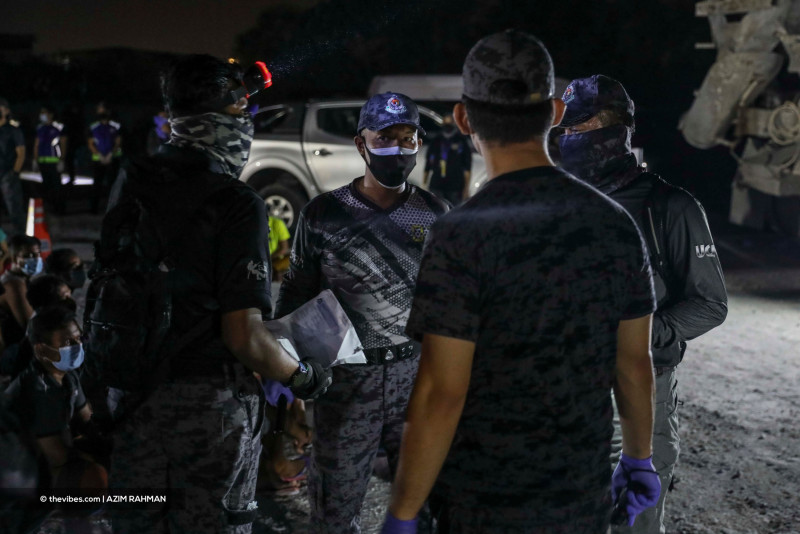

GEORGE TOWN – After dropping to Tier 3 on this year’s Trafficking in Persons (TIP) report, Penang Malaysia Trades Union Congress (MTUC) secretary K. Veeriah and Wanita DAP international secretary Kasthuri Patto are calling for a systemic change.
Speaking to The Vibes, Veeriah said enforcing officers should admit that there is a dark economy going on involving millions of undocumented migrant workers who are falling victim to traffickers and smugglers.
“This issue of trafficking is not something that is going to be eradicated immediately. There is no magical formula because this involves syndicates, among others.
Human trafficking is a dark economy. In many ways, it is an invisible and lucrative business. Though Malaysia has a multi-agency enforcement group, I think there is a lack of coordination between the police, Immigration, Customs and border patrols.
Although undocumented migrant workers run-up to a few million in Malaysia, Veeriah said that no crackdowns were done on the traffickers, instead, the trafficked become victims.
He added that one way to eradicate this demand for migrant workers is for the government to strive to make Malaysia less dependent on migrant workers.
“Once the demand is reduced, there will be less trafficking and smuggling of people.
“The reason why there are millions of migrants in this country is that there is an economic need for them. Otherwise, they won’t be here.
“The most recent call is for domestic maids. Our economic sectors need those people. The plantations and manufacturers need these workers. As long as our economy continues to need migrant workers, we are going to face the possibility of human trafficking, forced labour and abuse.
Sending these migrants back will not resolve the problem. If you remove a million people from the dark economic sector, it will be replaced by another million, because there is a demand for it.
One way to reduce the dependency on migrant workers is for employers to rethink their employment terms and conditions as minimum salary is viewed as maximum salary by most of these companies, Veeriah added.
“RM1,200 cannot be the basic salary; that is not adequate anymore. We need to move on to a living wage system. If RM1,200 is sufficient wage, there is no reason for workers in the manufacturing site to work excessive hours.
“If our government is serious about reducing dependency on migrant workers and increasing Malaysians taking employment, they have to review the minimum wage and change it to a living wage.
“Revise all the terms and conditions of the Employment Act 1955, we need it to be more in line with current trends of employment. The new concept of working from home is not covered under the law. There are so many things that need to be revised. We need a complete overhaul,” he said.

Traffickers still the crux of the issue
Kasthuri echoed Veeriah’s sentiments, telling The Vibes that though many investigation papers have been opened and submitted to the Attorney-General’s Chambers, the conviction rate is low.
“Over the years, we have seen reports of high-level officers in immigration and police who have been linked to crime associated with these trafficking, but they have either been suspended, or downgraded from field duty to desk job.
“The crux of the issue is still the traffickers. The issue of trafficking is something we raise in our speeches, but rarely addressed. Sometimes we are given a written answer, which is like a template, a dry answer that does not carry weight,” she said.
The Batu Kawan MP blames the current Prime Minister Tan Sri Muhyiddin Yassin – who was the home minister during the previous administration – for not acting on reforms during his time that covers citizenship, the Independent Police Complaints of Misconduct Commission (IPCMC), police welfare, immigration issues, border patrol and security.
“All these are very deep-seated issues that have been going on for so long. It will take time to find the root of the problem. But you must start somewhere, and you must exert your force. Invest in manpower and channel finances to get to the problem of it.
“Southeast Asia is a hub for trafficking, whether it is for transit, main destination or where people are picked up.
If we are looking at what is happening in Malaysia, we don’t have much issue between Malaysia and Singapore, but we have a greater issue between Thailand. Is it because Singapore has stricter border security? Or less corruption at the border security? Maybe it is the technology or the geography? It cannot be used as an excuse. We need to weed out corrupt officials.
She said that the TIP report is quite fair as it gives credit where it is due and calls out inconsistencies that exist in the system.
“If Malaysia wants to redeem itself, it must take heed of this report. Malaysia should not be defensive of the report.
“If Malaysia wants to make a mark in the world, not just as a country who can boast about tourism, food, culture, and colours, it is also important to be a frontline country in Asean which upholds, protects and promotes human rights in the region.
“It must make the necessary changes and invest in it,” she said.
The US State Department had downgraded Malaysia from Tier 2 in its Trafficking in Persons report to the lowest Tier 3 category, citing concerns over migrant workers’ rights in the country in various sectors, particularly the palm oil and rubber industry. – The Vibes, July 3, 2021














.jpeg)