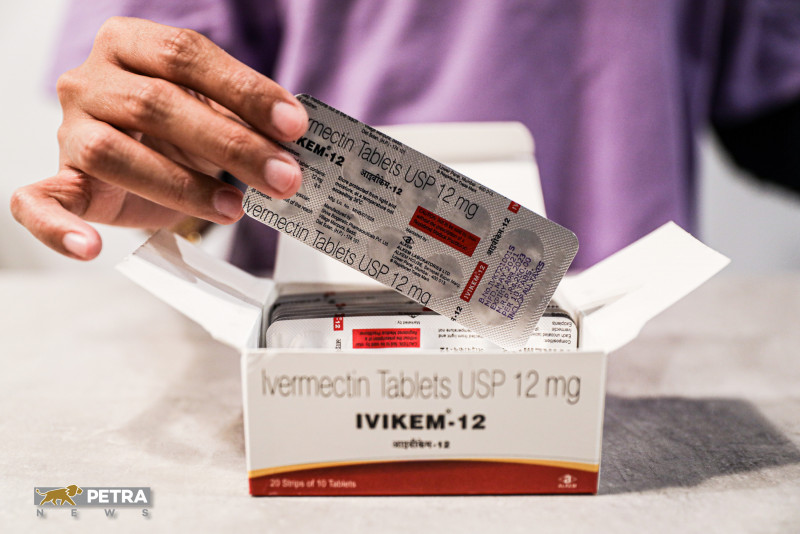

KUALA LUMPUR – The proposed use of ivermectin for Covid-19 prevention and treatment has once again become a bone of contention between proponents and medical authorities.
Briefly put, those in favour of the anti-parasitic veterinary drug insist that it can help treat Covid-19 cases, while most health authorities and experts cite a lack of hard evidence.
Last week, the drug was the subject of heated debate in Parliament when Sivarasa Rasiah (Sg Buloh-PH) said private doctors should be allowed to prescribe ivermectin to coronavirus patients, as reported by Astro Awani.
His reasoning? The spike in deaths from Covid-19 and requests from private doctors lamenting the delay in ivermectin’s roll-out.
However, Health Minister Datuk Seri Dr Adham Baba insisted that sufficient clinical data is not yet available to prove the efficacy of the controversial drug.
The Health Ministry is conducting ivermectin trials, initiated at the end of May, with the help of the Institute for Clinical Research at 12 ministry hospitals. It plans to conclude the trials by end-September.
Sivarasa was backed by the likes of Kota Raja MP Mohamad Sabu, Khalid Abdul Samad (Shah Alam) and Datuk Johari Abdul (Sg Petani).
But, opposition MPs with medical backgrounds, such as Datuk Seri Dr Dzulkefly Ahmad (Kuala Selangor), Dr Lee Boon Chye (Gopeng) and Dr Kelvin Yii (Bandar Kuching), said the use of ivermectin must be “evidence-based”.
The three, in a joint statement on July 29, said it must also be based on data collected in “randomised clinical trials”.

On July 28, the Malaysian Pharmacists’ Society and Malaysian Medical Association urged the authorities to crack down on the widespread illegal sale of ivermectin nationwide, saying the public must understand that its uncontrolled use can cause possibly damaging side effects.
The deadline for the ministry trials, however, is too far away for some quarters. Like Sivarasa, many of ivermectin’s proponents are not from the medical or public health fraternity.
For example, the Consumers’ Association of Penang (CAP) said it supports the Malaysian Alliance for Effective Covid-19 Control, which has been lobbying for the use of ivermectin under emergency use authorisation alongside the country’s current immunisation programme.
CAP, in an open letter to the government, said Malaysia will be among 32 countries worldwide to use the drug in “successful” Covid-19 prevention and treatment programmes. It also insisted that ivermectin is a low-risk, low-cost and widely used medicine that has been used for decades.
The ivermectin lobby often points to India’s success in bringing daily record highs of more than 360,000 Covid-19 infections to below 7,000 after mass distribution of the drug in its worst-hit cities and states.
Dr Sanjay Rampal, an epidemiologist from Universiti Malaya (UM), said India’s success in flattening the curve should not be attributed solely to the mass distribution of ivermectin.
“The pandemic propagates in waves. There will be an increase in cases, then it drops for a while, followed by another increase and a steep decline.
“But, India is expecting another large wave in the coming months,” he said during an online talk titled “Evidence-Based Practice on Ivermectin Use and Covid-19” hosted by UM on July 16.
“In terms of ivermectin, it could have worked (in India), but then, it could also have been due to chance. This means that there were other forces at play in India, like the lockdown and other non-pharmaceutical intervention that the Indian government and medical fraternity took that resulted in the reduction in cases.”
Dr Sanjay said there is also a possibility that the outbreak in India “burnt itself out”, whereby many people become less susceptible to the coronavirus due to widespread localised clusters and the intensity of infections.
He raised concerns about the dosage of the drug that should be taken by Covid-19 patients, saying there are currently no specific recommendations on the matter, which may pose a danger to those who consume it.
He said the pro-ivermectin movement is not the first to call for the repurposing of a known drug for use on coronavirus patients.
“As we search for an effective treatment for Covid-19, some have questioned the long duration of the drug development cycle, the expensive nature of drug repurposing and registration, and the need for large confirmatory, randomised clinical trials,” he told The Vibes.
History warns us of repurposing drugs without sufficient research. One such incident is the thalidomide incident of the 1960s, when the off-label use of a supposedly harmless compound led to severe congenital disabilities.”
Evidence-based principles should be used to evaluate the efficacy and safety of vaccines and drugs for use in the Covid-19 pandemic, he said, adding that it is important to critically evaluate the validity of research reports before using them.
“There is suggestive evidence for ivermectin’s effectiveness. However, the evidence is from small, heterogeneous studies that may be susceptible to various biases.
“There is a need for large, higher-quality randomised controlled trials to answer this clinical question.”
Aside from the Health Ministry, global regulatory bodies, such as the World Health Organisation, United States Food and Drug Administration and European Medicines Agency, have insisted that the current evidence for ivermectin’s use on Covid-19 patients is inconclusive, and recommended that such use be restricted to clinical trials.
The proposed use of ivermectin came under the spotlight in April last year, after researchers from Australia’s Monash University found that it prevented the Covid-19 virus from replicating in cell culture within two days.

‘Certainty of efficacy low or very low’
However, other research papers in favour of the drug have cast serious doubt, such as one led by Dr Ahmed Elgazzar, of Benha University in Egypt, whose study was retracted over “ethical concerns”.
According to The Guardian, Dr Ahmed’s study found a 90% reduction in mortality rate, but London-based medical student Jack Lawrence noticed the study’s preprint, which appeared to have been almost entirely plagiarised and contained noticeable quality issues.
On July 28, a Cochrane Database of Systematic Reviews 2021 article titled “Ivermectin for preventing and treating Covid‐19” concluded that the efficacy and safety of the drug in treating and preventing Covid-19 is uncertain due to the current “very low‐ to low‐certainty evidence” of overall studies on the matter thus far.
“The completed studies are small, and few are considered high-quality. Several studies are under way that may produce clearer answers in review updates,” said researchers in the journal.
“Overall, the reliable evidence available does not support the use of ivermectin for treatment or prevention of Covid‐19 outside of well‐designed randomised trials.”
Meanwhile, Universiti Putra Malaysia’s clinical research unit and Universitas Indonesia’s medical faculty, in their joint research paper Ivermectin on Covid-19: Scientific Plausibility, Clinical Evidence, Clinical Epidemiological Issues of the Studies published on July 29, found that clinical trials to date showed “imprecise and inconsistent effects of ivermectin in different studies, suggesting the irreproducibility of the results in different settings”.
“The data so far indicated that the clinical effects of ivermectin are likely due to chance, which means the reported effects observed were as good as rolling a dice; it has no real or true effect on SARS-CoV-2 and Covid-19.
“The data (of) the situation is more of ‘no evidence of effect’ (rather) than ‘evidence of no effect’.” – The Vibes, August 5, 2021












.jpeg)

_Datuk_Rusdi_Mohd_Isa._Facebook_pic..png)