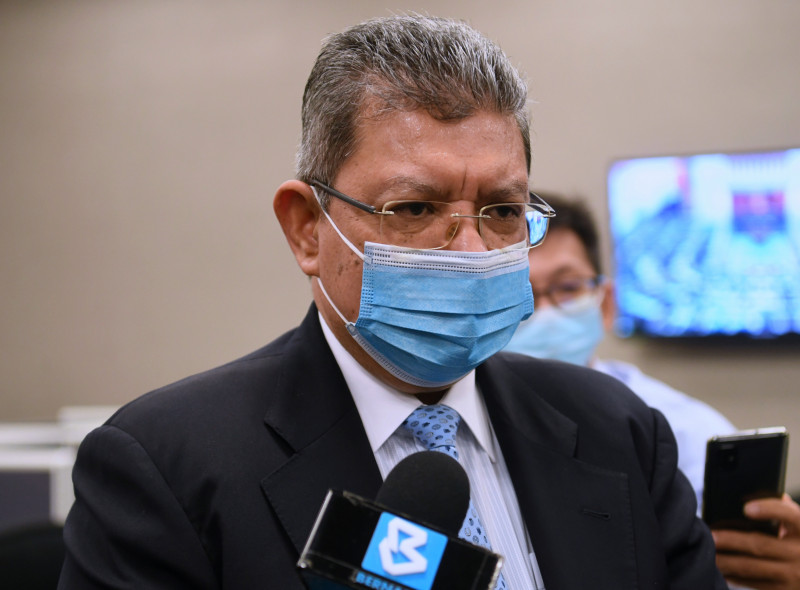
KUALA LUMPUR – Foreign Minister Datuk Saifuddin Abdullah will be talking to Asean special envoy to Myanmar Erywan Mohd Yusof regarding Myanmar shadow government’s call for a revolt against the ruling military junta.
He said the Malaysian embassy in Yangon is also closely following the latest developments in the country, which has endured civilian unrest since the February 1 military coup that overthrew the democratically elected government led by Aung San Suu Kyi.
Despite the lack of progress over the last six months, Saifuddin stressed that Asean is committed to the five-point consensus mandated by the 10-member group’s leaders to resolve the conflict in Myanmar.
“I’ll be contacting him to see what else we can do and how fast we can push this. But now with the latest developments, we really have to go back to the drawing board,” he told a press conference in conjunction with his visit to the Institute of Strategic and International Studies here today.
Malaysia as an Asean member country is frustrated that the five-point consensus cannot be implemented as quickly as possible with the special envoy still unable to get to Myanmar to meet with all stakeholders.
Saifuddin said this when asked on the views from certain parties that Myanmar’s National Unity Government’s (NUG) call for revolt against the junta reflected a failure on Asean’s part.
NUG, a government in exile formed by lawmakers ousted in the February 1 military coup, declared a “people’s defensive war” against the ruling junta yesterday, raising the spectre of more bloodbath in Myanmar.
In a video posted on Facebook, Duwa Lashi La, the acting president of NUG, asked all citizens of Myanmar to revolt against military rule.
The five-point consensus is: the immediate cessation of violence in Myanmar and all parties to exercise utmost restraint; constructive dialogue among all parties concerned to commence to seek a peaceful solution in the interests of the people; a special envoy of the Asean chair to facilitate mediation of the dialogue process, with the assistance of the secretary-general of Asean; the association to provide humanitarian assistance through the Asean Coordinating Centre for Humanitarian Assistance on Disaster Management; and the special envoy and delegation to visit Myanmar to meet with all parties concerned.
Saifuddin also noted that humanitarian assistance could not be channelled into areas affected by violence in the country as the Aha Centre is not equipped to send aid to conflict zones.
“It was of great concern even before the latest turn of events,” he said. – Bernama, September 8, 2021