.jpeg)

SANDAKAN – New visitors may find it surprising that Sandakan, dubbed a nature city and seafood paradise, has no clean recreational beach available.
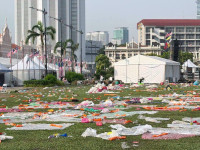
What it does have is the locally famous Pantai Pasir Putih or White Sands Beach – now a misnomer, seeing that it no longer lives up to its name and glory days of yore after being besieged by wave upon wave of rubbish.
It seems that no matter the repeated beach cleaning activities conducted by non-government organisations and government agencies in the area, the tides will bring in garbage and the beach will be filled with litter again within a week.
It started in the late 90s
Local elders said before the late 90s, the beach was very clean and had white sand – thus its name “Pasir Putih” (white sand in Bahasa Malaysia).
A restaurant owner right across the road from the beach, Chin Yun Min, 61, said his family had run the restaurant since 1972, and he had witnessed the changes over the years.
“It was not like this before. It used to be spotless and beautiful. People would come here for a picnic and swim in the sea during the weekends and public holidays. They (the people visiting the beach) were mostly Chinese at the time.
There would also be a dragon boat race annually during the Dragon Boat Festival. This stopped many years ago.
“Now, only those from the villages in Batu Sapi come here because it has become very dirty. The local Chinese have stopped coming. Tourists do not come here because there is nothing to enjoy here but a dirty beach,” he told The Vibes.
Beginning in the late 1990s, there has been an increasing number of water villages in Karamunting and Sekong, Batu Sapi, possibly due to the increasing number of migrants from Indonesia and the Philippines.
Chin said he wishes for the beach to be clean, and hopes that the local authorities would monitor visitors so that they do not litter, and thus maintain its cleanliness.
.jpeg)
Local Bone Ken, 69, said she remembers back when her primary school teacher would take students to the beach for recreational activities.
“It was not like this before. We had fun building sandcastles and playing with the water. Now, I do not even dare to take my shoes off at that beach,” she said.
Where is the rubbish from?
Chin believes that the rubbish is from nearby water villages, and Karamunting community development leader Datuk Chew Kok Woh agrees.
He said he had looked into the problem at Pasir Putih beach for many years and opines that the rubbish is from water villages around Sandakan Bay, such as Kg Leila Laut, Kg Seng Kee, and Kg Gelam, where villagers living in the city’s coastal line would dump their household waste directly into the sea.
Chew said some visitors at the beach would also leave rubbish behind, such as plastic food containers and water packaging.
It is sad to admit that there is still a tremendous lack of awareness among the villagers here. There should be continuous cleanliness awareness programmes and roadshows targeting the people living in the coastal area, especially in water villages.”
Future Alam Borneo, an NGO that has been actively studying water pollution around Sandakan Bay, also came to the conclusion that the rubbish is contributed by none other than the people in Sandakan themselves.
Its chairman Anton Ngui said it is a combination of everyone’s trash, and because Sandakan has many water villages, the rubbish that moves around Sandakan Bay would get trapped in areas where the water flow is weak, like another village or the beach.
“All around the coastline, rivers, and streams, we have villages. Everyone is chucking stuff into the same water body, and it does not get sucked out of the sea. We have to have better education on rubbish disposal,” he said.
Meanwhile, a snack stall seller at Pasir Putih beach, Emma, 36, said people would blame traders such as herself for the trash on the beach.
However, she alleged that the rubbish comes from the water villages nearby, as well as irresponsible visitors.
.jpg)
“I am one of the earliest to be selling snacks here – I have been selling snacks with my father here since I was a child in 2005, and now I am bringing my child with me.
“I witnessed first-hand the condition of the beach. I know that the rubbish is from water villages over there (pointing to Kg Pukat) and other water villages, and also from irresponsible visitors.
“People would blame sellers like me for the trash here. But the fact is, us hawkers clean up the area surrounding our stalls before we leave for the day.
“Some visitors would have picnics here, bringing their own food and drinks, and leaving all the wrappings and bottles on the beach as they leave,” she lamented.
Road to a clean beach
While Chew and Anton said education and awareness is important in changing the people’s attitude to keep the coastal line of Sandakan clean, Karamunting assemblyman George Hiew Vun Zin said parents also play an important role.
He said cleanliness and awareness on environmental protection should start from childhood, with parents having a major role to play in teaching their children to ensure that beaches are kept pristine.
The Warisan rep said cleaning activities would be made easier if he had the allocation to rent heavy machinery such as an excavator to deep-clean the beach.
“I am working to get an allocation to transform the Pasir Putih beach as it has such high potential to become a famous tourism spot, given that Sandakan is already known by tourists as a nature city and seafood paradise,” he added. – The Vibes, November 6, 2021