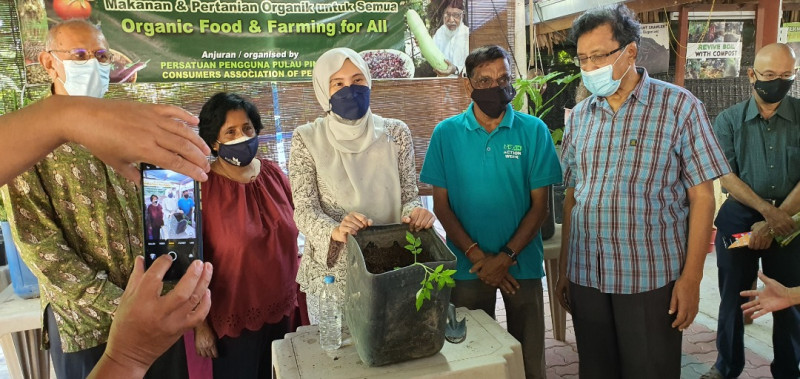

GEORGE TOWN – Sustainable farming, which is chemical-free and resistant to climate change, can be done if the government starts now with proper funding, said the Consumers’ Association of Penang (CAP).
Its president Mohideen Abdul Kadeer called on the government to implement strong policies and programmes for such farming.
“Funds should also be allocated to groups such as CAP, which can assist in moving the plans forward,” Mohideen said at the launching of the association’s Urban Garden Training initiative, which was officiated by Permatang Pauh MP Nurul Izzah Anwar.
“Our current system of industrial agriculture and pest control relies heavily on chemical inputs.
“Science shows that even at low levels of exposure, many of these chemicals are harmful to humans, especially to children, as their developing minds and bodies are particularly vulnerable.”
From CAP’s ventures and the experience of small-scale farmers, it is increasingly clear that chemical-free approaches to farming are not only viable but would also strengthen the resilience of agricultural production, said Mohideen.
“We have demonstrated how yields can be increased sustainably – promoting food safety and food security, improving livelihoods, and successfully decreasing or refraining from using agro-chemical inputs.”
CAP has been actively promoting urban farming or kitchen gardening among households as a means to lower dependence on food imports, he said.
Vegetables and herbs grown in simple containers can help families meet their needs for fresh and nutritious produce free of chemical residue and subsequently reduce their food expenses.
“This can be integrated with rainwater harvesting and composting of garden and kitchen organic waste,” Mohideen said.
CAP’s school garden projects have also raised awareness among students of the importance of food production and provided them with training in agriculture, practical nutrition education, and marketing of their produce.
The old paradigm of industrial, energy-intensive, and chemical-laden agriculture is a concept of the past.
“Our natural resources such as soil and agro-biodiversity have undergone degradation or loss – and in some cases, irreversibly so.
“Meanwhile, climate change is already leaving its mark on the agriculture sector, and it will do so on a much greater scale in the future.”
These realities all call for specific responses at the policy level.
Small-scale farming and agro-ecological methods provide the way forward to fulfil food security, avert a food crisis and meet the nation’s needs, Mohideen said.
Malaysia must thus have high targets and strategic plans for the country, he noted.
As an example, Bolivia has aimed to become entirely self-sufficient in food production by 2020 by enhancing its local capacities.
The tiny mountainous nation of Bhutan announced in 2011 its goal to make the country’s agricultural system 100% organic by 2020.
Denmark is also working in multiple ways to convert the entire country’s agriculture into organic and sustainable farming.
In 2015, the Scandinavian nation released an ambitious plan to double organic farming and to serve more organic food in the nation’s public institutions by 2020.
"Sikkim in India is now a 100% organic state, with no chemical pesticides or fertilisers and no genetically modified organisms.
“This shows that (producing) organic food for an entire region is possible,” said Mohideen. – The Vibes, January 16, 2022














.jpg)