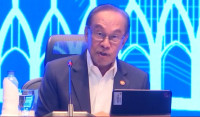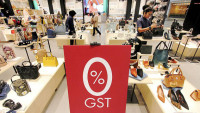
KUALA LUMPUR – The government plans to reduce subsidies for high-income groups instead of reimposing the goods and services tax (GST) on the people, said Prime Minister Datuk Seri Anwar Ibrahim (Tambun-PH).
Recalling how his administration had ensured that increased electricity tariffs are focused on multinational corporations (MNCs) and the super-rich instead of the general public, Anwar also assured that there are no plans to inflict broad-based consumption taxes on citizens.
“As I have explained in the previous session, the former government made the decision to increase electricity tariffs (for household consumers), but the current government withdrew the proposal and only implemented it for MNCs and other big companies not involved in food security.
“Instead of GST or a broad-based consumption tax, the government intends to tighten the reduction of subsidies for rich groups, like what happened with the increased electricity tariffs.
“We will take other similar measures, including with diesel subsidies,” he told the Dewan Rakyat today during the inaugural Prime Minister’s Question Time.
He was answering a question by Wong Kah Woh (Taiping-PH) on the country’s national debt and ways to tackle it.
Anwar said that the government’s debts and liabilities have exceeded RM1.5 trillion or 8.2% of Malaysia’s gross domestic product, with 1Malaysia Development Bhd-related dues amounting to RM18.2 billion.
He said Malaysia’s revenue can be increased without burdening the people, and one way to do this was targeting interested domestic and foreign investors.
Earlier this month, Anwar had said that it would be irresponsible to implement GST as many people are suffering from abject poverty or earning below minimum wage.
While he acknowledged that the taxation system would be the most transparent and efficient, he said that basic issues affecting the poor and general public must be prioritised.
On developing targeted subsidies, Deputy Domestic Trade and Living Costs Minister Senator Fuziah Salleh said that the ministry is organising a session with the finance and economy ministries this week to discuss matters related to targeted subsidies.
“The session aims to determine which items should be subsidised by the government, who should receive the subsidies, and the necessary mechanism to execute the policy,” the senator said in response to a question by Datuk Rosol Wahid (Hulu Terengganu-PN).
She added that the National Action Council on Cost of Living is taking a two-pronged approach towards the high cost of living by tackling the increased prices of goods and services and looking into raising people’s incomes.
“In reality, our cost of living is high because people cannot afford their expenses as they have no disposable income,” she said. – The Vibes, February 14, 2023