KOTA KINABALU – The issue involving what encompasses Sabah’s 40% revenue entitlement took centre stage during a talk on exploring new avenues for the state’s revenue channels here yesterday.
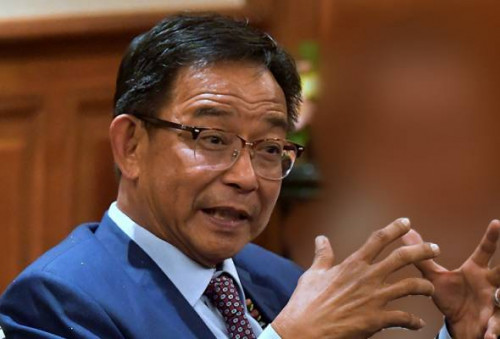
Sabah deputy chief minister Datuk Seri Jeffrey Kitingan said the collection of revenues by the federal government, in which 40% of the net collection is constitutionally required to be returned to Sabah, should not be limited to only taxes.
He said the revenues collected from firms headquartered outside of Sabah and the revenue from proceeds of fees and charges imposed by government agencies, such as the Royal Customs Department, Immigration Department, and others, should also be included in the formula.
“The 40% revenue rights (as stipulated under Article 112C of the federal constitution) are not just from taxes.
“It should be all revenues derived from Sabah. This is not a small sum. But what we are getting at present is merely a paltry sum.
“They (Putrajaya) say the federal government will be bankrupt if they meet the 40% constitutional requirement…but I don’t think so. It is Sabah’s money that was collected.
“They (Putrajaya) are not solely dependent on us (Sabah) for revenues. There are other states, which Putrajaya is also collecting its revenues from,” he said in his keynote address at Sabah’s new sources of revenue panel talk held at the Institute for Development Studies here yesterday.
In highlighting the comprehensive nature of the 40% entitlement outlined in Article 112C of the federal constitution, Kitingan also noted Sabah’s portion, of which dividends the national oil firm, Petronas, paid to Putrajaya were also supposed to be included.
He argued that natural resources, including those on land and in the subsoil, belong to Sabah, which borders up to the continental shelf and is where many of the oil and gas platforms are operating.
Under Article 112C of the federal constitution and Part IV of the Tenth Schedule, Sabah is entitled to two-fifths or 40% of the revenue collected by the federal government from Sabah.
A review must also be carried out, as stated under Article 112D.
Part III of the Tenth Schedule also provides sources of revenue for the states, as does Part V, which specifically provides additional sources of revenue for Sabah and Sarawak.
Part III covers, among others, revenue for land, mines, and forests, licencing of services and supplies, entertainment duties, court fees, and revenue from town boards, councils, rural boards, and local councils.
Part V includes import and excise duties on petroleum, forest products, and propelled vehicles, as well as state sales tax, port duties and fees, water rates, and other charges.
The federal government has never fulfilled its 40% constitutional duty, which was also among the matters discussed at the talk.
It was also noted that the annual developmental budget set aside for Sabah by Putrajaya was not to be taken as part of the special grant.
Between 1963 and 1968, no sum was determined to make up the 40% of Sabah’s special grant payments.
In the first review, an agreement was reached between Sabah and the federal government, under which Sabah received RM20 million, RM21.5 million, RM23.1 million, RM24.8 million, and RM26.7 million between 1969 and 1973.
No review was carried out from 1974 to 2019, and no reasons were given as to why a review was not held.
Sabah was given a fixed amount of RM26.7 million over the same period, and both instances do not reflect the 40% entitlement.
Sabah’s special grant was doubled in 2020 to RM53.4 million and later to RM125.6 million in 2022, following reviews of the entitlement.
At the same time, the Sabah government maintained that both increases were an interim special grant in lieu of the 40% entitlement.
Sabah Law Society president Roger Chin, however, expressed concern over the 2022 review, saying the fixed payments paid to Sabah between 1974 and 2021 were absent and would pose an issue if not addressed.
He described this as “Sabah’s lost years”, claiming Putrajaya has breached its constitutional duty to realise the 40% entitlement.
The Vibes was made to understand that Putrajaya could owe Sabah billions of ringgit by not honouring the special grant requirements since 1974. – The Vibes, June 23, 2023