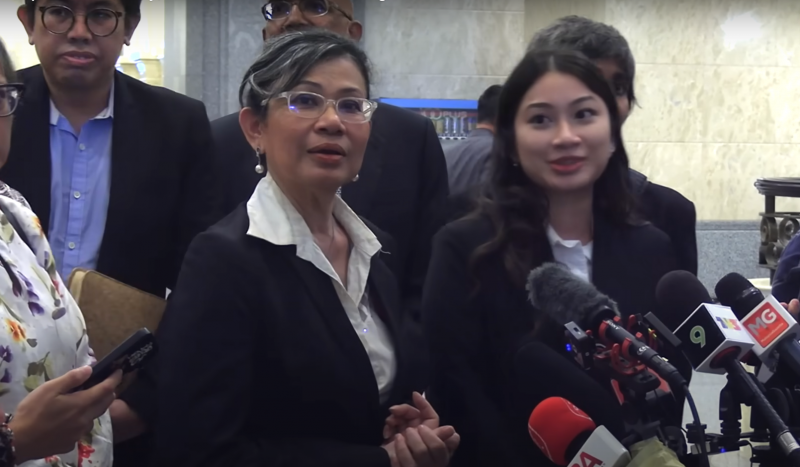
A NINE-PERSON bench chaired by Chief Justice Tengku Maimun Tuan Mat in an 8-1 split majority decision granted Nik Elin Zurina Nik Abdul Rashid and her daughter Tengku Yasmin Nastasha Tengku Abdul Rahman’s petition.
In her petition, she and her daughter had challenged the constitutionality of 18 provisions contained in Kelantan’s Syariah Criminal Code (I) Enactment 2019 ("the 2019 Enactment”).
Constitutionally speaking the petitioners had not done something extraordinary. In a country which espouses the doctrine of the supremacy of the Constitution (see Article 4 of the Federal Constitution) the petitioners merely exercised their constitutional rights duly enshrined in our apex law.
After all, Article 128(1) (a) of the Federal Constitution permits them to challenge those 18 provisions in the 2019 Enactment. And to challenge those provisions, the petitioners had rightly invoked the jurisdiction of the Federal Court under Article 4 (4) of our supreme law.
And pursuant to Article 4 (4), Malaysia’s highest court is duly empowered to declare the validity of such a state law, including the 2019 Enactment. In fact, the federal court is the sole competent authority to make such a declaration.
Hence we may safely say that the basis of the petitioners' claim is rather straightforward, which is that the Kelantan state legislative assembly did not have the required and necessary powers to create or enact those 18 syariah provisions in state law. Period.
Despite the fact the petitioners never sought to challenge the sanctity of Islamic law – which under the existing constitutional framework is duly reserved as the sole monopoly of the state's jurisdiction – the critics, especially PAS leaders and supporters, have happily spinned off the issue as if the petitioners sought to "abolish" the Islamic laws.
Unfortunately, some irresponsible elements have been trying to hammer home these uncalled-for-remarks that “there is an attempt to wipe out the Quran and hadith.”
In my previous article titled ‘Syariah law case: Making a mountain out of a molehill?’ I, inter alia, penned “challenging or questioning the invalidity or constitutionality of any law – even a religious enactment – is nothing extraordinary except, perhaps, in Malaysia.”
Such a legal challenge did take place in other jurisdictions, for instance in Pakistan, namely in the case of Muhammad Aslam Khaki vs the Federation for Pakistan (PLD 2010 Federal Shariat Court 191).
In that case, the petitioner even challenged the validity of Articles 8 and 25 of the Prohibition (Enforcement of Hadd) Order, 1979 on the grounds that those two provisions were violative of the injunctions and spirit of Islam. Hadd is a singular noun of hudud.
Nik Elin Zurina Nik Abdul Rashid and her daughter, on the other hand, merely challenged the jurisdictional competency of the state legislature in Kelantan in criminalising certain syariah offences as they are of the view that such jurisdiction is only vested in Parliament.
If the critics were truly honest and fair to the petitioners, they would have realised that in their petition, the petitioners were only seeking the court’s ruling to clearly demarcate the legislative boundaries of Parliament and state legislature in their law-making enterprises.
Though such a demarcation is already embedded in the Federal Constitution, it is, unfortunately, not as clear as daylight. Apparently there are still grey areas which badly need federal court’s clarification or determination.
Let me cite one example. Which legislative body is really empowered to legislate any law relating to Islamic school? Federal or state?
Yes, school has to do with education hence it should be under parliament’s legislative competency. Education clearly falls under the federal list.
But here we are talking about Islamic education and not education per se. And Islam falls under the state list hence it is under the sole jurisdiction of a state. As a lawyer I did raise this issue at the federal court prior to this. Unfortunately, my client passed away before the case was duly heard in our supreme court. Interestingly, my client was a PAS member. – The Vibes, February 10, 2024
Mohamed Hanipa Maidin is a former deputy minister of law and former MP for Sepang