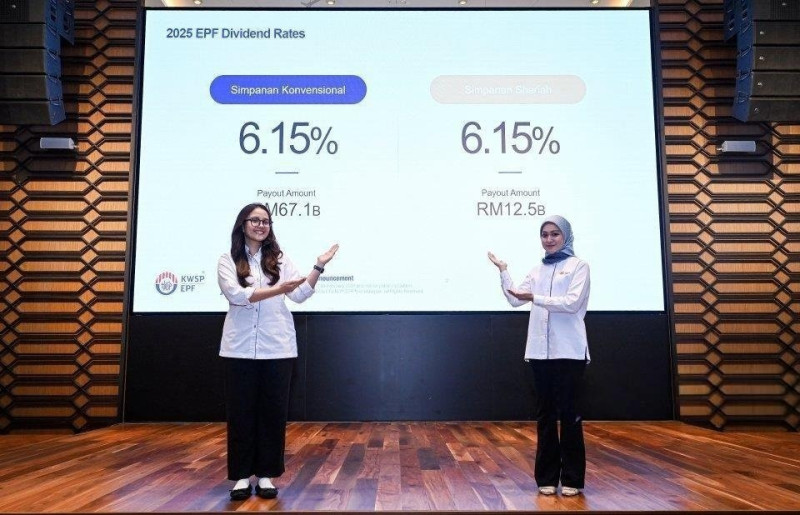
THE Employees Provident Fund (EPF) announced a dividend of 6.15 per cent for both its Conventional and Shariah savings accounts for the year ending 31 December 2025, providing reassurance to millions of contributors relying on the fund for retirement planning.
The total distributions amount to RM67.1 billion for Conventional savings and RM12.5 billion for Shariah-compliant savings.
Despite the announcement, some contributors expressed concerns that the dividend was lower than anticipated, particularly in light of reports that 12 EPF subsidiaries recorded losses, raising questions about the fund’s investment performance relative to Malaysia’s improving economic outlook and a strengthening ringgit.
Professor Emeritus Dr Barjoyai Bardai of Universiti Sains dan Teknologi Malaysia emphasised that the performance of EPF cannot be judged solely on the profitability of a few subsidiaries, but should be assessed based on the overall investment strategy and structure of the fund.
“Even if some subsidiaries report short-term losses, this is part of a diversified investment strategy designed to balance risk and ensure sustainable returns,” he said, noting that EPF manages approximately RM1.4 trillion in assets, with 45 per cent in fixed-income instruments such as sukuk, bonds, and real estate, three per cent in money market investments, and 10 per cent in private markets including private equity, which encompasses the 12 subsidiaries reporting losses.
Dr Barjoyai explained that the fund anticipates potential losses in certain investments but expects gains in other areas to offset them.
“Investments in fixed-income instruments are stable, but annual returns typically only reach four to five per cent. Losses in private equity do not significantly determine the overall performance,” he said.
He further clarified that expectations linking higher dividends to a stronger economy and ringgit are not entirely accurate.
“While the ringgit has appreciated roughly ten per cent against major currencies, about 39 per cent of EPF’s investments are international, largely denominated in U.S. dollars. A stronger ringgit reduces the value of these foreign holdings when converted back to ringgit, so even profitable investments can result in lower reported returns,” Dr Barjoyai noted.
Dr Mohamad Khair Afham Muhamad Senan, Senior Lecturer at the School of Management and Business, MILA University, added that subsidiary losses reported in the 2026 Auditor-General’s Report reflect accounting adjustments such as fair value changes, interest payments to the parent fund, and early-stage investment phases rather than cash shortfalls affecting EPF’s ability to pay dividends.
“Losses at the subsidiary level can coexist with continued returns to the parent fund through dividends or interest, depending on financing and investment structures,” he said.
He also highlighted that factors such as initial investment phases, market-sensitive valuation adjustments, and internal allocation mechanisms can make subsidiary accounts appear unprofitable on paper while the overall fund continues to generate steady returns.
Dr Mohamad Khair stressed that the annual dividend is determined by asset performance and market conditions, not directly by GDP growth or the strength of the ringgit.
“EPF’s international investments account for a substantial portion of total assets, and fluctuations in exchange rates naturally affect the ringgit value of returns, even when underlying assets perform well in their original currency,” he said.
Overall, experts agree that the declared 6.15 per cent dividend reflects careful management aimed at providing contributors with reliable and stable returns, rather than an immediate reflection of the broader economy or currency movements. - March 3, 2026