MALAYSIA’S nuclear energy ambitions have entered a critical evaluation phase, but the government’s immediate focus is not on selecting a reactor or announcing a power plant project.
Instead, Malaysia is concentrating on a more fundamental challenge: building the institutional, regulatory and safety foundations required before the country can make any decision on introducing nuclear power into its energy mix.
Management and socio-economic consulting firm, 27 Advisory said leading the preparatory process is MyPOWER Corporation, an agency under the Ministry of Energy Transition and Water Transformation (PETRA), which has been designated as Malaysia’s Nuclear Energy Programme Implementing Organisation (NEPIO).
The move places Malaysia’s nuclear assessment process in line with the International Atomic Energy Agency’s (IAEA) Milestones Approach, a globally recognised framework designed to guide countries considering the development of civilian nuclear energy programmes.
Under the assessment process, Malaysia will examine whether it has the necessary infrastructure and capabilities across key areas including national policy, legal and regulatory systems, project feasibility, financing arrangements, industrial readiness, stakeholder engagement and skilled workforce development.
PETRA has emphasised that Malaysia has not made a final decision to proceed with nuclear power, with no determination yet on reactor technology, generation capacity or implementation timelines.
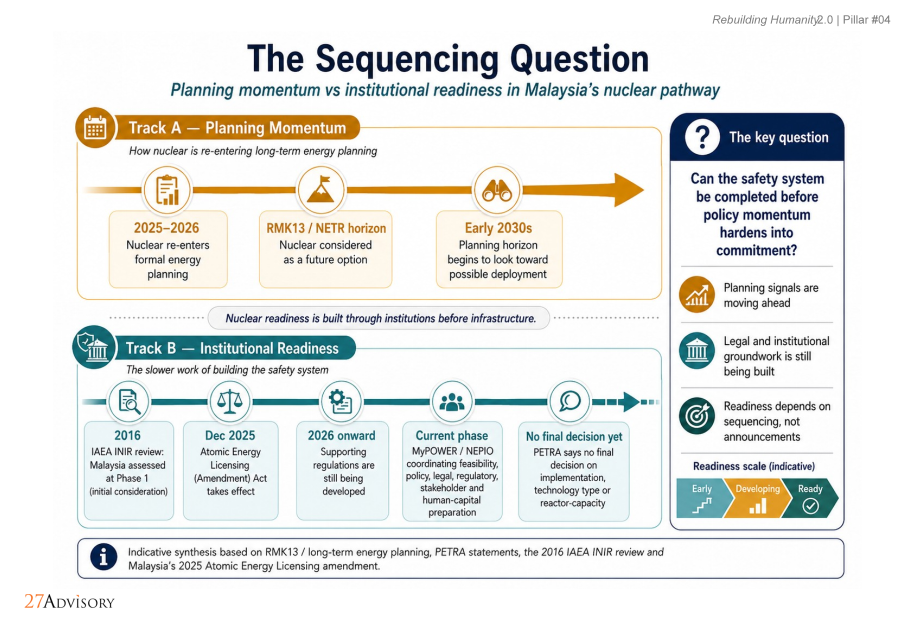
The current priority is to establish whether the country can develop the comprehensive safety architecture needed before any future investment in nuclear infrastructure becomes difficult to reverse.
Malaysia is not starting from zero. The country has more than four decades of experience in nuclear technology through the TRIGA PUSPATI research reactor in Bangi, which began operations in 1982.
The reactor has supported scientific research, nuclear training, isotope production and peaceful applications of nuclear technology, providing Malaysia with a foundation in nuclear science and expertise.
The country has also expanded its nuclear ecosystem through the National Nuclear Technology Policy 2030 (DTNN 2030), introduced by the Ministry of Science, Technology and Innovation (MOSTI) in 2023.
The policy seeks to promote peaceful nuclear applications in sectors including healthcare, food and agriculture, manufacturing, environmental management, industrial activities, as well as nuclear safety and security.
However, policymakers acknowledge that developing a commercial nuclear power programme would represent a far greater undertaking.
Unlike research-based nuclear applications, nuclear electricity generation requires a comprehensive national framework covering independent regulatory oversight, reactor safety management, radioactive waste disposal, emergency response systems, nuclear safeguards, financing mechanisms, grid readiness, specialised manpower and sustained public acceptance.
The IAEA’s Milestones Approach identifies 19 critical infrastructure areas that countries must develop before embarking on nuclear power, including legislation, regulatory frameworks, nuclear safety, nuclear security, radioactive waste management, emergency preparedness, financing, human resources and stakeholder involvement.
The framework reinforces a key principle of nuclear development: safety depends not only on reactor technology, but also on the strength of institutions, the independence of regulators, the competence of operators and the transparency of decision-making processes.
Malaysia has also moved to strengthen its legal framework through the Atomic Energy Licensing (Amendment) Act 2025, which was gazetted to improve oversight of atomic energy activities, including safety, security and safeguards.
However, several major provisions, including requirements involving permits, financial guarantees and the establishment of a Radioactive Waste Fund, still require supporting regulations before they can be fully implemented.
This highlights a central challenge in nuclear development: legislation provides the foundation, but effective nuclear governance depends on detailed regulations, capable institutions and consistent enforcement.
Global experience has shown that successful nuclear programmes are built through decades of institutional preparation before physical construction begins.
Countries with established nuclear sectors have invested heavily in regulatory capability, financing structures, technical training, international cooperation and public engagement to ensure long-term safety and confidence.
For Malaysia, public trust is expected to be one of the most decisive factors shaping the future of nuclear energy.
Previous public concerns surrounding radioactive materials and industrial waste have reinforced expectations for transparency, accountability and strong environmental safeguards.
As a result, communication is increasingly recognised as a core component of nuclear safety itself.
Any future nuclear programme must be able to clearly demonstrate how risks will be managed, which institutions will be responsible and how radioactive waste will be safely handled over generations.
Malaysia’s renewed interest in nuclear energy comes amid rising electricity demand, rapid expansion of data centres, concerns over long-term energy security and commitments to reduce carbon emissions.
While nuclear power could provide a stable source of low-carbon electricity, authorities maintain that energy needs cannot come at the expense of careful preparation and strong safety governance.
The immediate test for Malaysia is therefore not whether it can build a nuclear plant, but whether it can first prove that it has the laws, regulators, expertise, safety systems and public confidence required to support one.
Before Malaysia moves from studying nuclear energy to committing to nuclear power, the foundation must come first: stronger legislation, independent oversight, trained specialists, long-term waste management solutions, emergency preparedness and an open national conversation on the risks and benefits of nuclear technology. - July 18, 2026