MALAYSIAN knowledge workers are moving faster than their employers in adopting artificial intelligence (AI), with employees reporting significant gains in what they can produce while many organisations have yet to establish clear leadership, accountability and workflows around the technology.
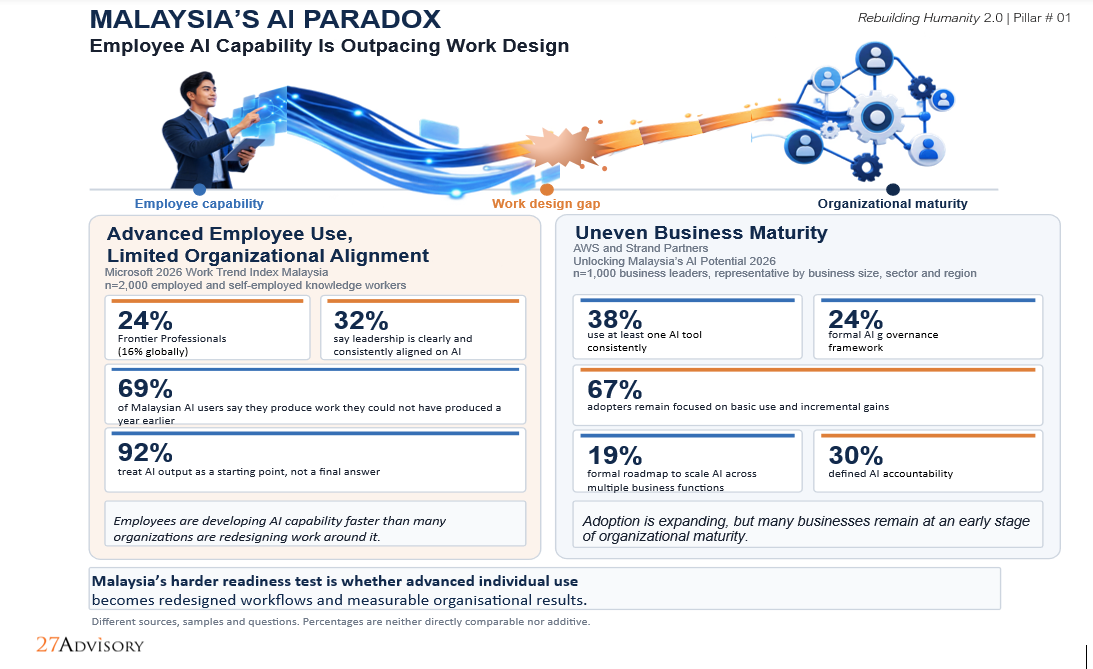
Management and socio-economic consulting firm, 27 Advisory cited Microsoft’s 2026 Work Trend Index for Malaysia, which is based on a survey of 2,000 full-time employed and self-employed knowledge workers, found that 24 per cent of respondents qualified as “Frontier Professionals”, compared with 16 per cent globally.
The survey found that among the Malaysian AI users surveyed, 69 per cent said they were producing work they could not have produced a year earlier.
But only 32 per cent said their leadership was clearly and consistently aligned on AI, pointing to what Microsoft calls the “Transformation Paradox” — the gap between employees rapidly building AI capabilities and organisations putting the systems and structures in place to make those capabilities count.
The findings suggest Malaysia’s AI challenge is shifting from adoption to organisational integration.
For employees, using AI can begin with access to an online tool. For an organisation, meaningful adoption requires trusted data, redesigned workflows, defined accountability when AI-generated work is wrong, measurement of productivity gains and mechanisms to retain organisational knowledge.
The distinction matters because faster individual output does not necessarily mean an organisation has developed an enduring AI capability.
A Stanford University study of 5,172 US customer-support agents found that generative AI increased productivity by about 15 per cent, with the largest gains among less experienced workers.
But the study illustrates what AI can achieve within a defined workflow; it does not establish the extent to which Malaysian organisations have embedded AI into their operations.
Stanford’s review of AI adoption among small and medium-sized enterprises similarly found that evidence on mature, firm-level adoption remains limited.
Adoption Is Uneven Across Malaysian Businesses
27 Advisory opined that the organisational gap is also reflected in business adoption data.
The “Unlocking Malaysia’s AI Potential 2026” study, commissioned by AWS and conducted by Strand Partners among 1,000 business leaders, found that 38 per cent of Malaysian businesses consistently use at least one AI tool, up from 27 per cent a year earlier.
However, 67 per cent of those adopters were still using basic, off-the-shelf tools, while only 19 per cent had a formal roadmap for scaling AI across multiple business functions.
Adoption also varies significantly by sector.
Financial services recorded adoption of 53 per cent, followed by manufacturing at 50 per cent, compared with 38 per cent across businesses overall. But the sectors differ in organisational maturity.
In financial services, 64 per cent of businesses had moved beyond experimentation, 42 per cent had a scaling strategy and 39 per cent had a formal AI governance framework, compared with 24 per cent across all businesses.
Manufacturing, meanwhile, showed a different pattern. Some 57 per cent of manufacturers were still exploring or experimenting with AI despite 80 per cent expecting the technology to transform their industry, while only 15 per cent had a formal AI strategy.
The AWS findings indicate that governance investment is associated with deeper AI adoption, rather than necessarily acting as a brake on implementation.
SMEs Face A Different Set Of Constraints
The difficulty of moving from experimentation to measurable results is particularly evident among smaller businesses.
A 2025 Ecosystem study developed with Red Hat and the National AI Office, involving 133 SMEs in the Malaysia Digital Economy Corporation (MDEC) network, found that 36 per cent were piloting AI but only 21 per cent had scaled it into measurable results.
Lack of in-house technical expertise was cited by 60 per cent as their biggest obstacle, while 52 per cent cited cost.
These figures do not necessarily indicate that SMEs are resistant to AI.
For businesses operating with thin margins and without dedicated data, compliance or technology teams, informal use of readily available AI tools may be the most practical option.
The available evidence does not establish whether businesses have yet to formalise their AI use because they cannot afford the organisational investment or because informal productivity gains are already sufficient to reduce the pressure for further change.
The Missing Layer Is Accountability
The AWS findings point to a further gap between individual AI use and organisational adoption.
Only 30 per cent of Malaysian businesses had clearly defined accountability for their AI initiatives, while 27 per cent conducted regular monitoring or audits and just 18 per cent had a documented escalation process for when something went wrong.
Employees appear to be compensating for some of that gap themselves.
Some 92 per cent of Malaysian AI users surveyed said they treated AI output as a starting point rather than a final answer, indicating that many were already applying their own judgement to the technology’s output.
But individual caution is not a substitute for organisational controls.
In a more mature AI operating model, review requirements, data handling rules and responsibility for errors would be defined within the workflow rather than left primarily to individual employees.
Malaysia’s obligations under the Personal Data Protection Act also continue to apply when personal data are processed using AI tools. Confidential business information can create separate contractual, security and intellectual-property risks.
The absence of an internal AI policy does not remove those exposures.
From Access To Measurable Results
Malaysia’s National AI Action Plan 2026-2030 recognises that AI development requires more than simply expanding access to technology.
The plan sets three headline targets for 2030: placing Malaysia among the global top 10 AI indices; generating up to 1.2 percentage points of additional GDP growth attributable to AI; and creating up to 300,000 new jobs attributable to AI.
Its “AI for MSMEs: Modular Resources for MSMEs” initiative aims to provide 1.5 million micro, small and medium enterprises with scalable access to AI tools already embedded in platforms they use.
The plan also includes an AI governance initiative aimed at establishing a national risk-based regulatory framework and positioning Malaysia among leading countries in AI governance and ethical readiness.
It proposes support tailored to different levels of MSME maturity, public-sector process and operating-model changes, risk-based governance and organisational maturity scorecards for large listed companies.
The next measurement challenge is therefore not simply access.
A target covering 1.5 million MSMEs can show how widely AI tools become available, but it does not by itself show how deeply AI has been integrated into those businesses.
What Malaysia Should Measure Next
27 Advisory said the evidence points to a shift in the central question facing Malaysia’s AI economy.
It is no longer simply how many workers or businesses are using AI. Adoption is already under way, and Malaysian knowledge workers are reporting advanced use at a higher rate than the global measure in Microsoft’s survey.
The harder question is whether organisations can convert that individual capability into durable business capability.
That means measuring how many firms have moved beyond pilots, how many have redesigned workflows around AI, how many have a named person accountable for AI-related decisions, how many have documented procedures for dealing with erroneous AI output and how many can demonstrate measurable productivity gains.
For Malaysian businesses, particularly SMEs, access may be the starting point.
The next stage is proving that AI has been integrated into the organisation deliberately, safely and measurably.
That is where the gap between AI use and AI transformation will become clearer, 27 Advisory added. - September 20, 2026