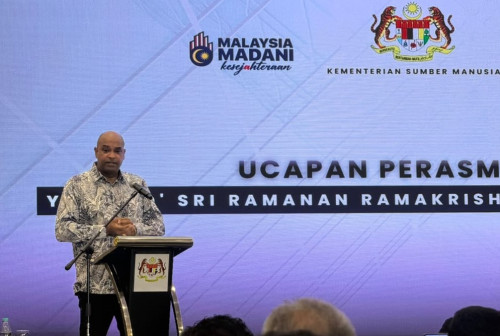
LONG before the claim about 200,000 Bangladeshi workers made headlines, Malaysia’s foreign-worker recruitment system had accumulated questions about contracts, charges and accountability.
For a business waiting to fill a genuine vacancy, uncertainty makes planning harder. For someone who has borrowed money to work overseas, a promised job that never materialises can turn a chance at a better life into a debt trap.
Rebuilding confidence means dealing with that history while showing what is changing now. Human Resources Minister Datuk Seri R. Ramanan has taken several documented steps towards a more orderly process, with local recruitment through MYFutureJobs an important part of it.
The legacy: a system carrying years of unanswered questions
In March 2025, Parliament’s Public Accounts Committee raised concerns about the procurement of the Foreign Workers Centralised Management System, or FWCMS, developed by Bestinet.
The committee found that a dispute over charges had prevented the agreement from being finalised during the period covered by the earlier letter of acceptance. It recommended clearer disclosure of the agreed charging arrangements, stronger cybersecurity and compliance with procurement rules.
That history helps explain the scrutiny surrounding today’s changes. Employers and workers need to understand who controls the process, what they are paying for and who answers when something goes wrong.
The impact reaches the shop floor—and the worker’s family
The human consequences can be severe.
In a 2024 communication to Malaysia, UN human rights experts raised allegations involving excessive recruitment fees, workers arriving without promised jobs, unpaid wages and confiscated passports. These were allegations put to the government for clarification, rather than court findings against every party involved.
A worker without wages still has living costs and may have recruitment debt waiting back home. A legitimate employer also needs confidence that an approved hire will reach a real workplace through a reliable process.
Protecting Malaysians’ job opportunities and protecting migrant workers belong in the same conversation. Both depend on employers demonstrating genuine vacancies and offering proper working conditions.
Ramanan’s corrective steps: put applications through a clearer route
On 6 July 2026, Ramanan said foreign-worker quota applications were being processed through FWCMS’s eQuota module, following Cabinet’s decision to place the Foreign Worker Management One-Stop Centre under KESUMA.
He said case-by-case quota approvals were ending and asserted that the ministry had full system control, including source-code and super-administrator access held by its secretary-general.
He also reinforced the requirement to prioritise local recruitment through MYFutureJobs before seeking foreign-worker quotas.
These are useful contributions to the reform effort: a stated application route, responsibility within the ministry and an explicit place for Malaysian jobseekers in the process.
The next operational change came on 22 August, when KESUMA announced fully online employment applications through FWCMS, replacing manual submissions and walk-in applications.
The ministry said complete, compliant applications could reach the Conditional Approval Letter stage within 14 days. That concerns a particular approval stage; it should not be read as a promise that a worker will arrive and start work within a fortnight.
The Federation of Malaysian Manufacturing welcomed the direction while calling for integrated systems, application tracking and clear service standards. Its test was practical: faster processing, manageable costs and greater certainty for employers.
The 200,000-worker claim showed why clear communication matters
On 2 September, government spokesperson Datuk Fahmi Fadzil addressed reports that Malaysia would recruit 200,000 Bangladeshi workers within six months.
Fahmi said he had contacted Ramanan, who explained that the statement attributed to a Bangladeshi junior minister did not represent Bangladesh’s official position. The headline number therefore could not be treated as confirmation of an approved recruitment programme.
Ramanan’s clarification helped establish a necessary distinction between a reported statement and an official decision. Employers and prospective workers need that distinction before making plans or paying anyone to secure a placement.
Where things stand: MYFutureJobs makes the local-hiring test concrete
PERKESO’s FAQ dated 1 October 2026 gives substance to the local-first requirement for covered foreign-worker hiring in Peninsular Malaysia and the Federal Territories.
It says employers must advertise vacancies on MYFutureJobs for at least 14 days and conduct local-talent interviews under the localisation process. The FAQ lists the plantation sector as exempt from advertising, subject to subsequent changes.
Employers must state the actual salary, provide a detailed job description and advertise through the applying company’s own account. The verified local-interview declaration is uploaded to FWCMS; the advertisement must remain active for the full period.
PERKESO says local recruitment efforts influence its consideration of applications. False or doubtful declarations can lead to rejection, suspension pending investigation or referral to enforcement agencies. These requirements have a specific geographical scope; Sabah and Sarawak have separate guidance.
For Malaysian jobseekers, this provides an opportunity to be considered. For employers, it creates a record of the recruitment effort. Its value depends on vacancies and interviews being genuine.
Questions about the wider recruitment chain remain. A September commentary in The Edge raised concerns about access for recruitment agencies in Nepal and the transparency of their selection. That is a reason for continued scrutiny of how the system operates across borders.
There is also work underway beyond recruitment. On 16 October, Ramanan said KESUMA was refining an e-Wages mechanism to strengthen wage-payment monitoring, with coverage proposed for non-citizen workers too. It remained under development in that announcement.
The next direction: let people check the results
Ramanan’s strongest contribution here is the combination of clearer administration and a local-hiring requirement that can be documented. The next opportunity is to make the outcomes easier to assess.
A regularly updated public recruitment dashboard would be a useful next step. It could show applications, approvals and rejections by sector, processing times, and how often the 14-day conditional-approval target is met. A linked guide could explain authorised charges, agency eligibility, complaints and appeals.
Worker protection deserves equal visibility: complaints resolved, unpaid wages recovered and action against abusive recruitment practices. Aggregate reporting can show progress while protecting personal information.
Those are recommendations for the next stage. They would help connect the application process to what happens after approval.
For the jobseeker, the employer, and the migrant worker, confidence is easier when there is something concrete to check: a genuine vacancy, a recorded decision, and understandable costs and wages arriving as agreed.
Jacqueline Tan from Jalan Masjid Negeri, Penang is a reader of The Vibes