APART from Singapore and Brunei, the remaining Asean states have all implemented a minimum wage. Malaysia is no exception but has adopted a different wage-setting approach compared to some of its immediate neighbours – notably, Thailand, Indonesia, and the Philippines – where wages are tiered according to provinces or municipalities.
Under the recently revised regulations, Malaysia’s minimum wage has risen to RM1,500 per month starting May 1, this year, for the entire country. The adoption of a standard nationwide minimum wage is somewhat puzzling, considering that the former minimum wage (until April 30) stipulated a two-tier approach with RM1,200 for urban districts and RM100 shaved off for rural districts.
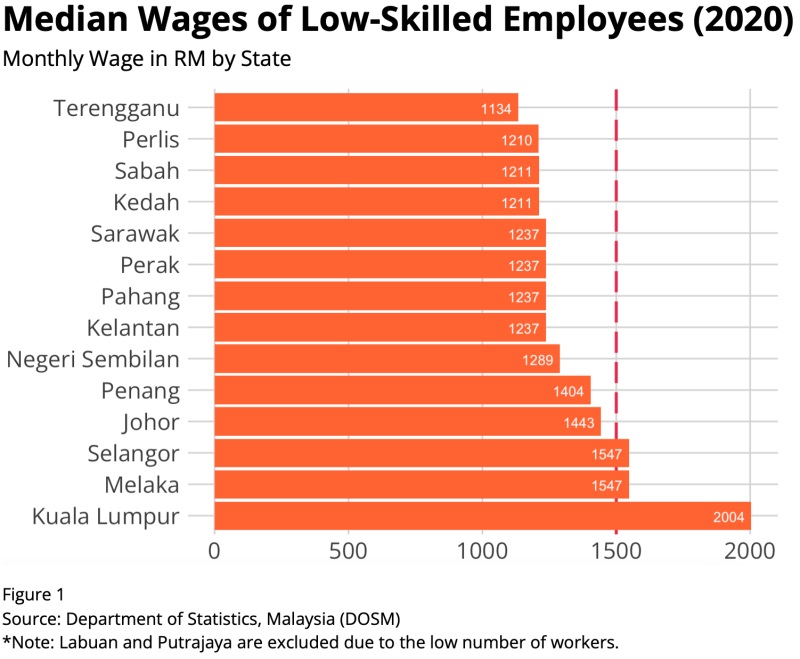
The nationwide RM1500 minimum wage does not take into consideration existing differences across states, as reflected in the median salary of low-wage earners. The earnings of low-skilled workers – comprised of elementary workers such as cleaners, helpers, and labourers – vary significantly depending on the states in which they reside.
In 2020, low-skilled workers in Kuala Lumpur received considerably higher median wage than all other states, and almost doubled their counterparts’ earnings in Terengganu (Figure 1). Low-skilled workers stand to gain in states where their median income falls below RM1,500. On the other hand, low-skilled workers in Kuala Lumpur are likely to see negligible benefits from the minimum wage hike.
Similar observations could be made for semi-skilled workers, which comprise the bulk of the Malaysian employees, at 55% of the total pool of 9.4 million employees in paid employment.
Semi-skilled workers include workers in clerical support, service and sales, and craft and related trade, as well as plant and machine operators and assemblers. These workers from Sarawak and Sabah and the four northern peninsula states stand to benefit the most from the minimum wage hike, since their median income is significantly below RM1,500 (Figure 2).
On the other hand, semi-skilled workers in Selangor and Johor – states with higher concentrations of semi-skilled jobs – are unlikely to benefit from the wage hike as the existing median wage is significantly above RM1,500.

A common argument used to explain state differences in wages and salaries is the difference in the cost of living across Malaysia. Employees are presumably compensated with higher wages in states where the cost of living is higher.
Unfortunately, Malaysia does not report cost of living data at the state level. In lieu of that, a spatial price index (SPI) can be used to infer differences in the cost of living across states, since an SPI captures differences in the cost of a reference basket of goods across different locations at the same point in time.
Since this is also not available, the World Bank has computed a special purpose SPI based on the Poverty Line Income (PLI) reference basket, or the average consumption of poor households, as opposed to the average of the entire population. The reference basket is essentially the basic goods and services consumed by the poorest one per cent of the population.
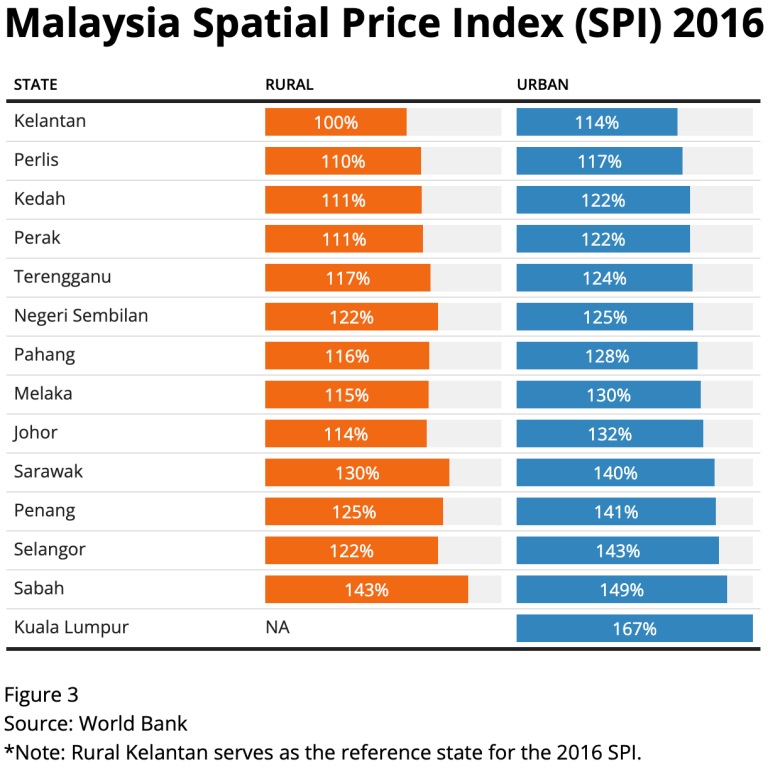
Assuming the same household composition, rural Kelantan, which is the base reference state, has the lowest cost for a PLI basket, while Kuala Lumpur has the highest cost for the same set of goods (Figure 3).
In particular, the cost of the PLI basket in urban Penang, Sabah, Sarawak and Selangor is at least 40% higher than rural Kelantan. Prices are mostly lower in the northern and east coast states of Peninsular Malaysia. These spatial price differences corroborate the conventional wisdom that the cost of living varies significantly across states.
Importantly, not all lower-wage states face lower prices. Sabah, for example, stands out for being the second highest in terms of prices but the state is the fourth and sixth lowest, respectively, in the median wages for low-skilled and semi-skilled workers.
Given state differences in median wages and salaries as well as spatial price differences, it is important for Malaysia to consider a reformulation of the minimum wage that can take these into account.
One of the key goals of a minimum wage is to provide employees with a wage that can sustain their basic livelihood. Therefore, a more appropriate minimum wage scale should create several tiers where wages are calibrated according to state or regional differences.
Since a regional approach will be administratively easier to handle, the states can be divided into high, medium, and low cost of living groups, with appropriate minimum wages set for each group.
To enable the National Wage Consultative Council’s deliberations, the Statistics Department should provide data on annual cost-of-living differences by state and region. This will ensure that the formulation of minimum wage is supported by evidence-based data, as espoused in the 12th Malaysian Plan. – The Vibes, June 1, 2022
This article is reproduced with permission. Fulcrum is published by Singapore’s Iseas–Yusof Ishak Institute.