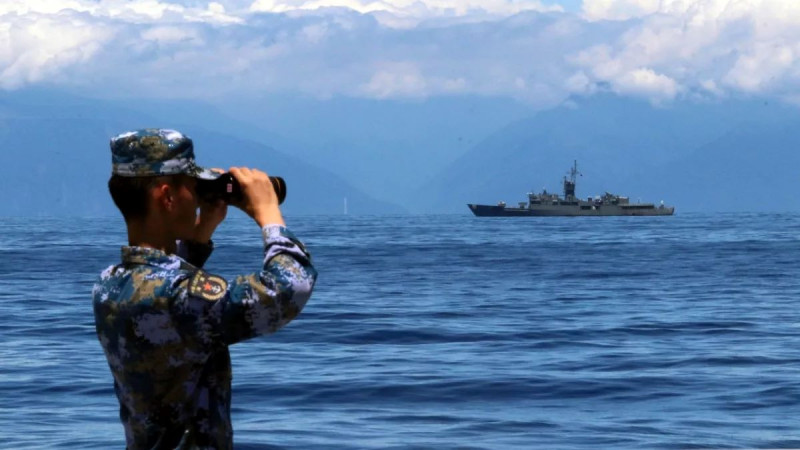
THE New Zealand navy’s largest vessel, the HMNZS Aotearoa, briefly encountered a Taiwanese warship while transiting the sensitive Taiwan Strait last month, the New Zealand Defence Force (NZDF) confirmed on Tuesday, releasing a rare image of the episode.
Reuters reported today that the oiler, which sailed from the South China Sea to the North Asian region on November 5, was shadowed by seven Chinese warships that maintained a professional and safe distance, according to previous statements from the NZDF.
In an image published on its website on Monday, a New Zealand sailor is seen observing a distant warship through binoculars.
The defence force confirmed that the ship was the Taiwanese frigate Cheng Kung, marking a rare public acknowledgment of Taiwan escorting a foreign naval vessel.
A senior Taiwan security official explained that the Cheng Kung’s presence followed standard practice for providing an “escort” to vessels from like-minded nations transiting the strait, ensuring that Chinese ships and aircraft could not harass or simulate attacks against them.
“It is to ensure that communist ships and aircraft are unable to further harass them,” the official said on condition of anonymity.
The Cheng Kung is a heavily armed, Taiwan-built frigate modelled on the U.S. Navy’s Oliver Hazard Perry class. While Taiwan monitors foreign warships in the strait, it is unusual for images of such encounters to be publicly released.
Taiwan views these transits as demonstrations of support for freedom of navigation in waters claimed by Beijing, and routinely shares intelligence with allied partners operating in the area, Tsai Ming-yen, director-general of Taiwan’s National Security Bureau, said earlier this month.
China, which claims sovereignty over the strait and has increased military activities in the region over the past five years, has not renounced the use of force to assert control over Taiwan. The island’s democratically elected government continues to reject Beijing’s territorial claims.
New Zealand, like most countries, has no formal diplomatic relations with Taiwan but maintains de facto diplomatic channels, viewing Taipei as a key democratic partner.
The transit aligns with similar operations by U.S. warships, which regularly pass through the strait, and occasional missions by allied navies, including Australia, Britain, and Canada.
The encounter underscores ongoing tensions in the Taiwan Strait and highlights the careful navigation required by foreign navies amid overlapping claims, frequent Chinese military exercises, and Taiwan’s strategic efforts to safeguard passage for allied vessels. - December 9, 2025