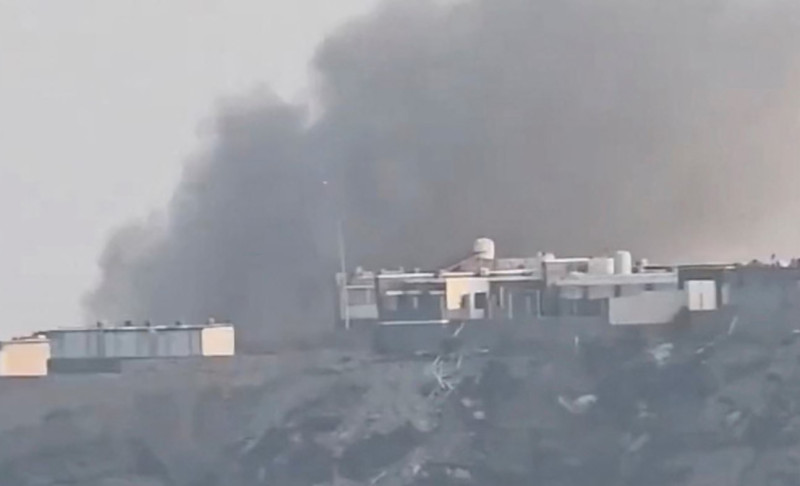
A HOUTHI missile and drone attack on Yemen’s presidential palace complex in Aden killed five people and wounded 16 on Thursday, as the Saudi-led coalition reported repeated strikes by the Iran-aligned group on key infrastructure across Saudi Arabia.
Yemen’s Health Minister Qasim Buhaibeh said the casualties at Al-Maashiq palace included guards and civilian employees. Prime Minister and cabinet members were safe following the attack, Information Minister Moammar al-Eryani said.
Reuters reported that the strike marked the first attack on the palace in the current phase of fighting between the Houthis and Saudi-backed government forces, which resumed last month.
Houthi military spokesman Yahya Saree said the group had targeted what he described as the Saudi military operations headquarters in Aden, under its stated policy of striking Saudi reinforcements wherever they were located.
The Houthi-run SABA news agency said the facility was operated by Saudi officers and contained weapons depots. Reuters could not independently verify those claims.
The attack came as the Saudi-led coalition accused the Houthis of targeting dozens of sites in Saudi Arabia in recent weeks, including airports and oil installations, raising concerns over civilian safety and regional security.
Coalition spokesman Turki al-Maliki said the Houthis had launched 20 attacks on King Khalid International Airport in Riyadh this month, killing 17 people and wounding 333. He also said attacks on Abha airport in southwestern Saudi Arabia had killed three people and injured 28.
The governing council of the United Nations’ International Civil Aviation Organization condemned recent attacks on civilian airports, aircraft and aviation infrastructure in Saudi Arabia.
Al-Maliki said the Houthis had obtained advanced military technology, including ballistic missiles, drones and explosive-laden fast boats, with assistance from “regional actors”.
Iran has provided weapons, funding and training to the Houthis, although Tehran has denied arming the group in violation of a United Nations arms embargo.
The coalition said it had destroyed 127 weapons storage facilities and launch platforms in Yemen’s mountainous areas, and called on the Houthis to stop attacks on civilians and civilian infrastructure.
The Houthis subsequently warned that Saudi airspace and airports were unsafe, renewing a warning to airlines while excluding airspace over the holy cities of Mecca and Medina.
Saudi authorities issued early-warning alerts over potential threats in Najran and Jizan and their surrounding regions on Thursday, before later declaring the danger had passed. The coalition also said it had intercepted and destroyed two drones, including one over Khamis Mushait in southwestern Saudi Arabia.
The renewed fighting adds to the risks facing Yemen, where aid agencies have warned of rapidly deteriorating conditions. Government forces launched an operation last week to retake Houthi-held territory, making gains near the Bab el-Mandeb Strait, a vital shipping route linking the Red Sea and the Gulf of Aden.
Yemen’s war began in 2014 when the Houthis seized the capital, Sanaa, forcing the internationally recognised government south. A Saudi-led military intervention followed in 2015, leading to years of fighting and a bloody stalemate before a truce in 2022. The ceasefire held until fighting resumed this year. - October 16, 2026




.jpeg)