THE United States, South Korea and Japan have reaffirmed their commitment to the complete denuclearisation of North Korea, as speculation grows over a possible meeting between US President Donald Trump and North Korean leader Kim Jong Un.
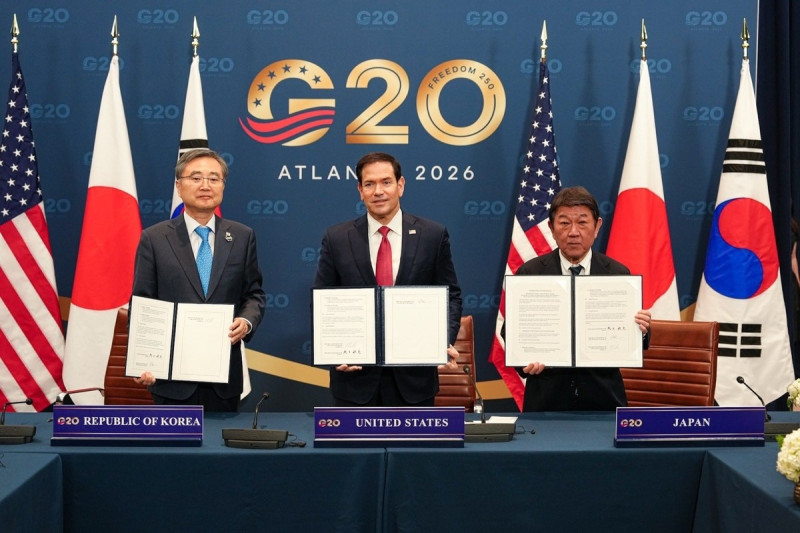
US Secretary of State Marco Rubio, South Korean Foreign Minister Cho Hyun and Japanese Foreign Minister Toshimitsu Motegi reiterated the three countries' position during talks on Friday on the sidelines of the Group of 20 (G20) meeting in Atlanta, Georgia, according to the US State Department.
They also pledged to fully implement United Nations Security Council resolutions against Pyongyang, including restrictions on financial support that could contribute to North Korea's nuclear and ballistic missile programmes.
Speculation has mounted over a possible Trump-Kim meeting during the Asia-Pacific Economic Cooperation (APEC) summit in China in November.
Trump has repeatedly expressed willingness to resume nuclear talks with Pyongyang, but North Korea has yet to respond to his overtures.
AFP reported that despite longstanding UN sanctions, North Korea, which has the backing of Russia and China, has enshrined its status as a nuclear-armed state in law and repeatedly declared that its nuclear arsenal is permanent and non-negotiable.
Trump has also scaled back joint military exercises with South Korea and departed from Washington's longstanding policy in 2025 by acknowledging North Korea as a nuclear power.
South Korean analysts and intelligence officials believe Kim may have conveyed Pyongyang's position on possible talks with Trump to Beijing during his recent visit to Dandong, a Chinese city near the North Korean border.
South Korean President Lee Jae Myung, who favours diplomatic engagement, has repeatedly offered unconditional talks with Pyongyang.
In September, he proposed that Washington consider freezing North Korea's nuclear programme rather than insisting on its immediate dismantlement, in exchange for sanctions relief.
The proposal drew criticism from those concerned that it could indirectly legitimise North Korea's nuclear status while allowing Pyongyang to benefit from eased sanctions without surrendering its weapons.
Analysts have also suggested that China may be increasingly willing to accept North Korea's nuclear status in practice, pointing to the absence of any reference to denuclearisation in statements following Kim's meeting with Chinese President Xi Jinping in June.
Meanwhile, North Korea on Saturday criticised a joint statement by a group of countries monitoring the implementation of sanctions against Pyongyang.
It said sanctions imposed by the United States and Western countries would not change its position as a nuclear-armed state. - October 31, 2026