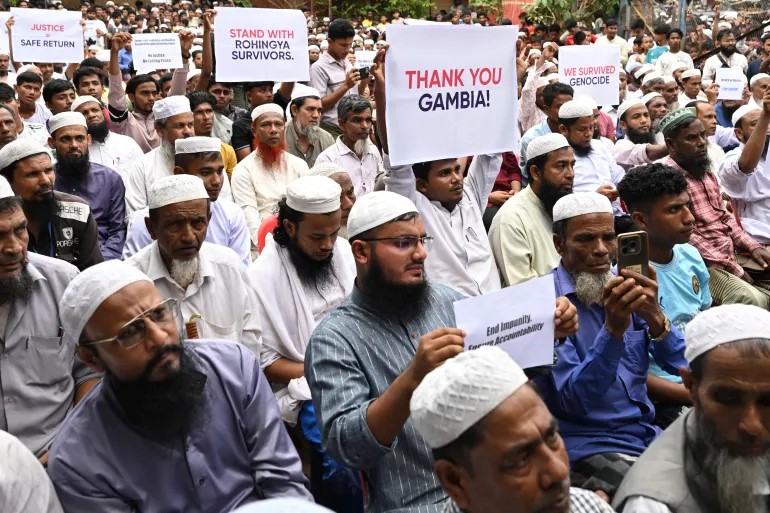
MYANMAR has rejected a landmark International Court of Justice (ICJ) ruling that its security forces committed genocide against the Rohingya Muslim minority, saying the return of refugees from Bangladesh would only be possible when conditions permit.
The country's Foreign Ministry said the ruling, delivered on Thursday, was a disappointment and questioned its findings, noting that the decision was not unanimous because of dissenting opinions.
The ICJ found that Myanmar's military committed genocide during its 2017 crackdown in Rakhine State, including mass killings, widespread sexual violence, attacks on children and violence against civilians fleeing the military operations.
It marked the first time the world court had held a state responsible for genocide.
Reuters reported on Saturday that Myanmar's Foreign Ministry maintained that military operations in northern Rakhine between 2016 and 2018 were counter-terrorism measures rather than acts of genocide.
It said the operations were limited in scope and duration, lasting only several days, and were carried out in response to widespread terrorist attacks.
The ministry also disputed accounts presented by The Gambia, which brought the case before the ICJ, and reports cited during the proceedings, saying they did not accurately reflect the military's actions.
The court, meanwhile, ruled that Myanmar must compensate the Rohingya for violations committed, with the amount to be determined later, and ensure the safe return of those displaced by its actions.
The ruling followed findings that Myanmar's military carried out mass executions of Rohingya men and boys, widespread rape and sexual violence against women, and the destruction of hundreds of villages during so-called clearance operations.
About 750,000 Rohingya fled Myanmar following the 2017 military crackdown and sought refuge in Bangladesh, where the refugee population in overcrowded camps has since grown to approximately 1.2 million.
Before the exodus, an estimated 1.1 million Rohingya lived in Myanmar, but only about 600,000 remain in Rakhine State, including 140,000 in displacement camps.
Myanmar's Foreign Ministry said it would continue humanitarian assistance and rehabilitation programmes for displaced people in northern Rakhine, alongside efforts to verify and repatriate refugees in Bangladesh when circumstances allowed.
In August, the military-backed government said it had verified 308,797 people living in refugee camps in Bangladesh as former residents of Rakhine, but stressed that repatriation would begin only when security conditions improved.
The prospects for their return remain complicated by Myanmar's ongoing conflict, which intensified after the military seized power from the elected government led by Aung San Suu Kyi in 2021, triggering a civil war that has also engulfed Rakhine State.
Myanmar has long refused to recognise the Rohingya as citizens, describing them as illegal migrants from neighbouring Bangladesh despite generations of Rohingya families having lived in the country. - November 21, 2026