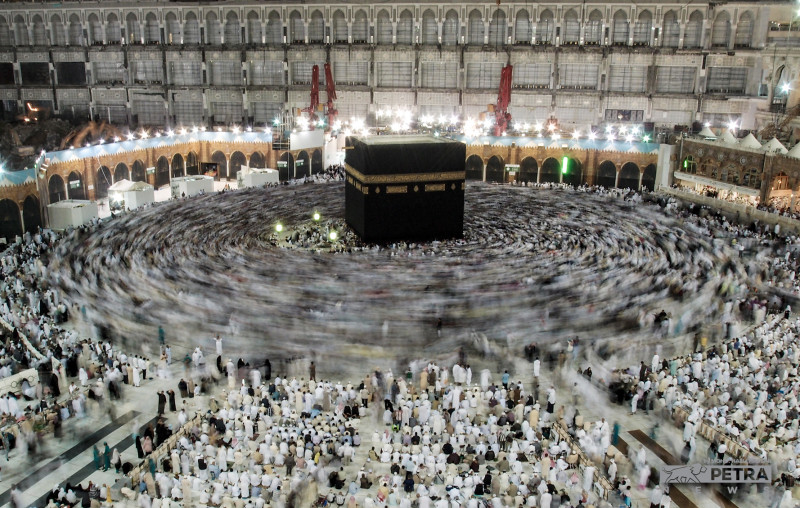
MECCA – White-robed worshippers from across the world have packed the streets of Mecca as Islam’s holiest city prepares to host the biggest haj pilgrimage since the coronavirus pandemic.
Banners welcoming the faithful, including the first international visitors since 2019, festooned squares and alleys, while armed security forces patrolled the ancient city, birthplace of the Prophet Muhammad.
“This is pure joy,” Sudanese pilgrim Abdel Qader Kheder said in Mecca, ahead of the event expected to start on Wednesday. “I almost can’t believe I am here. I am enjoying every moment.”
One million people, including 850,000 from abroad, are allowed at this year’s haj – a key pillar of Islam that all able-bodied Muslims are required to perform at least once – after two years of drastically curtailed numbers due to the pandemic.
At least 650,000 overseas pilgrims have arrived so far in Saudi Arabia, the authorities said yesterday.
In 2019, about 2.5 million people took part in the rituals, which include circling the Kaaba, the imposing black cube at Mecca’s Grand Mosque, gathering at Mount Arafat and “stoning the devil” in Mina.
The following year, foreigners were barred and worshippers were restricted to just 10,000, rising to 60,000 fully vaccinated Saudi citizens and residents in 2021, to stop the haj turning into a global super-spreader.
One million vaccinated pilgrims under the age of 65 will attend the haj under strict sanitary conditions, with the Grand Mosque, the holiest site in Islam, scrubbed and disinfected 10 times a day.
The rituals have seen numerous disasters, including a 2015 stampede that killed up to 2,300 people and a 1979 attack by hundreds of gunmen that left 153 dead, according to the official toll.
Unaccompanied women
The pilgrimage, one of the five pillars of Islam, is a powerful source of prestige for the conservative desert kingdom and its de facto ruler, Crown Prince Mohammed bin Salman, who is returning from the diplomatic wilderness.
Days after the haj, Prince Mohammed will welcome US President Joe Biden who, with oil prices sent soaring by Russia’s invasion of Ukraine, has reneged on promises to turn Saudi Arabia into a “pariah” over the 2018 murder of journalist Jamal Khashoggi by Saudi agents.
The haj, which costs at least US$5,000 per person (RM22,000), is a money-spinner for the world’s biggest oil exporter, bringing in about US$12 billion a year along with other religious visits.
It is also a chance to showcase a country that is undergoing rapid transformation, while still drawing regular complaints about human rights abuses and limits on personal freedoms.
Saudi Arabia – which has under recent reforms permitted raves in Riyadh and mixed-gender beaches in Jeddah – now also allows women to attend the haj unaccompanied by a male relative, a requirement that was dropped last year.
‘Serenity’
Masks are no longer compulsory in most enclosed spaces in Saudi Arabia but they will be mandatory at the Grand Mosque. Pilgrims from abroad will have to submit a negative PCR test result.
The Grand Mosque will be “washed 10 times a day... by more than 4,000 male and female workers”, with more than 130,000 litres (34,000 gallons) of disinfectant used each time, authorities said.
Since the start of the pandemic, Saudi Arabia has registered more than 795,000 coronavirus cases, 9,000 of them fatal, in a population of about 34 million.
Aside from Covid-19, another challenge is the scorching sun in one of the world’s hottest and driest regions, which is becoming even more extreme through the effects of climate change.
Although summer has only just begun, temperatures have already topped 50°C (122°F) in parts of Saudi Arabia.
But for Iraqi pilgrim Ahmed Abdul-Hassan al-Fatlawi, the hot weather is the last thing he thinks of when in Mecca.
“I am 60 years old, so it’s normal if I get physically tired because of the hot weather, but I am in a state of serenity, and that’s all that matters to me,” he said. – AFP, July 4, 2022