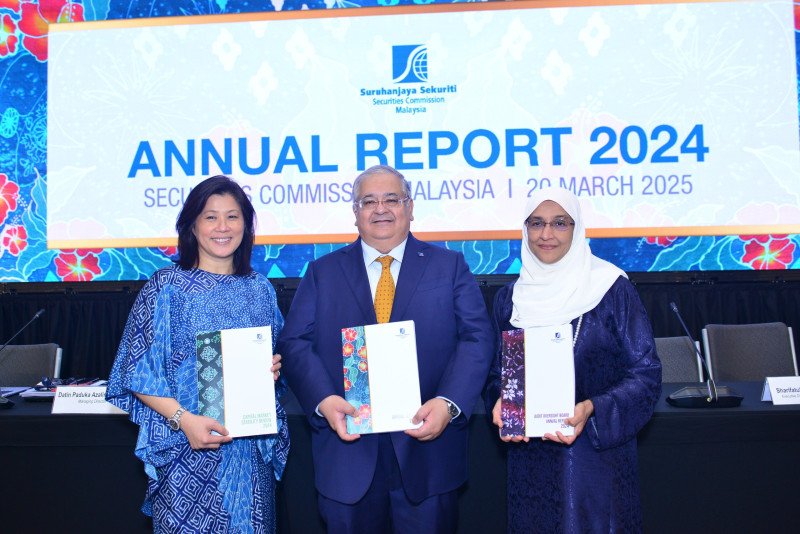
THE Securities Commission Malaysia (SC) is set to propose a review of fees levied on licensed intermediaries, including securities dealers, fund managers, and investment advisors, with a submission expected to the Ministry of Finance (MoF) by the end of March.
“The Securities Commission Malaysia (SC) will submit a proposal to review its fee structure by the end of March,” said SC Executive Chairman Datuk Mohammad Faiz Azmi.
The proposal seeks to revise the levies on licensed intermediaries who engage in regulated activities such as securities dealing, fund management, and investment advisory services.
Since its establishment in 1993, the SC has not reviewed its fee framework, despite a considerable expansion in its roles and responsibilities.
Mohammad Faiz said, the SC is aiming to implement a fee system that is fair, proportionate, and equitable, with fees structured based on the size, complexity, and level of activities involved.
"The fees will vary depending on the type of service provided. For instance, a unit trust consultant may pay RM50, while others could face higher charges," Mohammad Faiz explained during a press conference accompanying the release of the SC’s Annual Report for 2024 today.
However, he said the SC plans to engage with stakeholders to understand the potential impact of the fee changes on their businesses.
"We don’t want to implement changes without first having conversations and understanding the effect on profits. It’s important for us to ensure that the costs aren’t passed on to consumers. The aim is for businesses to bear the cost, not the customers," he added.
Mohammad Faiz reiterated that the primary goal of the fee review is to ensure the SC’s operational costs are covered, rather than generating profit. “As a regulator, the SC is not a profit-making entity. We need these adjustments to ensure that we can continue functioning effectively," he added.
Regarding the timeline for the implementation of the new fees, Mohammad Faiz noted that some changes could take effect sooner through bilateral agreements, while others might require adjustments to existing regulations or legislation.
"What’s crucial is that we’ve initiated the process. We could see some changes as early as next year," he said.
In addition to the fee review, the SC is also intensifying efforts to promote Malaysia's Family Office Incentive Scheme, which is being established in Forest City, Johor.
This initiative aims to attract both local and foreign investors looking for a more cost-effective and strategic location in Southeast Asia.
To further support this initiative, the SC plans to visit the Middle East, beginning with Oman this year, followed by Saudi Arabia next year, in a bid to engage with investors and regulators.
"It’s essential for us to meet with key stakeholders and understand their concerns, as well as the opportunities and restrictions they may face when investing in our region," Mohammad Faiz explained.
He highlighted the advantages of Johor over Singapore, particularly in terms of cheaper land, lower labour costs, and its proximity to Singapore, making Forest City an attractive alternative.
"The key to attracting these investors is proximity to decision-makers. When they are on the ground here, it’s easier to influence them to invest further. The amount we are asking them to invest is small, but the long-term benefits are significant," he added.
By strengthening these international connections and promoting the advantages of investing in Malaysia, the SC aims to enhance the country's standing as a competitive destination for global capital. – March 20, 2025