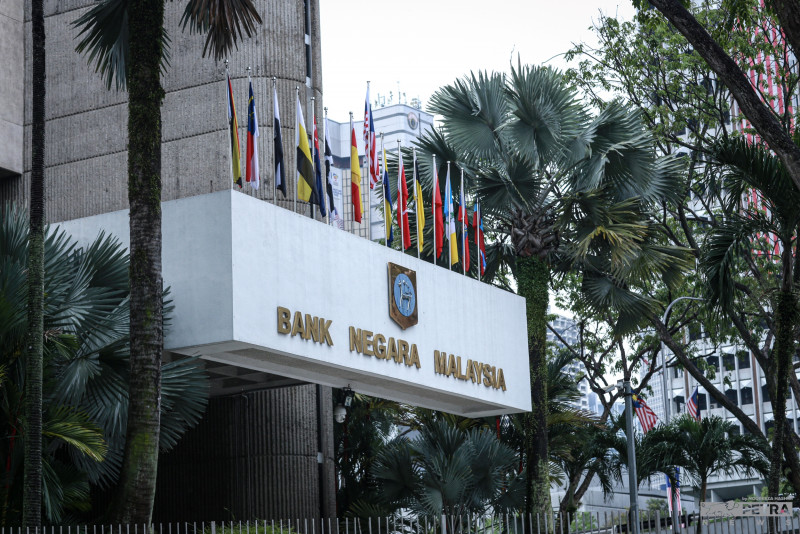
BANK NEGARA Malaysia (BNM) has highlighted that the decentralisation of Malaysia’s international reserves has played a significant role in the accumulation of substantial non-reserve external assets, thereby expanding the country's external position.
In its *Economic and Monetary Review 2024*, BNM reported that Malaysia's net external assets in foreign currency (FCY) stood at RM1.3 trillion, representing 65.4% of the nation's Gross Domestic Product (GDP).
The central bank noted that the strengthening of the ringgit against the US dollar and other major currencies has led to a more modest rise in FCY assets in comparison to external FCY liabilities.
“In light of this position, the appreciation of the ringgit against the US dollar and other major currencies has resulted in a smaller increase in FCY assets relative to external FCY liabilities,” the central bank stated.
BNM added the accumulation of FCY-denominated assets by banks and corporations in recent years, with liquid assets amounting to RM945.9 billion, has provided sufficient resources to meet short-term foreign debt obligations of RM575.4 billion, without tapping into Malaysia’s international reserves.
At the end of 2024, Malaysia’s international reserves stood at US$116.2 billion (RM520.1 billion), which BNM deemed adequate to finance 4.9 months of imports of goods and services, as well as cover 0.9 times the country’s short-term external debt. "However, alternative means of meeting external obligations remain available and will continue to be strengthened," BNM added.
In terms of Malaysia’s International Investment Position (IIP), BNM noted a net external liability position of -RM6.7 billion, equivalent to -0.3% of GDP. This was primarily driven by a significant increase in external liabilities, which rose by RM197.9 billion, largely due to higher foreign direct investment (FDI).
“The rise in external liabilities more than offset the increase in external assets of RM67.5 billion, particularly from portfolio investments. However, both external assets and liabilities were partly offset by exchange rate valuation effects, particularly due to the stronger ringgit against the US dollar,” BNM explained.
Looking ahead, BNM pointed out Malaysia's potential to regain its position as a neutral and key partner in the global electrical and electronics (E&E) value chain. The central bank underscored the importance of Malaysia being proactive in shaping its continuous recalibration to fully capitalise on the benefits.
“To achieve this, Malaysia’s domestic E&E industry needs to shift its direction and enhance its capacity to compete on a global scale,” BNM stated.
With an already established ecosystem and strengths in assembly, testing, and packaging processes, BNM sees opportunities for Malaysia to transition towards creating higher value at the research and development, design, and chip manufacturing levels.
“Ultimately, establishing a more dynamic and resilient domestic semiconductor ecosystem will allow the industry to better withstand global technology cycle volatility and ensure Malaysia’s long-term economic growth prospects and prosperity for its people,” the central bank added. – March 24, 2025