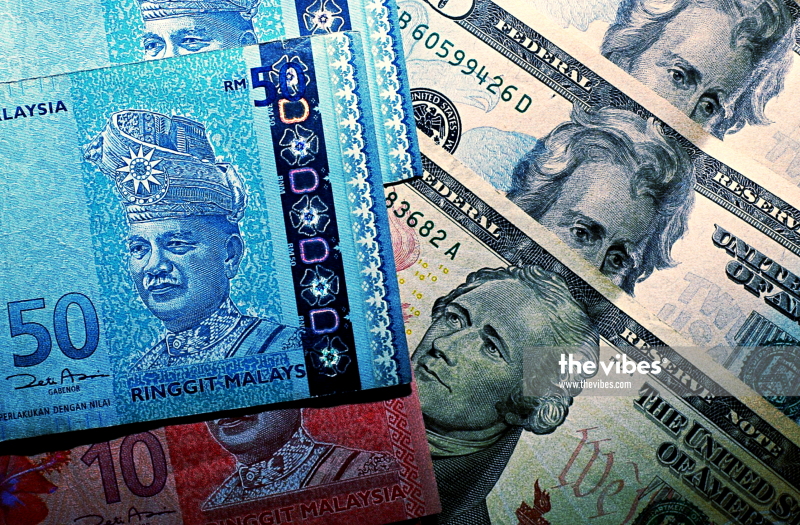
THE ringgit opened stronger against the US dollar on Thursday, boosted by a retreat in the greenback after the United States announced a temporary halt on reciprocal tariffs, a move that has brightened sentiment across global currency markets.
At 8.01am, the Malaysian currency was trading at 4.4700/4850 against the US dollar, a marked improvement from Wednesday’s close of 4.4935/4990.
Bank Muamalat Malaysia Bhd Chief Economist Dr Mohd Afzanizam Abdul Rashid attributed the ringgit’s rally to renewed optimism sparked by the White House's decision to implement a 90-day pause on reciprocal tariffs affecting most of its trading partners.
“This opens the door for negotiations, which could lead to better trade deals. As such, we can expect the ringgit and other currencies to perform better today,” he told Bernama.
During the three-month reprieve, tariffs for 75 countries currently in trade talks with Washington will return to a baseline rate of 10 per cent — a significant development welcomed by financial markets looking for signs of de-escalation in trade tensions.
Nevertheless, the respite came with a twist. Despite softening his stance toward many countries, US President Donald Trump imposed a sharp increase in tariffs on Chinese imports, raising them from 104 per cent to a steep 125 per cent, while insisting that the risk of a broader trade conflict remains low.
Still, the broader foreign exchange market reacted positively. The ringgit strengthened not only against the US dollar but also made gains across a range of major and regional currencies.
It appreciated against the Japanese yen to 3.0326/0432 from 3.0921/0964, improved against the euro at 4.8969/9133 from 4.9640/9700, and climbed against the British pound to 5.7346/7538 from 5.7629/7700.
In regional trade, the local unit was mostly on firmer footing. It gained against the Singapore dollar at 3.3279/3398 from 3.3349/3395, rose against the Philippine peso to 7.79/7.82 from 7.83/7.85, and edged up versus the Indonesian rupiah at 264.9/265.9 compared with 266.3/266.7 previously.
However, the ringgit dipped slightly against the Thai baht, weakening to 13.0778/1325 from 12.9915/13.0153.
Market analysts suggest that while the US’s tariff freeze provides a temporary cushion, currency volatility may persist as trade negotiations unfold and global investors weigh the impact of America’s hardened stance on China. – April 10, 2025