THE Ministry of Science, Technology and Innovation (MOSTI) has reaffirmed the government’s commitment to accelerating Malaysia’s transition into high-value semiconductor activities through advanced packaging technology, with a strategic ambition to capture 7 per cent of the global market by 2035.
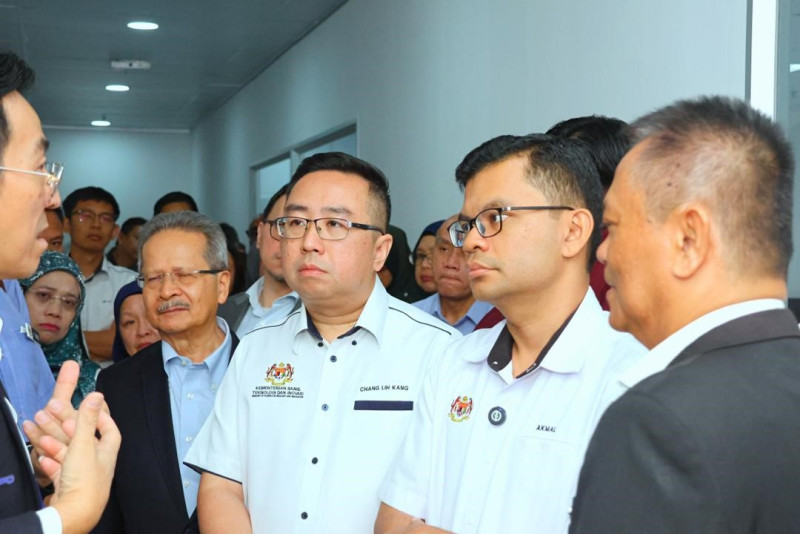
The initiative was highlighted during a working visit by Science, Technology and Innovation Minister Datuk Chang Lih Kang to advanced packaging industry facilities in Penang, aimed at assessing the implementation of research and development (R&D) projects under the Malaysia Science Endowment (MSE) Trust Fund.
The visit was also joined by Economy Minister Akmal Nasrullah Mohd Nasir, Deputy Investment, Trade and Industry Minister Sim Tze Tzin, and MOSTI Secretary-General Datuk Dr K. Nagulendran.
The programme is designed to strengthen Malaysia’s position in the global semiconductor value chain by focusing on advanced packaging technologies, a segment increasingly driven by artificial intelligence applications and next-generation chip design.
Under the MSE Trust Fund, the government has approved RM92 million in R&D grants over a 24-month period.
The funding has been channelled to a consortium of five leading local companies, supported by an additional RM93.8 million in industry matching contributions, bringing the total investment to RM185.8 million.
The consortium includes SkyeChip Berhad, which is developing high-bandwidth memory (HBM) chip design and 2.5D/3D chiplet technologies; Inari Technology Sdn Bhd, which is building pilot capacity for advanced packaging assembly; FusionAP Sdn Bhd, a start-up focused on high-end intellectual property transfer; Pentamaster Instrumentation Sdn Bhd, which is developing automated test equipment and high-end inspection systems; and NSW Automation Sdn Bhd, which specialises in sub-10-micron precision liquid dispensing systems.
Chang said the project is a critical component of Malaysia’s National Semiconductor Strategy (NSS), as the global semiconductor industry is projected to reach a value of US$1 trillion by 2030.
“Malaysia has a 50-year semiconductor foundation and a neutral geopolitical position, making it an ideal hub for investors seeking supply chain resilience outside China and Taiwan,” he said.
The strategy reflects Malaysia’s broader ambition to move beyond traditional assembly and testing operations into design-intensive and high-value manufacturing segments, particularly advanced packaging.
According to the ministry, Malaysia is currently the world’s sixth-largest semiconductor exporter, contributing approximately 13 per cent of global assembly, testing and packaging (ATP) activities.
The government is now pushing aggressively into advanced packaging to avoid the “low-margin trap” associated with labour-intensive competition in the region.
The segment is seen as offering significantly higher profit margins of between 40 and 50 per cent, driven by rapid expansion in artificial intelligence technologies.
Meanwhile, Akmal said under the 13th Malaysia Plan, the government’s focus is to move the country further up the value chain into high-growth, high-value sectors, particularly semiconductors, through stronger R&D, automation and talent development.
He said the initiative demonstrates how national policy is being translated into tangible industry collaboration to attract high-quality investments, create high-skilled jobs and deliver long-term economic returns.
The programme is also intended to serve as a talent development platform, bridging industry and academia while providing exposure to frontier technologies and creating a pipeline of highly skilled workers.
MOSTI said the initiative reflects the MADANI government’s commitment to ensuring Malaysia secures a 7 per cent share of the global advanced packaging market by 2035, positioning the country as a key player in the next phase of global semiconductor evolution. - May 8, 2026