MALAYSIA’S economy expanded by 5.4% year-on-year in the first quarter of 2026, according to preliminary national accounts, reflecting a moderation from the 6.2% recorded in the preceding quarter.
The results continue to signal a resilient underlying momentum amid a gradually shifting economic structure.
Data from the Department of Statistics Malaysia and policy assessments linked to Bank Negara Malaysia indicate that growth continues to be increasingly concentrated in services and select manufacturing segments, rather than broad-based across all sectors.
27 Advisory cited that services remained the dominant pillar of expansion, growing 5.6% and accounting for 59.9% of GDP in Q1 2026, up from 57.6% in 2019.
The sector’s performance was underpinned by sustained household consumption, mobility, retail trade, transport activity, accommodation and food services, alongside an expanding digital economy footprint that continues to reshape Malaysia’s urban economic landscape.
Tourism-related activity provided an additional boost, with 10.65 million international arrivals recorded in the quarter, the strongest first-quarter performance on record. Rather than operating as an isolated growth engine, tourism activity fed directly into hospitality, transport and consumer-facing services, reinforcing the broader consumption-led structure of the economy.
Manufacturing, which maintained a stable share of GDP at 23.1%, expanded by 5.9%, with growth heavily concentrated in electrical, electronic and optical products.
These subsectors remain closely tied to global semiconductor cycles and emerging artificial intelligence supply chains, positioning Malaysia as a critical node in advanced electronics assembly and packaging.
However, 27 Advisory cautions that this resilience is increasingly reliant on a narrower set of high-value industries rather than diversified industrial expansion.
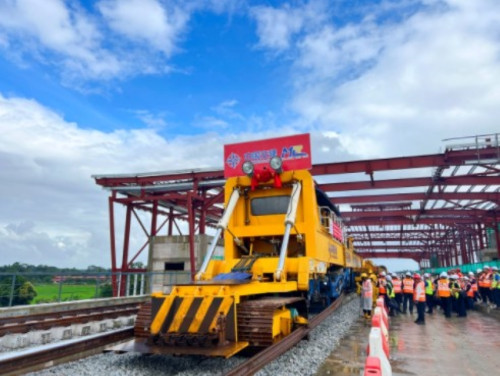
Construction recorded robust growth of 7.7%, continuing to benefit from ongoing infrastructure development, utilities expansion, industrial facilities, data centre investments and housing projects.
Nevertheless, the pace of expansion moderated compared with the double-digit growth seen in 2024 and early 2025, reflecting the natural progression of large-scale projects towards completion phases.
Agriculture expanded modestly by 2.6%, with performance shaped by mixed conditions across sub-sectors. Normalising palm oil yields contrasted with softer output in rubber and fisheries, underscoring the sector’s continued exposure to commodity cycles and weather variability.
Mining was the only major sector to contract, declining by 2.1% due to lower output of crude oil, condensates and natural gas.
The decline highlights structural production constraints within Malaysia’s resource extraction industries, even in the context of fluctuating global energy prices.
Over a broader twenty-quarter horizon, Malaysia’s economic composition has continued to evolve, 27 Advisory said.
The combined share of agriculture and mining has fallen from 14.4% of GDP in 2019 to 11.3% in Q1 2026, while services have expanded steadily to absorb much of this relative decline.
Manufacturing, by contrast, has remained broadly stable, indicating continuity rather than displacement within the industrial base.
Investment trends further reinforced the services-led expansion. Approved investments totalled RM92.8 billion in Q1 2026, with services accounting for RM60.8 billion, or 65.5% of the total.
Within this, information and communications activity contributed RM38.9 billion, largely driven by data centre expansion and cloud infrastructure development, reflecting Malaysia’s growing role in regional digital infrastructure networks.
Policy measures such as the Global Services Hub incentive, introduced to replace the expired Principal Hub framework, are designed to strengthen Malaysia’s position as a regional base for higher-value services and multinational operational headquarters functions.
Within manufacturing, ongoing developments in advanced semiconductor packaging facilities in Penang underscore Malaysia’s deepening integration into global electronics value chains, particularly those linked to artificial intelligence hardware and high-performance computing systems.
External stability conditions remained broadly supportive during the quarter. Bank Negara Malaysia reported an increase in international reserves from US$126.6 billion at end-March to US$130.6 billion by end-May, providing a stronger buffer against external volatility, although reserves do not directly contribute to domestic output growth.
Looking ahead, economists note that while Q1 2026 growth exceeded Budget 2026’s full-year projection range of 4.0% to 4.5%, sustaining this performance will depend heavily on the durability of current growth drivers.
These include continued global demand for semiconductors, as well as tourism momentum linked to Visit Malaysia 2026.
At the same time, structural constraints remain evident. Agriculture continues to require targeted productivity support for smallholders and commodity-dependent subsectors, while mining faces longer-term output pressures tied to both depletion dynamics and the broader energy transition outlined under the National Energy Transition Roadmap.
Construction growth is also expected to moderate further as major infrastructure projects move beyond peak execution phases, shifting future expansion towards productivity gains and the long-term economic utility of completed assets rather than construction intensity itself.
Taken together, 27 Advisory said the latest data points to an economy that is not undergoing abrupt transformation, but rather a steady and increasingly defined rebalancing.
Services continue to expand their dominance, manufacturing retains strategic importance within narrower but globally integrated segments, and resource-based sectors gradually diminish in relative contribution to national output. - July 6, 2026
.jpeg)