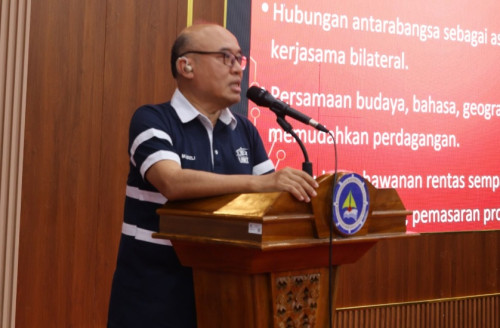
THE Economy Ministry has recorded stronger-than-average development spending performance in 2026, with Economy Minister Akmal Nasrullah Mohd Nasir calling for continued discipline to ensure every allocation delivers measurable outcomes for the people.
Akmal said RM1.214 billion, or 57.42 per cent of the ministry’s original development allocation of RM2.115 billion for 2026, had been spent as of July 21 based on records from the MyProjek system.
He said the performance exceeded the national average of 45.93 per cent, where RM37.18 billion had been spent out of the overall RM81 billion development allocation, placing the Economy Ministry fourth among all ministries.
“Our target is to be among the top three ministries by the end of the year,” he said during the Economy Ministry’s monthly assembly in Putrajaya on Monday.
However, Akmal stressed that the government was not merely pursuing higher spending rates, but ensuring that every ringgit allocated translated into completed projects, quality implementation and clear benefits.
“Every ringgit must be accompanied by physical progress, quality implementation and clear benefits. Delayed projects must be recovered immediately,” he said.
“Expenditure only matters when the money produces completed work and benefits that reach the people.”
He said issues involving procurement, project sites, technical approvals and coordination between agencies could not be allowed to continue until the end of the year.
Akmal also stressed the importance of maintaining the same level of discipline in screening projects under the second Rolling Plan (RP2) for 2027.
He said high-level assessments of proposed projects had been carried out from June to July before the final list is submitted to the Ministry of Finance in August.
Budget 2027 is scheduled to be tabled on October 9.
“The projects selected must truly be ready for implementation, high impact, non-overlapping, have clear ownership and address the needs of the people,” he said.
He added that the Economy Ministry aimed to maintain at least 70 per cent, or RM58 billion, of the RP2 2027 basic development allocation to ensure continuity of projects, sustain economic growth momentum and accelerate national physical development.
Akmal said the government must be willing to reject projects that were not sufficiently prepared, even if the proposals appeared attractive.
“We do not choose projects because they are easy to approve. We choose projects because they are ready to be implemented and capable of solving problems,” he said.
Meanwhile, Akmal highlighted the passing of the Statistics Bill 2026 by the Dewan Rakyat on July 16 as a significant step towards modernising Malaysia’s statistical framework.
He said the country required a new legal framework after more than six decades operating under the Statistics Act 1965, given the changing realities of data, technology and policymaking requirements.
“This reform is not merely about changing names or structures. It modernises the way official statistics are collected, coordinated, managed, protected and delivered,” he said.
Once implemented, he said the new framework would serve as the foundation for a more coordinated, professional and trusted National Statistical System.
Akmal described official statistics as part of the country’s public infrastructure, warning that inaccurate or outdated data could result in ineffective policies, poorly targeted assistance and investments that failed to deliver maximum impact.
“This is the true meaning of evidence-based policy making,” he said.
“Structured and timely data must help us determine who needs assistance, what skills industries require, which projects should be accelerated and which areas need specific interventions.”
He said the Statistics Bill had undergone its Second and Third Readings in the Dewan Rakyat on July 14 and July 16 respectively.
A briefing for the Dewan Negara’s Special Select Committee on Legal Review was held on July 21, with the next process scheduled for August 4 before the bill proceeds for consideration by the Senate and subsequent gazettement.
Akmal said the Department of Statistics Malaysia (DOSM) and relevant ministries would need to prepare regulations, guidelines, operational procedures and engagement sessions during the transition period.
“Legal reform only becomes meaningful when its implementation is understood and trusted,” he said.
“Data is not merely a collection of numbers. Data is a trust because data determines who receives assistance, where money is spent and whether policies are truly effective.” - July 27, 2026