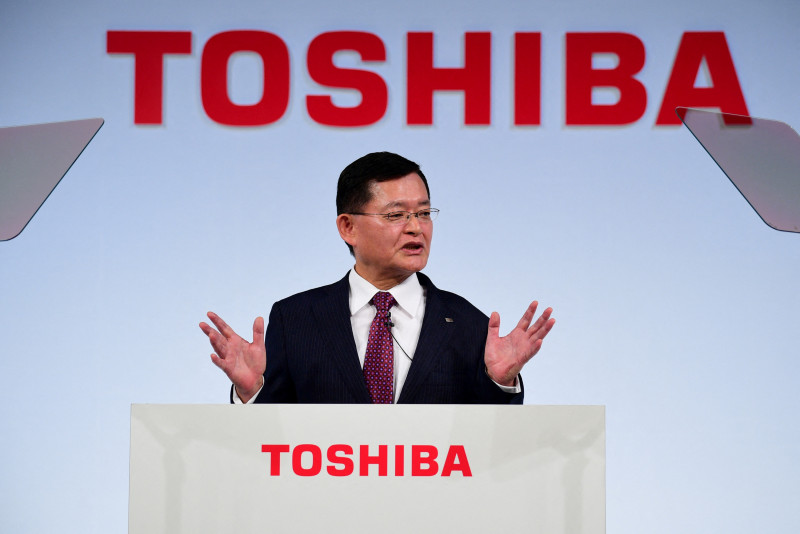
TOKYO – Toshiba president Nobuaki Kurumatani has resigned, the firm announced today, as a buyout offer from a private equity fund reportedly stirs turmoil at the company.
The resignation comes as reports said two other funds are considering their own offers for the Japanese household name, potentially setting up a bidding war.
In a statement, Toshiba said the board has accepted Kurumatani’s resignation, without giving details on why he asked to step down.
He will be replaced by chairman Satoshi Tsunakawa, it said.
The move comes as board members raise questions about the buyout offer from CVC Capital Partners, where Kurumatani formerly headed Japanese operations.
The private equity firm is reportedly offering a deal in excess of US$20 billion (RM82.58 billion), though there are reports that some in Toshiba see the sum as too small.
The Financial Times today said another private equity fund, KKR, is planning to offer its own, larger buyout proposal.
And, Bloomberg News reported that a third, Canadian Brookfield Asset Management, is also exploring a possible offer.
Toshiba last week confirmed it has received an offer from CVC Capital Partners, which would take the former private.
Delisting the firm could produce faster decision-making by Toshiba’s management, which has clashed with shareholders recently.
It could also allow the company to concentrate resources on renewable energies and other core businesses.
CVC Capital Partners and Toshiba have close ties.
Kurumatani worked for the fund between 2017 and 2018, and a senior executive at its Japanese arm currently serves as an outside director on the Toshiba board.
That closeness has reportedly sparked concern, and Justin Tang, head of Asian research at United First Partners, said Kurumatani’s departure will “remove uncertainty over potential conflicts of interest”.
It will also “force the board to seek other offers that are in the best interests of shareholders”.
“It is a very sticky situation at present.”
The turmoil at Toshiba is a fresh blow to the firm, which has been trying to improve its governance after an accounting scandal in 2015 and the 2017 bankruptcy of its United States nuclear subsidiary. – AFP, April 14, 2021