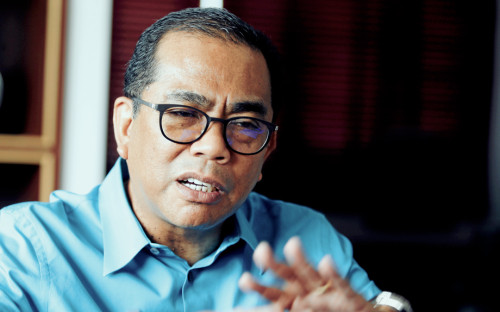
KUALA LUMPUR – The central bank is guarded with the latest assessments and while it acknowledges the visibility of economic recovery, the growth outlook is still tilted to the downside, said Bank Islam chief economist Mohd Afzanizam Abdul Rashid.
“Apart from that, the higher inflation rate is expected to be transitory, suggesting that rising inflation rate is not driven by higher demand,” he said today.
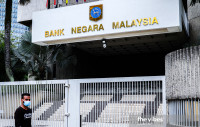
“In that sense, Bank Negara Malaysia (BNM) is likely to maintain the overnight policy rate (OPR) at 1.75% in 2021 in order to facilitate the recovery process,” Afzanizam added.
BNM maintained the key interest rate at 1.75% at its third Monetary Policy Committee meeting today, in line with market expectations amid strengthening global economies.
The central bank said the latest indicators point to continued improvement in the local economic activity in the first quarter of the year and into April.
BNM projected Malaysia’s headline inflation in 2021 to average higher between 2.5% and 4.0%, primarily due to the cost-push factor of higher global oil prices.
Afzanizam pointed out that talks of an OPR hike are quite premature at the current juncture, but risks of an OPR cut were something the market could not totally rule out given the extent of economic uncertainties arising from the pandemic.
“So the incoming economic data for May and beyond will be the deciding factor in determining their next course of action,” he said, adding that the sooner Malaysia achieves herd immunity, the better it will be for the economy.
Asked whether the OPR would remain at 1.75% in 2022, Afzanizam said it would really depend on the pace of economic recovery and the associated risks to financial imbalances.
“If the economy continues to recover at a snail’s pace and there is no risk of financial imbalances such as speculative activities in the real estate markets or a sharp increase in household debt, then BNM can afford to wait and maintain the prevailing OPR of 1.75%,” he said.
While the recent reimposition of containment measures in select locations will affect economic activity in the short term, BNM said the impact would be less severe as almost all economic sectors are allowed to operate.
On May 4, the government imposed a targeted movement control order (MCO), affecting six districts in Selangor from May 6-17 involving Petaling, Hulu Langat, Gombak, Klang, Kuala Langat, and Sepang.
Kuala Lumpur and several districts and mukim in Terengganu, Johor, and Perak are also placed under the MCO from May 7 to 20.
To this, Afzanizam said the lockdown would have an impact if containment measures become widespread as Malaysia progresses this year.
“Nonetheless, we could see a sharp increase in gross domestic product (GDP) in the second quarter of 2021 given the steep fall in GDP during the same period last year. So perhaps, in the immediate term, BNM will adopt a wait-and-see attitude,” he added.
Echoing Afzanizam, SPI Asset Management managing partner Stephen Innes said the recent lockdown would dampen Malaysia’s economic growth, but the export market remained in a good spot thanks to the improvising vaccinations in western markets.
“BNM left the OPR unchanged, preserving policy space while content to let the fiscal authorities do the bulk of the work. I expect BNM to keep policy on hold as most Asian central banks will be taking their policy cue from the United States Federal Reserve, which is unlikely to raise interest rates until 2023,” he said.
Innes added that by preserving policy space, the central bank would have much policy wiggle for a rainy day, if needed.
He added that commodity inflation should be transitory, and that he expected oil prices to bounce a little higher.
"I also expect the Organisation of Petroleum Exporting Countries would not want to overheat the market, and I think Brent will be capped at US$75 per barrel (RM309.15) this year.
“But even current prices offer a huge lifeline to improving Malaysia’s depleted budget coffers, and anything above is simply gravy,” said Innes. – Bernama, May 6, 2021