CARACAS – The official exchange rate of Venezuela’s bolivar went from 4.18 million to the United States dollar to just 4.18 overnight as the impoverished country yesterday slashed six zeros off its inflation-battered currency to simplify transactions.
It is the third banknote reform in 13 years, with 14 zeros shed since 2008 – giving Venezuela the dubious distinction of being the South American country to have lopped the most zeros off its currency.
“Everything expressed in national currency shall be divided by a million,” said the central bank.
The once-rich oil producer is battling its eighth year of recession and hyperinflation that reached nearly 3,000% in 2020 and more than 9,500% the year before, according to the lender’s figures.
Economic consultancy Ecoanalitica expects the 2021 figure to come in at around 1,600.
In May, the government tripled the minimum monthly wage, but the new amount was not enough to buy even 1kg of meat.
Three in four Venezuelans today live in extreme poverty, according to a recent study, with the economic crisis made worse by US sanctions and the coronavirus pandemic.
Millions have left the country in recent years to try their luck elsewhere.
‘Lack of capacity’
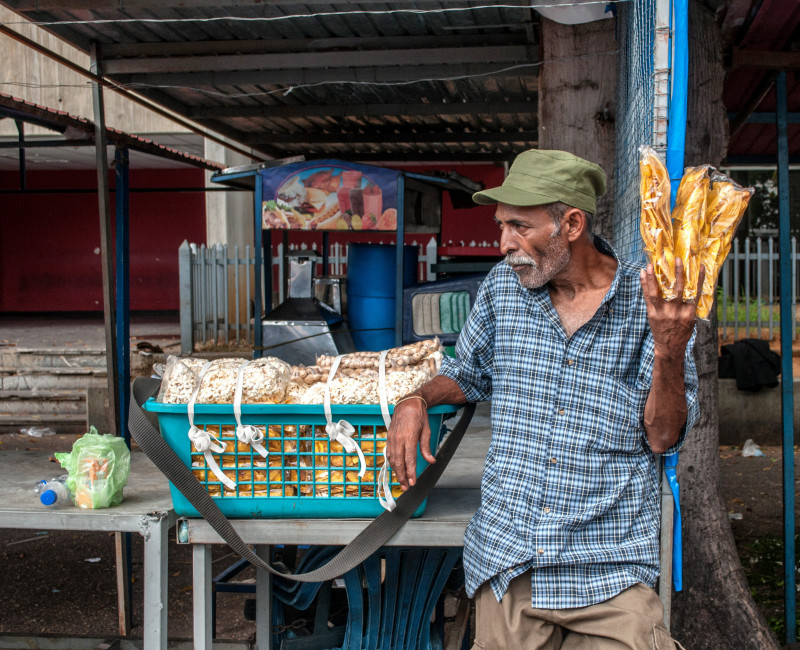
With the bolivar losing nearly all of its value, seven one-million bolivar notes – very hard to come by – were needed to pay for one loaf of bread before yesterday’s currency update.
The government issued new banknotes in denominations of 5, 10, 20, 50 and 100 bolivars, as well as a one-bolivar coin, but has said it wants the economy to become entirely digital.
Analysts read this as a way to avoid printing money that will just continue devaluing, eventually requiring another readjustment.
The biggest note in the retiring bolivar family, with a face value of a million, is worth barely US$0.25 (RM1.05) – not enough to buy a piece of candy. It will remain in circulation in parallel with the new notes for a few months.
“It (the bolivar) is not going to be worth more, it’s not going to be worth less, it’s just a monetary scale that we’re applying by removing six zeros to facilitate transactions,” said Vice-President Delcy Rodriguez this week.
Salaries of worthless millions
According to Luis Arturo Barcenas of Ecoanalitica, the readjustment reflects a “lack of capacity by the economic actors in Venezuela to control hyperinflation”, a phenomenon that “has greatly impoverished the population”.
Workers found themselves receiving salaries paid in millions of bolivars that are effectively worth nothing.
In Venezuela, the minimum public service wage is the equivalent of US$2.50 per month, and the average salary is about US$50, while a basket of basic groceries for a family of five costs around US$220.
With so many bolivars required for a simple purchase, and with notes in short supply, 70% of transactions in the country are conducted in US dollars, according to private sector estimates.
Prices on many shop shelves are displayed in the US currency, to keep things simpler.
In Venezuela’s border regions, it is common to also pay for goods in Colombian pesos or Brazilian reais, and even grammes of gold.
In the 24 hours leading up to yesterday’s recalibration, the dollar soared on the black market, though the central bank kept the official exchange rate stable.
By morning, some shops had already adopted the new bolivar and repriced their goods.
Others, fearful of operational problems, limited bolivar-based transactions.
“I made purchases this morning without problems,” domestic worker Josefina Galindo told AFP.
She used her debit card – the preferred method of payment when dealing in bolivar prices.
Jose Grasso Vecchio, president of Venezuela’s largest private bank Banesco, said the new, lower denominations will make the work of banks “easier, faster”. – AFP, October 2, 2021
_and_his_Venezuelean_counterpart_Nicolás_Maduro_agreed_at_their_meeting_in_St_Vincent_to_refrain_from_escalating_border_tensions._Facebook_pic..png)