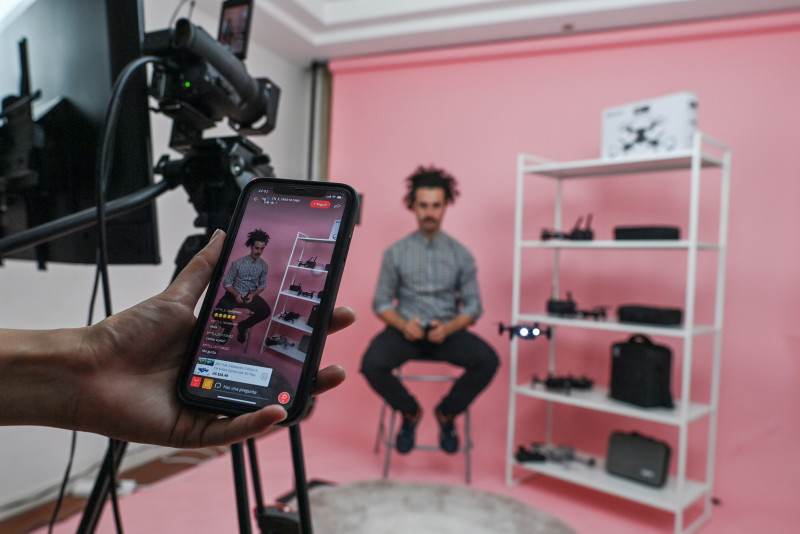
SHANGHAI – Late at night, Lalo Lopez heads to a small Shanghai studio for a livestream, punting Chinese products from cycling shorts to vacuum cleaners to Spanish speakers around the world.
The 33-year-old Spaniard, who describes himself as an artist, DJ and YouTuber, is in the vanguard of the growing ranks of foreigners hired by mainland agencies to extend China's livestream sales mania beyond its borders.
By some estimates, livestream shopping is a near US$70 billion (RM289 billion) industry inside China, attracting influencers who scour markets and malls for items to peddle to live audiences via social media.
Once an obscure form of shopping, livestreaming is predicted to change the habits of global consumers, whose footfall has already headed from the high street to online marketplaces.
Buoyed by the success of livestreams at home, Chinese companies crave bridgeheads for their goods overseas.
Enter hosts such as Lopez, who has lived in China for around nine years and was approached by Beijing-based marketing firm Linkone Interactive after it saw videos he posted on YouTube and Instagram.
“When I speak, I look at the product through my culture, through my experience,” said Lopez, whose streams can attract up to 15,000 viewers.
The medium allows him to answer viewers’ questions on everything from clothing and household appliances to gadgets in real-time, while entertaining them with trivia and flamboyant sales patter.
In one livestream, Lopez appears wearing a pink bathrobe over his regular clothing as he demonstrates using a handheld vacuum cleaner, at one point testing it on his hair.
“It’s easier (for me) because of the cultural background we share,” said Lopez, who earns up to 1,500 yuan (RM933) per session, referring to his foreign customers.
The pioneering livestreamers are a diverse mix of traders, with Polish speakers selling eye massagers and Italian speakers flogging lighting for selfies.
Chinese agencies are now training foreign hosts in China and recruiting influencers abroad, in hopes of hooking onto a winning pattern.
Zhang Zhiguo, CEO of Linkone Interactive, said his firm has been training non-Chinese livestreaming hosts for nearly two years, as brands look to expand abroad.
It has around 50 influencers now – more than half of whom are based in China – targeting markets such as the US, France and Spain.
Livestreaming has become a natural extension of online shopping.
Even the Chinese state media has touted it as a means to alleviate poverty in rural areas where farmers can sell produce like tea online.
This year, individual channels on e-commerce platform Taobao clocked sales of over 100 million yuan during one shopping festival in June.
Expectations are now running high for the biggest discount period of the year – “Singles' Day” on November 11 a bellwether of consumer sentiment in the world's second-largest economy.
The industry has grown rapidly after germinating in 2016, when online giants Taobao and JD.com both launched livestreaming platforms.
This year, it could gross more than 1 trillion yuan, according to a report by KPMG and AliResearch, an arm of e-commerce giant Alibaba.
That would more than double the 2019 numbers estimated by Shanghai-based firm iResearch of US$68 billion.– AFP, November 8 2020