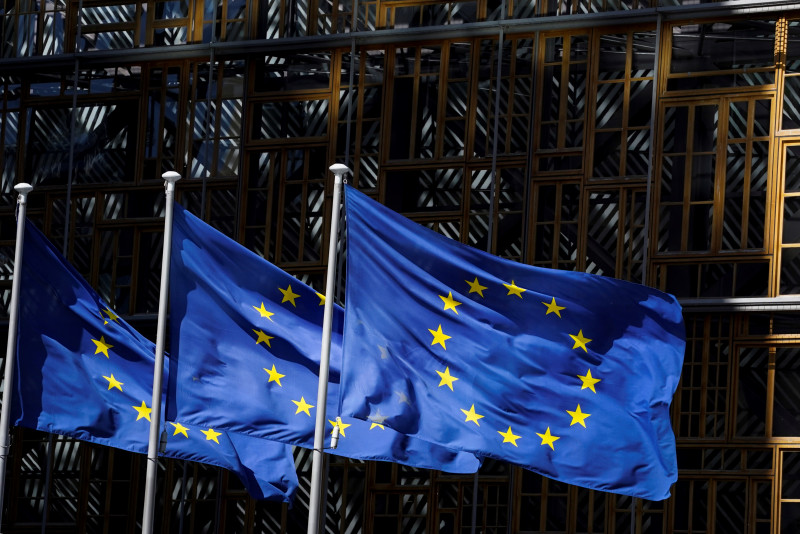
BRUSSELS – The EU and Britain launch the final stretch of trade negotiations on Monday after months of bickering, hoping to dispel the fear of failure by agreeing on a blueprint for their future.
Britain left the European Union in January, but the full economic effect of the bitter divorce will be felt at the end of the year when an 11-month transition period closes.
Britain dramatically shut the door on its 47-year membership of the EU after a 2016 referendum, ending a testy relationship marked by anti-EU euro-scepticism, especially among older voters.
Going forward, relations between Britain and Europe could be governed by a trade deal, but only if negotiations currently underway deliver, which is hardly guaranteed given still wide divergences.
Officials on both sides of the Channel are eyeing an EU leaders' video summit on Thursday as the de facto last chance for a breakthrough.
This gives negotiators Michel Barnier and David Frost just four days and nights to bridge differences that have remained unchanged since talks began in March.
And this, in turn, might give the European Parliament just enough time to ratify the deal for the end of the year.
“Logic and reason would all point to a deal,” said one EU diplomat with a close eye on the talks.
“But if anything became clear in the past three years when it comes to Brexit, economic rationale and pure logic are not enough to explain what's happening,” the diplomat said.
‘Not great’
Failure would see Britain's ties with the European economy governed by the World Trade Organisation (WTO) rules, slapping high tariffs, quotas and other impediments to cross-Channel trade that flowed unencumbered for decades.
Today's British economy, the sixth biggest in the world, was built on EU membership, with the London financial hub and a tapestry of car plants and multinationals enjoying access to the EU's 450 million consumers and complex supply chains.
Given the danger, British big business implored the government to find a middle ground and replicate the benefits of membership as closely as possible, even if this came with the condition that the UK align closely with EU rules.
But, when the pro-Brexit Boris Johnson became prime minister last year, London went the other way, asking for a zero-tariff deal on goods and services that must, he insisted, leave the UK sovereign to make its own decisions.
With positions starkly apart, the talks, led by EU chief negotiator Barnier and the UK's Frost, became bogged down on three core issues.
Fishing has been the least economically significant but most politically explosive issue, with Europe eager to keep open access to the UK's bountiful waters.
Fishermen in France, Belgium, Denmark and the Netherlands have trawled British waters for centuries, but London wants the access rethought to satisfy Britain's coastal communities, which voted strongly for Brexit.
Belgian's Member of the European Parliament (MEP) Philippe Lamberts said, on fishing, Europeans giving ground was “inevitable”.
“If there is no agreement, it will be dramatic; if there is an agreement it won't be great,” said the Greens MEP, who sits on the European Parliament's Brexit committee.
‘Fall apart’
The other obstacle is the lack of faith from the Europeans that once outside the EU single market, Britain will play fair in terms of competition rules, even with a deal.
This view sharpened when Johnson's government introduced a bill in parliament that effectively ripped up the terms of the divorce pact, potentially in violation of international law.
Under the trade deal, will British companies enjoy easier rules on the environment or food safety only to sell their goods cheaply in the EU, where their rivals must abide by stricter measures?
Seeking to maintain what it calls a “level playing field”, the EU is demanding that Britain make a commitment to not backtracking on standards as well as cooperating on how these evolve in the future.
The EU is also worried about how Britain will subsidise companies, afraid that too much taxpayer largesse could prove unfair towards firms in Europe, where state aid oversight is strict.
To solve those problems, the EU is insisting that the deal hold some sort of emergency mechanism, that could swiftly inflict penalties if either side breaks the terms.
“Either the British accept and we then move on to difficult negotiations on fisheries, or they refuse, and we will then be out of time and the negotiations fail,” a senior European diplomat warned.
How matters develop in the next hours or days will be hard to predict.
Brexit from the very start has had its surprises, delays and disappointments.
Irish Foreign Minister Simon Coveney said last week that, while an agreement is likely, “it is quite possible that this could fall apart.”
That “will represent an extraordinary failure of politics and diplomacy”. – AFP, November 15, 2020