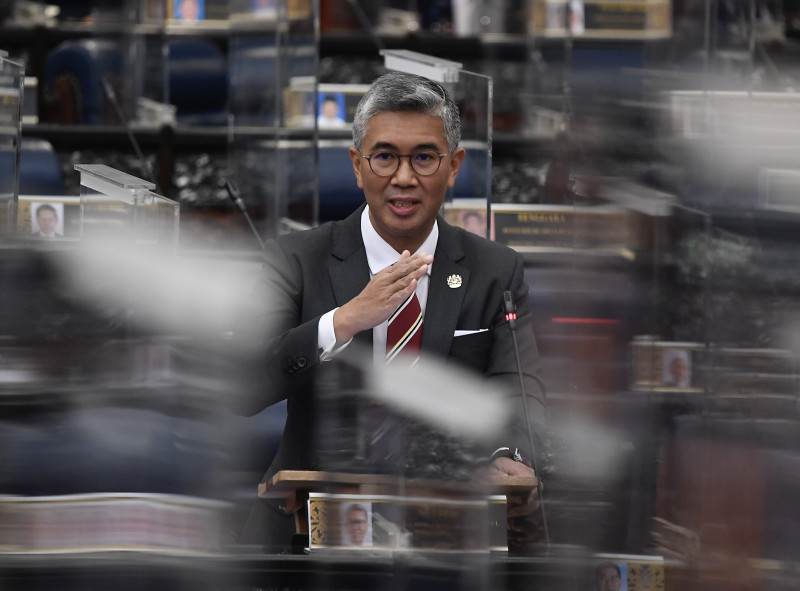

KUALA LUMPUR – Malaysia’s economy may be recovering, but its current growth rate is insufficient to necessitate further borrowings in a bid to channel more funds to the public, the Dewan Rakyat heard today.
Finance Minister Datuk Seri Tengku Zafrul Tengku Abdul Aziz noted that while the country’s debt level to gross domestic product (GDP) remains at 63%, considerably lower than other more developed nations, this does not mean it can afford and sustain further debts.
He pointed out that based on Malaysia’s debt service ratio to GDP of over 18% this year, the government is set to spend about one-fifth of its overall revenue on interests alone.
“For every RM1 made, close to 20 sen has to be used to repay our interests. This is excluding our ability to repay the principal loan.
“In this regard, our ability to further add to our debt level is limited compared to other countries,” he said today, noting that the ratio in countries like the United Kingdom (6.6%), United States (5.2%) and Japan (4%) is much lower than Malaysia’s.
On top of this, Tengku Zafrul noted that Malaysia’s tax collection level to GDP of 11% is also way short compared to even other Southeast Asian countries, with the Philippines, Thailand and Singapore respectively recording figures of 18%, 17% and 13%.
“On average, the tax ratio to GDP of developed countries is over 33%. This means that although our economy is improving, our growth is not generating enough additional revenues to increase our debt.”
The minister was responding to a supplementary question from Datuk Seri Ahmad Maslan (Pontian-BN) on whether there is a need for the government to undertake further loans to assist the rakyat, and whether the country is in danger of going bankrupt like Sri Lanka.
To the latter question, Tengku Zafrul said that based on economic indicators of the two countries, any chance of Malaysia suffering a similar fate is extremely slim.
On a separate question from Wong Hon Wai (Bukit Bendera-PH) on whether now is an appropriate time for the government to introduce a targeted subsidy for fuel products, amid the soaring cost of living, Tengku Zafrul said any measures to implement such a policy will be done in phases.
He said this similar initiative is also evident when the government only increased the ceiling prices of poultry by 50 sen, rather than floating it.
“We will not increase the price of petroleum straight to the market value, without any subsidies, considering its impact on inflation.”
Meanwhile, Tengku Zafrul said while the considerable increase in crude oil and palm oil prices in recent months is expected to see an additional tax collection of over RM10 billion, this is insufficient to cover the total spent by the government to continue providing subsidies of around RM80 billion for the people. – The Vibes, July 19, 2022