KUALA LUMPUR – The Asian Monetary Fund (AMF) proposal should be weighed carefully in the context of rising global economic uncertainty and geopolitics, said two economists.
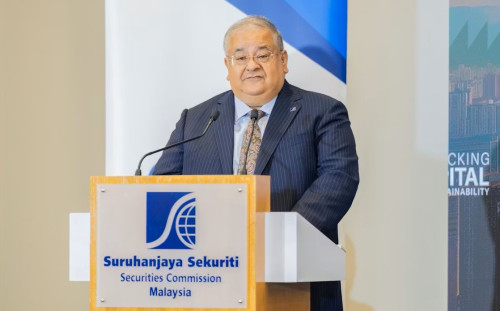
Malaysia, as a small trading nation, must remain open to all ideas and maintain a degree of neutrality while always acting deftly to safeguard its own interests, said Nungsari Ahmad Radhi.
The economist said the AMF proposal has been made as a result of the perception that the United States has abandoned the “liberal order” of international trade and relations and pursued its own national interests while projecting power everywhere.
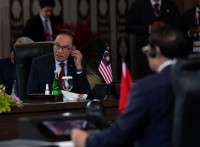
Prime Minister Datuk Seri Anwar Ibrahim recently proposed that Asian countries establish their own version of the International Monetary Fund (IMF) – the AMF.
“All major economic powers will become major political powers as well, and while the US has been dominant for roughly a century, it now struggles to coexist with the rise of China, which will also seek to project political power based on its economic standing.
“Whether it is a regional development bank – there is already the Asian Development Bank, which is largely Japan-centric – or the AMF, China will want its own platform, and owing to its size, it will dominate everything.
“Eventually, so will Indonesia, as our neighbour is the largest economy in Asean with a population of 300 million,” he said.
Nungsari emphasised that Malaysia should not neglect the heightened geopolitical situation surrounding the country and should strategically secure its position amid global economic changes.
“(Due to changes in the global economy and the US’ inward-looking policies) I believe supply chains have been and will continue to be disrupted because geopolitical developments and their reorganisation suggest closer regional cooperation. I agree that Asian economies can benefit from closer economic cooperation,” he added.
Pros and cons
Professor Geoffrey Williams, dean of the Institute of Postgraduate Studies at the Malaysia University of Science and Technology, highlighted three major concerns regarding the AMF.
They are the establishment of the AMF as an alternative to the IMF, the backing of the IMF by the US dollar, and its geopolitical implication and how it will affect the relationships between countries.
“The IMF is a fund for short-term financing to stabilise the international financial system at the government level, with the US and the dollar providing the majority of its backing.
“The second issue is the use of bilateral currencies rather than the US dollar as the primary trade currency to finance international commerce and investment.
“The majority of commodities are priced and traded in US dollars, but the direct transfer of oil between Russia, China, and India bypasses this arrangement. There is a growing likelihood that this will spread to additional nations and commodities,” he added.
Williams questioned the feasibility of establishing an Asian fund, stating that while it is possible, it requires the participation of a large number of Asian nations in order to provide the necessary funding and then to negotiate the terms under which access to that funding is granted.
“It is a geopolitical as well as financial issue,” he noted.
While recent discussions of the AMF have received a positive response from local financial experts, Indonesia’s Coordinating Economic Minister Airlangga Hartarto stated in an interview that the idea’s realisation would require difficult-to-obtain commitments from countries.
The IMF has revealed that roughly 50% of cross-border loans and international debt securities are denominated in US dollars.
While emerging market governments have made progress in issuing debt in their own currency, corporate sectors still have high levels of dollar-denominated debt.
It has been suggested that the AMF could give loans in other currencies to offset the pressure that the US dollar brings. – Bernama, April 26, 2023