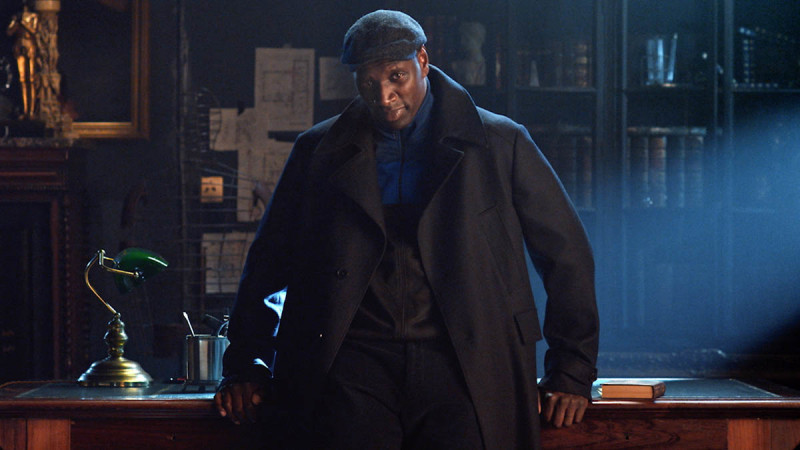
BRUSSELS – 'Lupin', a French reboot set in postcard Paris, has made Omar Sy a global star and fulfilled a long-lost dream for Europeans: the confidence to take on Hollywood.
But, in a devilish twist worthy of the gentleman thief himself, the leap forward for European productions comes thanks to Netflix, a quintessentially American success story.
Netflix is investing massively to become a global television player, but when it comes to making shows in Europe, the company, along with rivals Disney Plus and Amazon Prime, actually has no choice.
Since 2018, a European Union rule has dictated that platforms offer their subscribers at least 30% European content, and that they invest in local shows.
And, while the Netflix revolution is mostly welcomed, this brave new world of binge watching and algorithmic programme guides has triggered soul-searching among Europe's creators.
Greenlit in Paris
According to the company, Netflix has 100 films and series in various stages of production across the European Union with production teams and senior executives hard at work in France, Spain, Germany and Italy.
"When we think about European content we're really thinking about: 'Okay, what is a show that's going to be huge in France that our French members will love? What is a German show that our German members will love?" said Larry Tanz, who oversees Netflix's original programming for Europe.
"And what we find is, not to oversimplify, is that shows often fall into two categories. There's the very local shows ... like 'Love and Anarchy' in Sweden ... and then you have shows like 'Barbarians' or 'Casa de Papel' or 'The Crown' with a broader potential."
The Netflix model is radically different from old Hollywood, in which the major studios would unleash their blockbusters or TV series with no interest in setting up shop.
Netflix, on the other hand, wants to be seen as local.
"You go from somebody sitting in Los Angeles, getting a script that has to be translated and they make a decision there, to where we are now, which is an executive sitting in Paris, gets the script in French ... and the decision to make that show is made in Paris," Tanz said.
One of those executives in Paris is Damien Couvreur, who said Netflix wanted to send the signal "that we were willing to commit and find our seat at the table of the French industry".
"We're trying not to replicate what's already available," he added. Netflix is looking for the unique and authentic, he said.
Netflix high
Belgian screenwriter Sanne Nuyens has experienced the incredible high of Netflix fame.
Her show 'Hotel Beau Sejour', a moody fantasy thriller co-written with Bert Van Dael, became a sleeper hit on the platform, winning praise from bestselling US author Stephen King.
"You write a show for a certain audience and if the audience gets bigger, if it's not only Flanders, or Belgium, but it's also Europe and the whole world, it's fantastic," she said.
But creating quality content is expensive, pushing production companies to team up.
Elly Vervloet is on the frontlines of that new dynamic, in charge of international drama for the Flemish broadcaster VRT, which created 'Hotel Beau Sejour'.
Vervloet's Drama Initiative at the European Broadcaster Union pools money, allowing broadcasters to embark on more expensive projects and fight Netflix toe to toe.
Good partners, but...
If the co-production doesn't work out, Vervloet says that Netflix are "good partners" but "it comes with a cost. You have to talk about your rights, you have to talk about the branding. You have to be strong in your negotiations."
"And if you sell your content to a platform, it is less accessible for other public broadcasters and that is the concern on the European level."
Jerome Dechesne, the head of CEPI, an association for European creators, said Netflix's way of doing business is Hollywood-style: "They finance everything and they keep the final cut."
However, he praised Netflix for breaking what he called the "oligopoly" of major broadcasters – such the BBC or France's TF1 – that had controlled film and TV drama in Europe for decades.
Moreover, he said, Netflix has put an end to this "inferiority complex" of shows not made in English.
But he noted that the EU reform was pushing platforms to put money into independent content, not just their own shows, which helps preserve the independence of production companies.
Netflix's euro-blockbusters will co-exist with innovative content and "that will be super interesting," he said. – AFP, April 1, 2021