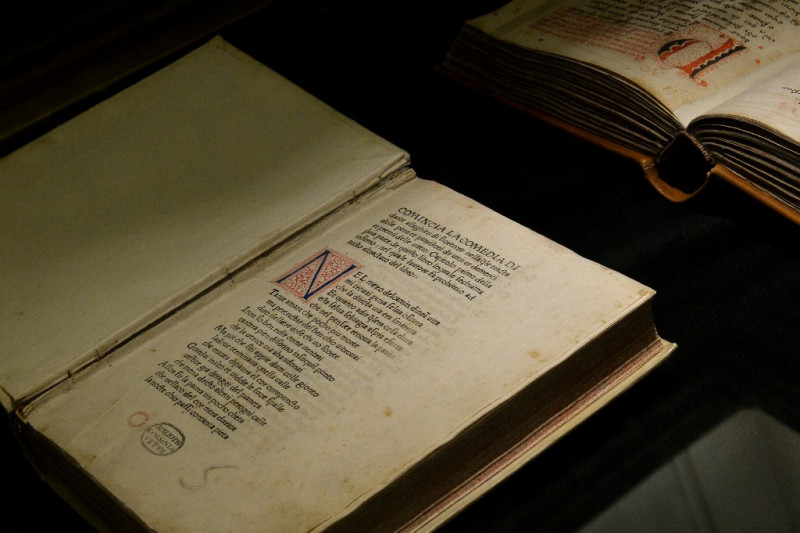
ROME – Dante Alighieri is chiefly remembered as the author of the 'Divine Comedy' and as the father of the Italian language.
On the 700th anniversary of his death in the night between September 13 to 14, 1321, here are five things to know about a titan of world literature.
Father of Italian language
Dante is credited with helping create the Italian language by using the Tuscan vernacular of his time – rather than Latin – to write his masterpiece.
The 'Divine Comedy', originally called simply 'Comedy', is an imaginary journey through hell, purgatory and heaven, published in several stages in the early 14th century.
Its popularity led other medieval Italian authors, such as Petrarch and Boccaccio, to also write in the vernacular, laying the literary foundations of Italian.
It is no coincidence that the institute for spreading Italian language and culture abroad is called the "Dante Alighieri Society".
As part of 700th-anniversary events this year, Italy is also preparing to open a Museum of the Italian Language in Florence, housed within the Santa Maria Novella church complex.
On par with Shakespeare
The 'Divine Comedy' is a poem, a personal tale of redemption, a treaty on human virtue, as well as one of the most influential pieces of science fiction.
Its first section, the "Inferno" (Hell) – with its circles of hell where punishments are inflicted on those having committed the seven deadly sins – still shapes the way we imagine the afterlife, at least in Christian terms.
British poet T.S. Eliot famously said: "Dante and Shakespeare divide the modern world between them; there is no third."
Argentine writer and bibliophile Jorge Luis Borges considered the 'Divine Comedy' as "the best book literature has ever achieved."
Dante in popular culture
Generations of writers, painters, sculptors, musicians, filmmakers and cartoonists have been inspired by the 'Divine Comedy', particularly the 'Inferno'.
These include everyone from Sandro Botticelli, William Blake, Salvador Dali and Pyotr Ilyich Tchaikovsky, to the creators of X-Men comic books and novelist Dan Brown.
Auguste Rodin's famous 'The Kiss' sculpture depicts Paolo and Francesca, the adulterous lovers Dante meets in the second circle of hell.
The 'Divine Comedy' was also a key inspiration for Oscar-nominated thriller 'Se7en', for a popular video game ('Dante's Inferno'), while Dante is quoted in popular TV series such as 'Mad Men'.
Bret Easton Ellis' black comedy 'American Psycho' opens with the epigraph "Abandon hope all ye who enter here" – one of the most-used quotes from the 'Inferno'.
Durante, but call me Dante
Like many other greats from Italy's cultural past – Giotto, Leonardo, Michelangelo – Dante is usually known only by his first name, which is a diminutive of 'Durante'.
He was born in Florence in 1265, exiled in 1302, and he died in Ravenna, on Italy's eastern Adriatic coast, on September 13 or 14, 1321.
Hailing from a wealthy family, albeit not aristocratic, Dante never worked for a living and dabbled in politics as well as literature, philosophy and cosmology.
He had at least three children with his wife Gemma Donati, but his lifelong muse was another woman, Beatrice, who appears in the 'Divine Comedy' as his guide in heaven.
Dante the politician
Dante was active in politics, serving as one of Florence's nine elected rulers, or priors, for a regular two-month term in 1300.
At the time, Italian cities were constantly on the verge of civil war between Guelfs, the papal faction, and Ghibellines, who sided with Holy Roman emperors.
Dante started out as a Guelf, but after being exiled with the indirect help of Pope Boniface VIII, he became increasingly critical of papal encroachment in political affairs.
He was put on trial and banished from Florence after a new regime took over the city and persecuted its old ruling class, and remained an exile until his death.
In 1302, a judge ordered Dante and his allies to be burnt at the stake if they tried to come back. The sentence was later changed to death by beheading.
In the 'Divine Comedy', the poet takes the opportunity to settle scores with many of his foes, notably reserving a place in hell for Boniface VIII. – AFP, September 15, 2021