Art

Can the art world reduce its carbon footprint?

The carbon footprint of the cultural world itself is skyrocketing

Updated 5 years ago · Published on 29 Oct 2020 7:00AM

Can the art world reduce its carbon footprint?
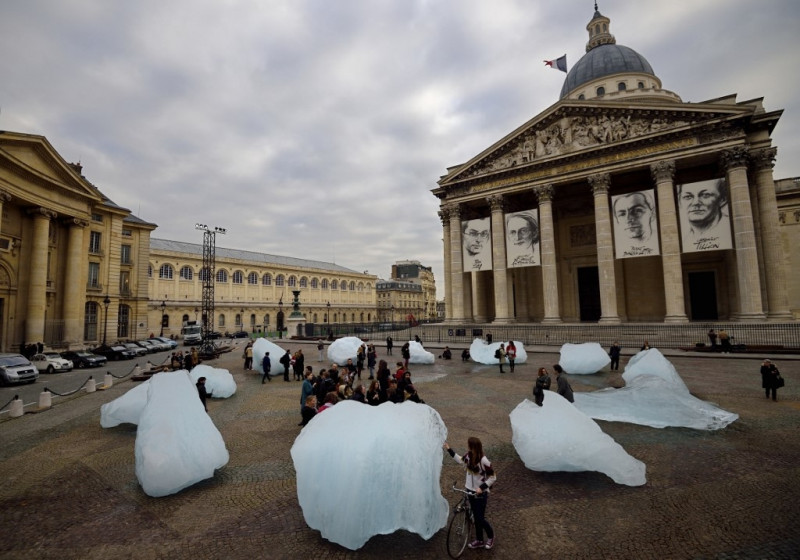
In 2018, Danish-Icelandic artist Olafur Eliasson created an installation comprising 30 blocks of ice from a fjord in Greenland in order to raise public awareness of global warming. – ETX Studio pic, October 29, 2020

AS climate change becomes a major theme for many artists, art and culture professionals are asking themselves tough questions about their own environmental impact. Among them is The Gallery Climate Coalition, a new organization which wants the art world to reduce its carbon footprint by 50 percent over the next ten years.

Blockbuster exhibitions, energy-guzzling conservation procedures and inter-institutional shipping and transport: the carbon footprint of the cultural world is skyrocketing.

The Gallery Climate Coalition is a new non-profit collective of London gallerists and other art and culture professionals working to develop a more ecologically respectful approach for the industry. 

For instance, Thomas Dane Gallery's carbon audit revealed that the gallery - a founding member of the coalition - consumed over 200,000 kg of CO2 in 2018-19, 94 percent of which was accounted for by the air freight of artworks, building energy use and business travel by staff. Another founding member, the Kate MacGarry Gallery, saw its carbon footprint reach 23,959 kg of CO2 in the same period.

These examples are far from outliers, according to the Gallery Climate Coalition. The organization has created a carbon calculator that helps members estimate the quantity of CO2 that their activities release into the atmosphere. Organisations can enter different parameters such as transportation, energy consumption of different spaces and the quantity of paper used for catalogues, brochures and promotional items into the tool to learn how to manage their carbon consumption.

The Coalition's website also offers other resources relating to potential sources of carbon emissions by cultural institutions; its aim is to become "a platform for discussion and debate on a spectrum of issues related to the environment and climate change, and their wider social and economic consequences."

Several international museums have recently set up initiatives to help the art world get greener. For instance, the Horniman Museum in London has pledged to implement greener working practices and work towards becoming greenhouse gas-neutral by 2040.

"We believe the Horniman has a moral and ethical imperative to act now. As a much-loved and trusted institution and the only museum in London in which nature and culture can be viewed together, we feel we have a unique opportunity and responsibility to use our collections, our indoor and outdoor spaces, and our relationship with our visitors, to create a movement for positive environmental change," said Nick Merriman, Chief Executive of the Horniman, in a statement.

Are cultural institutions ready to switch to more ecologically responsible methods of artistic creation?

While the art world seems increasingly aware of climate change and other environmental problems facing us, it has some way to go before it can overcome the paradoxes inherent in big-budget installations and events centered on environmental crisis.

In December 2018, the Danish-Icelandic artist Olafur Eliasson exhibited an installation comprising thirty blocks of ice harvested as free-floating icebergs from a fjord outside Nuuk, Greenland, to alert Londoners to the dangers of climate change... but according to a report by environmental sustainability charity Julie's Bicycle, which partnered with the artist for the event, "Ice Watch" itself generated over 55 tonnes of CO2.


‘Ice Watch’, Bankside, outside Tate Modern, London, 2018 (photo: Charlie Forgham-Bailey). ‘Can the art world provoke and drive social transformation, a shift in values, making us rethink our relationship to material culture? Can it reveal new definitions of what progress means? Without doubt, the current situation leads us to question/rethink/reimagine the way art institutions, art practices and artists operate. … What I am proposing isn’t linked to the materiality of the art object itself but to the impact of the art practice, and the characteristics and potential of the system that sustains it. It is about placing the emphasis on ideas, values, knowledge exchange, wisdom, tools for change, etc. or as Domenico Dom Barra once said: “it is about shifting the focus from the art piece to the art practice and from the artist to the community, art can influence society with its practices. We should engage in those that can help nurture human values and positive counter-narratives. It’s about acting and not about making”. This initiative doesn’t necessarily need to be “vast”. I believe small gestures/actions are in the end more powerful than spectacular works of art — think Eliasson’s blocks of ice brought to London from Greenland so the public could observe/interact with them while melting outside the Tate Modern. … Imagine art which is capable of rekindling values of care, kindness, compassion, action-taking, social justice and cooperation. I’d like art to take a larger social dimension. Art isn’t about stagnation, conformism, fear. Art is about risk taking, resistance, empowerment and transformation. If we are going to have to re-engineer society after coronavirus, we need art that is less about individualism and the “artistic genius” and more about artists and institutions that focus on systematic solutions and collective/collaborative practices that foster community care and participation, collective consciousness and action-taking.’ – Carmen Salas, ‘What should we expect from art in the next few years/decades? And what is art, anyway?’ @medium

A post shared by Studio Olafur Eliasson (@studioolafureliasson) on

"The carbon cost for bringing the thirty blocks of ice is approximately equal to flying two school classes (52 students) from London to Greenland and back to witness the melting of the Greenland ice sheet," said the non-profit organization. However, Eliasson announced that he had made a donation "in excess of the sum estimated for a traditional carbon offset" to the Woodland Trust, the UK's biggest woodland conservation charity, to compensate for the environmental impact of "Ice Watch." – ETX Studio, October 29, 2020

Related News

Malaysia / 3mth

Nine FCC projects endorsed to raise RM30.2m, boost forest conservation efforts

Malaysia / 3mth

Eight PKR MPs urge government to officially confirm cancellation of ART

Malaysia / 4mth

RON95 remains at RM1.99 per litre though world oil prices exceed US$100 per barrel – Anwar

Malaysia / 4mth

US tariffs: Government to avoid any hasty decisions, stresses PM

Places / 5mth

Sarawak looks to greater conservation efforts to boost tourism

Culture / 6mth

Art can play a key role in promoting peace and mutual understanding, says renowned artist

Spotlight

Malaysia

Jana Wibawa: Muhyiddin's instructions were to consider, not approve the project - Tengku Zafrul

World

Trump declares Iran peace accord 'over'

Malaysia

Rembau Undang’s office ordered to vacate premises within 24 hours amid adat dispute

By Alfian Z.M. Tahir

Malaysia

Don't repeat old mistakes, five ships must be completed according to cost and schedule – PAC

Malaysia

Friends in Putrajaya, rivals in Johor: Election exposes new realities of coalition politics

By Alfian Z.M. Tahir

World

Search intensifies off Karachi after Pakistan cargo jet vanishes following mid-air navigation failure

Malaysia

Salesman gets 10 years jail for slashing motorcyclist with meat cleaver

Malaysia

Thai PM Anutin to make first official visit to Malaysia with border connectivity in focus

Malaysia

Young voters could decide Johor election outcome as parties battle for new electorate