1-6 March 1966
Angkor
1) Seeing Angkor, city/palace/house of worship, vision of the Cambodian Kingdom that once was – all that remains now are the ruins of sandstone structures… crumbled through the course of time and dissolved by the forces of nature… over 800 years… At times, it feels to me like a cluster of sculptures left unfinished by a master sculptor…
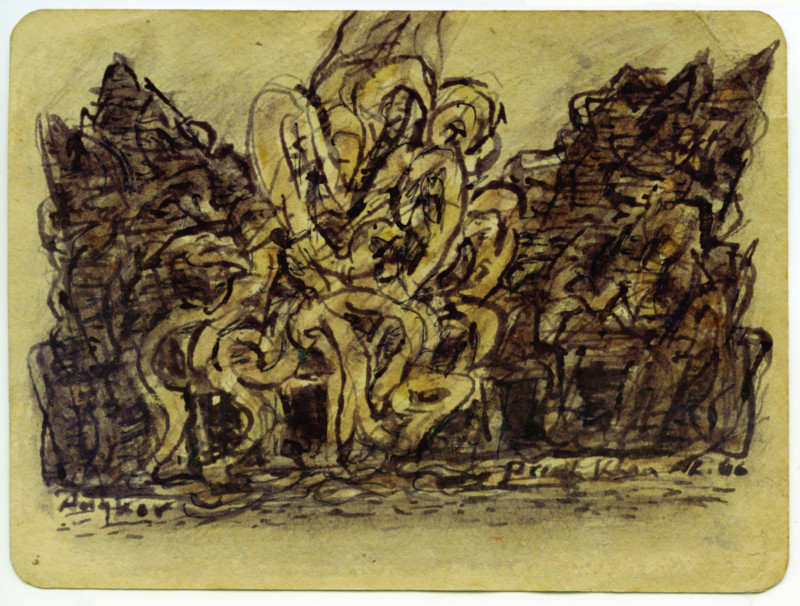
2) At Preah Khan earlier this morning I made a sketch of a similar object from the same angle (beneath a banyan tree)… only the approach was not as refined as the sequence of sketches I had completed yesterday… I focused all my senses specifically and solely on the energy and movement of the sequence.
How does that stone sculpture erect itself? Structures that are grounded, set, compartmentalised, levelled, storied and layered… the large widens at the base, the small tapers at its point… striped, a tapering movement that stunts, broken by the intense pressure of another movement: that is the energy of the shrub root, pulsing hard fibers that curve firmly upward then pierce forcefully downwards into the cavity of the sculpture.
There are strictures that are close to collapse, simply due to the bearing of its own weight… but the chain of sandstone appears as if to hold, even possessing the strength to bear and support… There are trees that have grown old, died? – squeezing part of the arm of the gateway, till it looks tilted… the veins of its roots still wedge, strangle whole visage/head of the deity… the hard, coiled hair unravels, vines, snaps…
There are shrub roots that rub, thick white slabs… melting, overflowing, till it envelopes the threshold of the gates, the doors and windows of the halls and chambers… encircling supple then flowing freely in abundance, towards the palace stairs, towards the outdoors, the stones palace yard, till it finally settles on the ground, the earth…
3) My friend asks: “What fades most easily? And what kind of work can truly last?” I am unsure. What appears in rows before my eyes are only the dance movements and the poetic music of the palace, in concrete. The bangled Apsara ladies, lined, ear-ringed, adorned in beads at the head (two, three, five ladies carved on each wall or on each pillar in the royal hall)…
“What do you think their dance was really like?” my friend asks again. Again I am unsure. (It is certainly not possible to see a performance of the Royal Corps de Ballet in Phnom Penh)… At a distance in the yard, beneath the tall and lush banyan trees, we saw two young girls (were they the drinks sellers?) still dancing… For a moment it was as if the tinkle of the anklets of the Apsaras could be heard, rising sinking in strains beside me…
We had left the small town of Siem Reap in the early hours of the morning. ‘Excavating’ the ruins of Angkor. As we were very tired, after walking just a few miles we came to an agreement: we would get on one of those trishaws that were passing again – (I had earlier refused, adamant I did not want to…) Nevertheless, it was true the grounds of these ruins were vast.
It is said, the space of the grounds containing these ruins were 60 kilometers square! We went along a road that was large and straight, nearing an area made shady by towering trees… Between the strains of the morning sun, a family of monkeys were seen jumping then staying still, startling the dwellers of the jungle, and this wilderness… For a moment, the birds fell silent, then rose to fly and scattered noisily… Wild fowls cooed and called within…
In the lanes that were dim-dark, a loud symphony could be heard: the whistling ringing rhythm of the crickets, as if we were approaching its nest… Suddenly at a treacherous bend, our trishaw puller was unable to control the brakes of his trishaw… And we slid along the slope of a hill, and were pushed deep into the bushes.
It was fortunate that the trishaw puller and my friend received minor cuts on the shoulder and arms. While I kept on rolling. When I became conscious, I saw, impaled in front of me, the statue of an ogre… and my vision became increasingly blur… and all of my body felt as if it was thrown back to a distant past, hundreds of years past… (Or was it the other way round – was it the whole of Khmer History that hit me in the face!)
4) Apart from the banyan trees, figs and the other great trees that reach up high there must surely be countless other small plants that grow upon these rows of sandstone ruins… Like ferns, touch-me-nots, jungle beans, also orchids and wild roses, growing fresh especially on the surface of these moist stones. Almost all the figure sculptures exposed to the rain and heat have been covered by mossy mushroom fungus. The statue we observed closely earlier for example (The King Kusta?) whose face with layers of rings of moss became ever more intriguing, while crust grew all over his body.
Apparently the rain drops had made small holes or pockmarks on his face. When the wind comes bringing earth dust, slumps of moss crust proliferate, sprout and grow… Perhaps this variety will be taken over by moss of another kind, cluster upon cluster… till herbage grows, then small shrubs… The rain and heat of the tropics cascades and swelters… and the earth grows more fertile… green seedlings begin to shoot, grow… And this is how, henceforth, the roots of the greater plants will creep towards the ruins there… till it is able to pervade the cracks in the sandstone: statues, sculptures, even the entire structure – till it forms holes that are bigger and deeper.
A few days ago (before venturing here, to Angkor) I should have, as a general rule, made better preparations, in the custom of the ‘tourist’… For example, to have read as much of the history and origins of each of these ruins. The names of the Kings who built them?
From which year and in which century? Of the distinctiveness of each individual structure, city, palace, and house of worship.
And most important: to get a camera and basket full of Kodachrome rolls… My knowledge was so limited. Different from my friends from Europe who, for a while now, have been prepared with all kinds of equipment and a knowledge of this area… All I brought with me as a guide was a small diagram, a small piece of an ordinary map that depicted the region of countries North of the Gulf of Siam, the areas where the River Mekong flowed and its tributary – the Tonle Sap River.
There were three dots above the diagram of the lake… and a brief explanation at the edge and at the bottom of the diagram. Still, this was my typical attitude whenever I travelled. I am more at ease when I can view and set my eyes on something directly while learning by supposing – to learn to live creatively with whatever there is, face to face or by encounter – facing directly the experience of each day… Try to observe and comprehend each movement of nature. And when able, set it down in the form of lines of sketches and drawings… Looking at the faces of the people all around – listening closely and carefully to their voices and to each word…
5) The day has gone late… My friends from Europe are still fervently discussing the aesthetic merits of each ruined structure they had seen up to this moment… For example, they were of the opinion, and this was arrived at through comparison, that: Angkor Wat was the structure most vital, splendid, formidable, the peak of all architectural achievement: in short, a masterpiece… While the Banteay Srei structure was sweeter, fragile and all the more thrilling… Most disturbing and oppressively unnerving was Bayon. The most pleasant: Ta Prohm and Banteay Kdei. Most regal: Angkor Thom… Most pretty: Preah Khan. And the most alluring and coquettish structure was Neak Pean…. That was according to them. There were certain observations I agreed with, and others I did not…
Yet, I thought repeatedly, using the same yardstick for a different age – that could not be right. Because the facilitator, the creator, the craftsman were not the same and each would obviously have encountered problems, complications that were different when grappling with the technique for each creation. It may have been the problem of material, technical process, local conditions and weather and even the emotional/psychological state of its patron…
(And let us not forget also the theoretical and practical contributions of the old researchers, the renovators who assembled and reconstructed these very structures)… For me, personally, I am more inclined to look at it as a ‘chain of compositions’… There are principal ones, secondary ones and there are those that are casual. Each effort has its separate strengths and weaknesses. Which means it possesses the value-quality of “its own uniqueness”…
Earlier, in front of a compartment with a relief, from the ‘emerging engravings’ at Preah Khan, I was seized awhile… There was a portion that tugged my attention: the engraving or the point of the indent was not very deep, till the boundary lines of the inlay appeared vague, almost flat in fact. Was it because the light that fell was weak? Or was the carver simply forced to work: to complete in haste?... Or, yes, perhaps time and nature had altered the original engraving. Nature and Time as a series of even more masterful carvers and engravers, I had not imagined!
6) It is as if every activity in life was to be recorded forever upon the surface of these stones… There are two display halls in Bayon (in the hallway). Its walls resemble the pages of a history book, drawn in the form of ‘emerging engravings,’ three tiered, filled with all kinds of news of war on land and in the sea… Most interesting were the impressions of the ‘everyday life of the people’ (in the hall towards the south there)…
Depictions of families farming, trading and playing. The women boiling rice or amusing their children. One of them as if looking for lice?... One in the midst of giving birth, with a midwife kneeling by her side… The men, meanwhile, seen playing or trading in the market, working to lift and carry goods at the jetty. Farmers bearing their yield, or working in the rice fields, and herding cows, buffaloes… Depiction of people hunting, shooting arrows and wild beasts and trapping fish…
(It all appeared idiosyncratic, the measurement of scale and distance – which, in this age of ‘modern perspective’ would be regarded as unreasonable, having no logic!)… Nevertheless, we are also made aware that in the daily life of the working people, the living environment of farmers has not changed, though hundreds of years have passed…)
7) Tomorrow, by 4am before the dawn, I have to awake quickly and leave behind the scene and setting of this age old past. At exactly 5 I have to be at the bus station at Siem Reap, to board for the town of Poipet and from there to continue my journey back to Bangkok…
But I am still unable to shut my eyes: my body is still sweating… so I reach for my sketch book and gaze again at the energy of the lines: Spot/dot the deep impression upon first arriving here, now many of these have become rough etchings, compact and sharp… Yet, looking closely at them has not brought about sleep… If that is the case – yes, let me get hold of the ink, and pen again… on and on to sketch again: work even more… scratch, etch and stretch those lines further still, all the way till the break of day!... – The Vibes, November 1, 2020
Translated from the Malay by Eddin Khoo
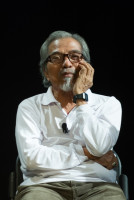
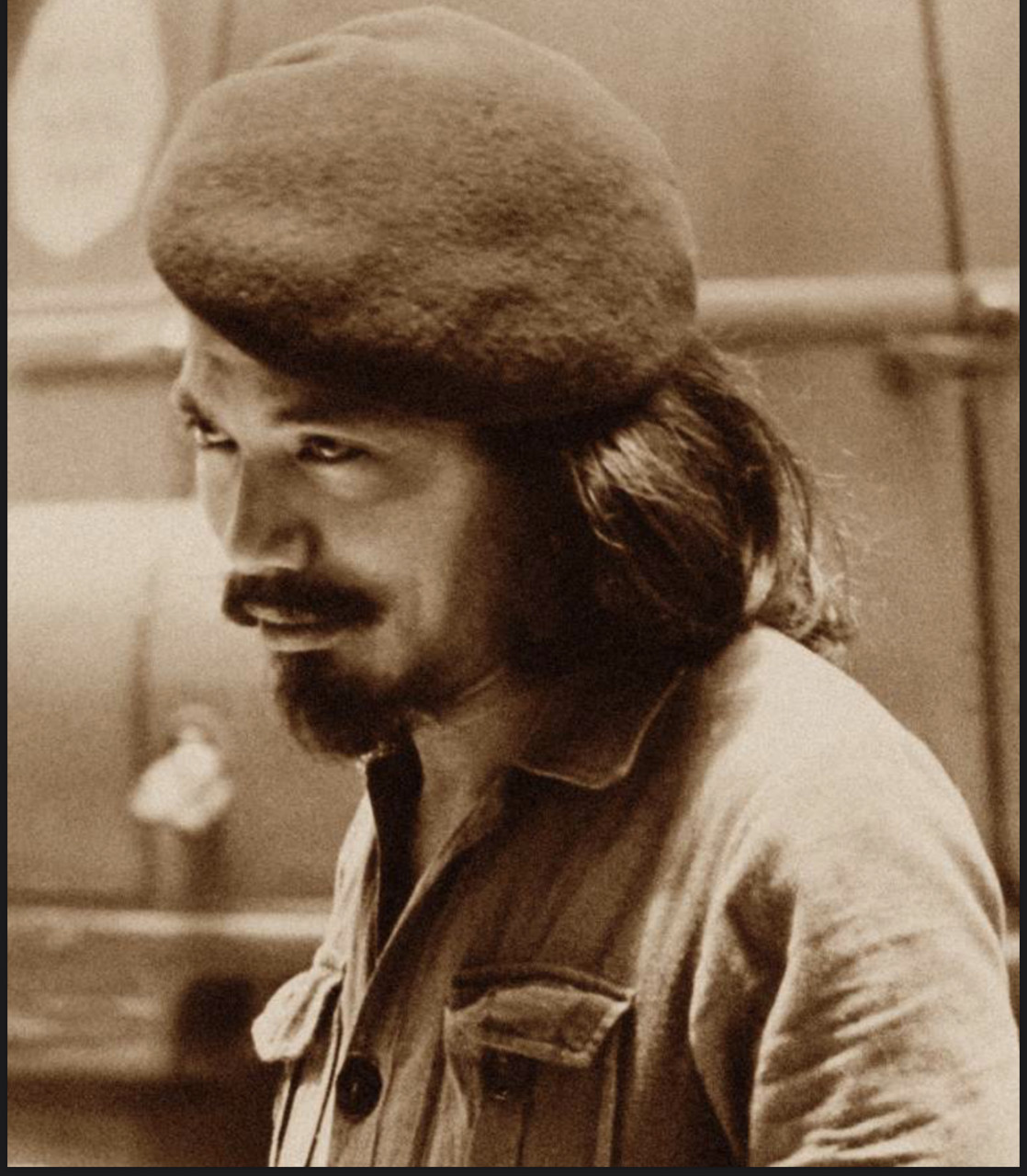
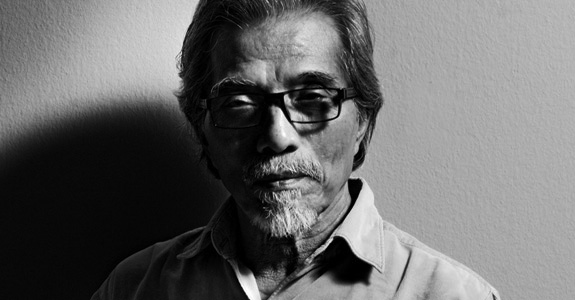
Latiff Mohidin is Malaysia's leading painter and poet. In 2018, a major retrospective of his paintings was held at the Centre Pompidou, Paris, as part of the National Gallery Singapore’s first travelling exhibition on Southeast Asian art. As a poet, Latiff Mohidin has been attributed with changing the course of Malay poetry. In 2012, his translation of Goethe’s Faust into Malay from the German, was published to wide acclaim. His travel journals, Catatan Kembara 60-an,was published in 2018. The English translation, entitled 'Travel Journals 60’s', is scheduled for international publication in 2021.
Catatan Kembara 60-an (2018) is published by LM Studio.
Order at: https://shopee.com.my/pusakaalias, or email: [email protected]