By Murray Hunter
CHINA’S latest five-year national action plan marks a decisive step in reshaping its education system for the AI era.
The plan issued by the State Council mandates the integration of artificial intelligence across all educational stages from primary schools to universities.
Students will not only learn about AI but will be trained to use it as a tool for understanding, problem-solving, and innovation.
The plan also pushes for greater emphasis on science, critical thinking, industry linkages, and the ethical deployment of AI in assessments and school management.
This is not incremental reform; it is a strategic overhaul designed to produce a generation fluent in the technologies that will dominate the 21st century.
Similar signals are emerging elsewhere.
Russia is preparing a national AI deployment plan across sectors, including education, while expanding dedicated AI faculties and exploring AI as a “sparring partner” for students.
These moves by major powers underscore a global race that Malaysia cannot afford to sit out.
AI has already moved from science fiction to everyday reality.
Tools like large language models, image generators, and predictive analytics are reshaping how we work, learn, and create.
In Malaysia, sectors ranging from manufacturing and finance to agriculture and healthcare are adopting AI-driven solutions.
Yet our education system remains largely anchored in pre-digital pedagogies.
Without urgent reform, we risk producing graduates who are spectators rather than participants in the AI economy.
The labour market consequences are already visible.

Routine cognitive tasks such as data entry, basic analysis, translation, and even aspects of content creation are being automated.
The workers who thrive will not be those who simply know more facts, but those who possess broad domain knowledge across disciplines and can intelligently direct AI to synthesise information, generate novel ideas, and solve complex problems.
Creativity, critical evaluation of AI outputs, ethical reasoning, and interdisciplinary thinking have become premium human skills.
A student who can harness AI to explore biology, economics, and design simultaneously will be far more valuable than one who has memorised isolated textbook chapters.
Malaysia’s current trajectory shows promising but insufficient progress. Initiatives such as the National AI Roadmap and some university-level programmes exist, yet AI literacy is not systematically embedded from primary level.
Many students still encounter technology primarily as consumers of social media rather than as creators and critical users of intelligent tools. Teachers, often overburdened, receive limited training in AI-assisted pedagogy.
If China is preparing millions of AI-fluent graduates while Malaysia debates pilot projects, the productivity and innovation gap will widen dangerously.
The risks of inaction are stark. Malaysia aspires to become a high-income nation and a regional technology hub.
We want to attract investment in semiconductors, green technology, and digital services. Investors and multinational companies will increasingly favour locations with workforces already trained in AI collaboration.
An education system that falls behind will produce graduates who require expensive retraining or, worse, remain underemployed.
Entire cohorts could face obsolescence, exacerbating inequality and social tensions.
In a world where AI reshapes entire industries every few years, incremental policy tweaks are no longer adequate.
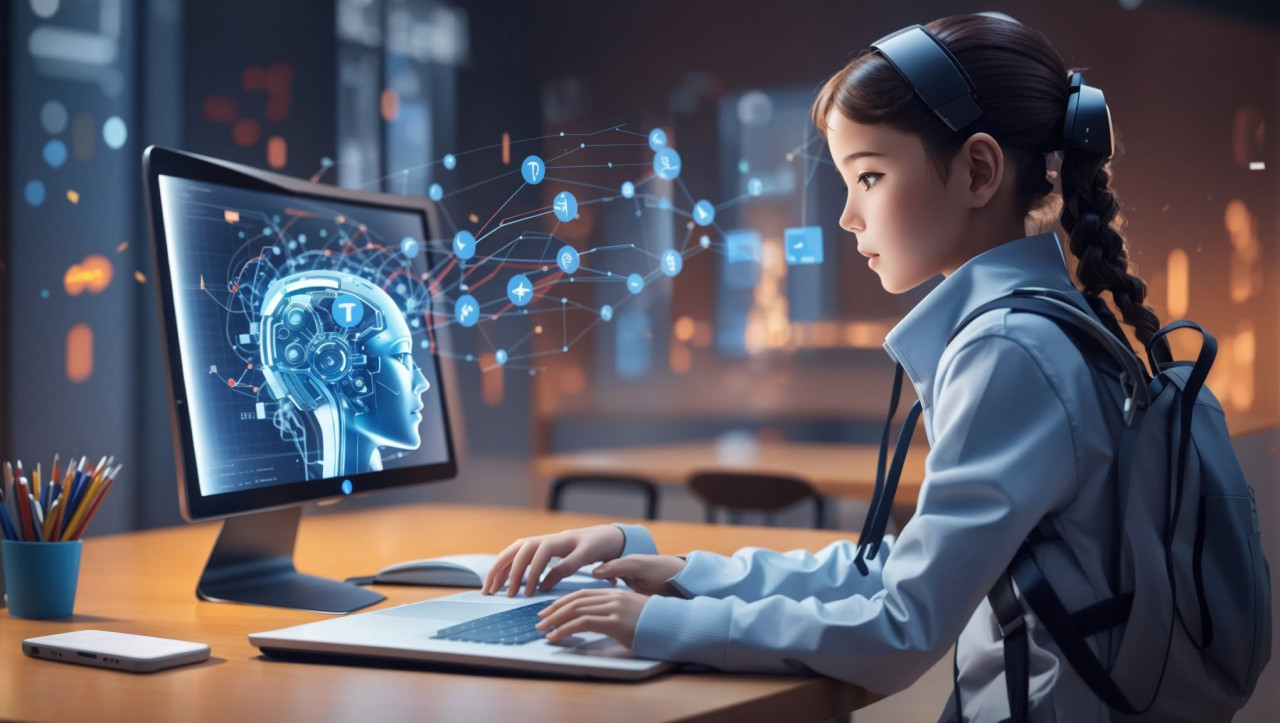
(Image from https://www.classpoint.io/blog/ai-in-education-guide)
A bold curriculum overhaul is needed
Malaysia should develop a national AI-in-Education strategy with clear milestones.
At the primary level, students can begin with age-appropriate tools that teach basic prompting, logical thinking, and data literacy through play.
Secondary education should integrate AI across subjects using it for historical analysis, scientific experimentation, language practice, and mathematical modelling. Universities must expand interdisciplinary AI programmes while ensuring every graduate, regardless of major, achieves functional AI competence.
Teacher training is critical. Professional development must equip educators to use AI for personalised learning, automated assessment, and lesson planning, freeing them to focus on mentorship and higher-order guidance.
We also need strong ethical frameworks addressing data privacy, bias, academic integrity, and digital well-being and areas that China’s plan rightly highlights.
Infrastructure gaps must be closed. Reliable internet, devices, and access to sovereign or regionally appropriate AI models are essential, especially in rural areas, to prevent a two-tier education system.
Public-private partnerships with local tech firms and international players can accelerate this.
This could greatly enhance the benefits to Malaysians from the high rates of IT-based FDI going on today.
Critics may warn of job displacement for teachers or over-reliance on technology.
These concerns are valid but manageable.
AI will not replace good teachers. It will amplify them and their value to the education system in general.
The goal is augmentation, not substitution.
Malaysia’s multicultural context and values can also shape an AI approach that prioritises harmony, sustainability, and human-centred innovation, differentiating us in the global landscape.
This will assist Malaysia in becoming globally competitive tomorrow.
The window of opportunity is narrowing.
China’s systematic push, together with Russia’s ambitions demonstrate that leading nations view AI education as a strategic imperative.
Malaysia has strengths, which include a relatively young population, a growing digital economy, and policy ambition through initiatives like Malaysia Digital.
Now is the time to translate ambition into classroom reality.
By embedding AI literacy at every level, we can cultivate a workforce that is not only competitive but capable of creating new opportunities for itself and future generations.
The alternative of watching others surge ahead while our education system grows obsolete is totally unacceptable.
Policymakers, educators, industry leaders, and parents must now engage in serious, sustained dialogue.
Malaysia’s future prosperity depends on acting decisively before the AI tide leaves us behind. – July 2, 2026