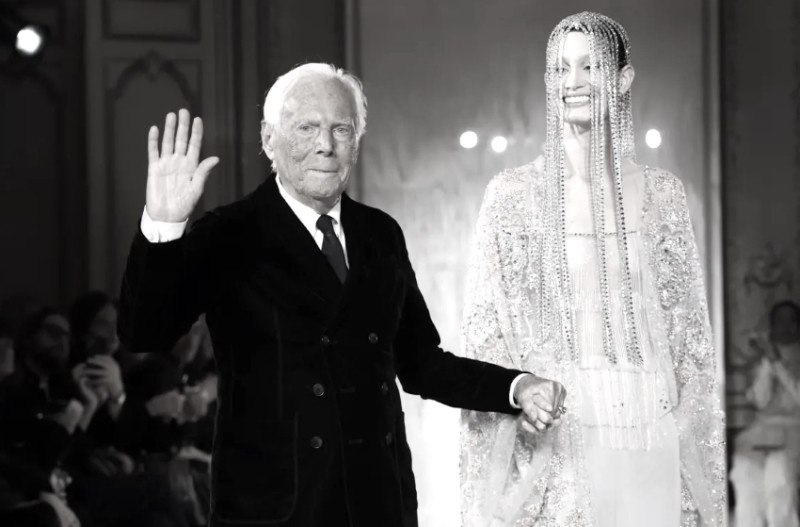
GIORGIO Armani, the Italian designer who redefined the modern suit and established one of the world’s most recognisable fashion empires, died on Thursday at his home in Milan. He was 91.
His passing was announced by the Armani Group, which noted that the designer had been working "until his final days".
A visionary who transformed the language of fashion twice over, Armani became a household name in the 1980s by stripping the male suit of its rigid internal structure.
Drawing from the traditions of Neapolitan tailoring, he removed shoulder pads and linings to reveal a softer silhouette — one that resonated not only with men but also with women seeking an alternative to the prim corporate wardrobe.
“All the women of my generation, including Hillary Clinton, were wearing jeans in the 1960s,” said Deborah Nadoolman Landis, costume designer and director of the David C. Copley Center for Costume Design at UCLA. “But where do you go from Woodstock? How do you professionalise that look when those women start entering the work force? You professionalise it by wearing a feminised suit from Armani.”
Armani’s fluid tailoring created a style that was both androgynous and commanding, blurring gender lines and offering a new form of power dressing.
At the height of his influence, an Armani suit became de rigueur for executives in Wall Street, Hollywood, and Madison Avenue — a sleek uniform of authority rendered in wool crepe, cashmere and a palette of disciplined neutrals.
“Armani is one of those, like Coco Chanel with the little black dress, as important for what he contributed socially through dress as for what he specifically designed,” said Harold Koda, former head curator of the Costume Institute at the Metropolitan Museum of Art.
Armani’s aesthetic soon migrated to Hollywood, where he became virtually synonymous with red-carpet glamour. He maintained close relationships with stars and studios, ensuring his designs were not just worn, but immortalised on screen and stage. In the Italian media, he was known simply as “Re Giorgio” — King Giorgio.
Tall, tanned, and with striking blue eyes, Armani cut a charismatic figure. Though not one for flamboyance, he embodied a quiet confidence that reinforced his status as both creator and brand.
Averse to trends, he rarely strayed from his minimalist codes, even as critics occasionally deemed his work repetitive or out of step with shifting tastes.
The designer remained unfazed, trusting the staying power of his vision — a faith rewarded in recent years as the fashion cycle returned to the 1980s and once again hailed him as a prophet of style.
Though never married and without children, Armani leaves behind a tight circle of trusted relatives and colleagues who helped manage the business. He was the sole major shareholder in the privately held Armani Group, which he founded in the 1970s with his partner Sergio Galeotti.
Until his death, he retained close control of both the creative and managerial direction of the company.
In 2024, the group reported stable revenues of €2.3 billion (US$2.7 billion), despite a challenging period for the luxury sector. Analysts, including Mario Ortelli of consultancy Ortelli & Co., continue to view the brand as highly attractive.
“Could Giorgio Armani be an interesting target? The answer is absolutely yes — it's one of the most recognised brands in the world, with a stylistic vision that is clearly and uniquely defined,” said Ortelli, though he noted that any near-term deal would be unlikely.
Over the years, Armani received several acquisition overtures, including one in 2021 from John Elkann of the Agnelli family and another from Gucci, then under Maurizio Gucci. However, the designer resisted every approach, particularly from French conglomerates, which he reportedly viewed with caution.
Armani made it clear he would never list his company on the stock exchange, and established a succession framework designed to preserve its independence. The group has been run with the help of close family members and long-time associates.
He is survived by his younger sister Rosanna, nieces Silvana and Roberta, and nephew Andrea Camerana — all of whom hold key roles in the business. His trusted deputy Pantaleo Dell’Orco, often described as part of the family, is also seen as a possible successor. The contents of Armani’s will, expected to be revealed in the coming weeks, may offer greater clarity on the future of the empire he built.
Giorgio Armani changed the way the world dressed — and in doing so, changed the way it saw itself. - Sept 5, 2025