AT least 111 people have been killed and 87 injured after a powerful 7.4-magnitude earthquake struck western Colombia, leaving hundreds of buildings damaged and triggering desperate searches for survivors trapped beneath the rubble.
The earthquake struck on Monday, with its epicentre in San Jose del Palmar in the Choco region, about 400 kilometres west of Bogota, according to the United States Geological Survey.
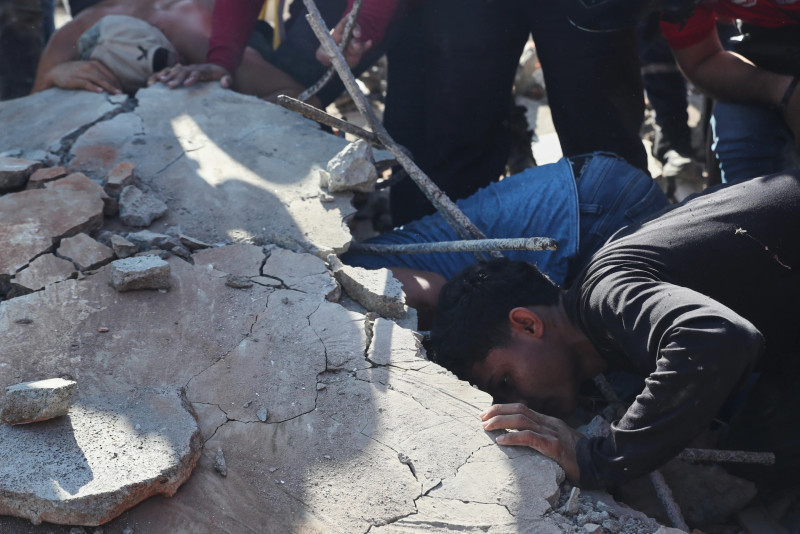
Rescue workers and civilians scrambled to search collapsed buildings in Cali, Colombia’s third-largest city, where volunteers formed human chains to clear concrete and debris from the ruins.
“Our building has basically been left in ruins, and the building next to ours? Completely collapsed,” said Álvaro López, who watched the rescue operation while cradling his dog.
The earthquake was felt across western Colombia, including Cali, Pereira, Quibdo and Manizales, as well as neighbouring Ecuador and Panama.
President Abelardo de la Espriella said about 1,600 buildings had been damaged, including at least 61 that completely collapsed. He declared an emergency to accelerate funding and relief efforts.
“We aren’t going to leave people alone. They are in our hearts and we are going to tend to people with our full determination,” AP reported him saying.
Colombia’s Geological Service described the quake as the strongest recorded in the country during the 21st century, with several aftershocks reported.
The death toll included at least 40 people in Risaralda, where Pereira is located, and 27 in Valle del Cauca, where Cali is situated, including three children. Authorities also reported nine deaths in Choco, two in Caldas and one involving a 73-year-old victim in Antioquia. The locations of the remaining 32 fatalities were not immediately disclosed.
The scale of the disaster remained unclear in Choco, a remote and impoverished Pacific region where poor transport links and disrupted communications have complicated rescue and assessment efforts.
The town of San Jose del Palmar, closest to the epicentre, has no airport and is situated on a mountain ridge along a highway connecting Cali and Pereira.
In Cali, taxi driver Jorge Moncayo, 64, described seeing clouds of dust rising across the city as buildings collapsed.
“My entire house shook. I’ve never lived through such a powerful earthquake,” he said. “We’re thanking God we’re alive.”
Authorities said people remained trapped in several of the 380 buildings damaged in Cali.
In Pereira, local media showed sections of the airport ceiling collapsing as passengers sought shelter. The city’s mayor, Mauricio Salazar, said at least 15 buildings had collapsed and people were feared trapped.
In Manizales, part of the city’s neo-Gothic cathedral collapsed into the nave. Authorities urged residents to remain outside because of the threat of further aftershocks.
Flights were also suspended at airports in Manizales, Quibdo, Armenia, Cartago, Buenaventura and Pereira while authorities assessed the damage.
The disaster prompted a regional outpouring of support, with governments across the Americas offering assistance.
The United States announced US$15.5 million in emergency aid for shelter, food and other earthquake relief efforts.
El Salvador President Nayib Bukele and Mexican President Claudia Sheinbaum also offered assistance, while Chilean President Jose Antonio Kast pledged support, saying Chile understood the pain and challenges caused by major earthquakes.
The disaster presents the first major crisis for de la Espriella, who was sworn in as president over the weekend and said he had personally taken charge of the government’s emergency response. - August 11, 2026