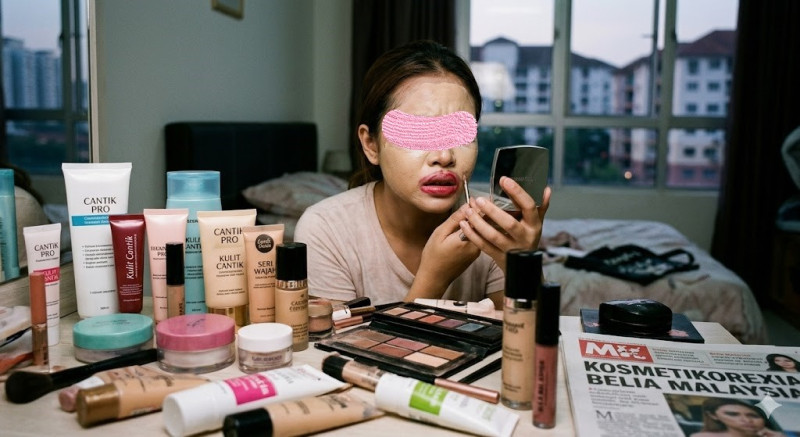
A TREND involving children as young as primary school age showcasing elaborate skincare and make-up routines on social media has prompted growing concern among experts, who warn that digital platforms and the beauty industry may be driving a culture of early appearance anxiety and unrealistic beauty standards.
In one widely shared TikTok video, Ellie-May, then aged 10, enthusiastically documents a multi-step routine as she prepares to visit a friend’s house.
“Get ready with me to go to my best, best friend's house,” the BBC quoted her saying to camera.
She proceeds to describe each step of her skincare regimen with excitement, applying toner, serum and moisturiser, followed by concealer, blush, highlighter, mascara and lip gloss, before finishing her routine after styling her hair.
“I love, love, love, love, love this toner,” she says, as she applies it to her skin. She later adds: “Oh my god it's so glowy,” while referring to a serum.
Now aged 13, Ellie-May has been posting skincare and lifestyle content since she was eight, beginning as a hobby during lockdown before evolving into a significant source of income for her family.
Her TikTok account alone has amassed more than 330,000 followers, while her family operates multiple accounts across Facebook, TikTok, YouTube and Snapchat.
Her mother Sophie says the family now earns more than £50,000 annually from content creation.
“Being content creators has transformed our lives,” she said during a video call from their home in south-east England. “So many other young kids just wanted to know about Ellie’s skincare routine and, well, it just took off.”
The rise of child influencers showcasing skincare routines reflects a broader online trend, with search results across platforms revealing thousands of similar videos featuring children—some as young as three or four—demonstrating beauty products, discussing daily routines or participating in “get ready with me” content.
While skincare marketing to younger audiences is not new, experts say the nature of products being used has changed significantly, with modern routines often involving multiple steps and ingredients associated with anti-ageing or skin-perfecting effects.
Some young influencers present themselves as “brand ambassadors” for cosmetics companies including Bubble, Drunk Elephant and P. Louise, promoting products designed to achieve what is described in marketing as “luminous” or “glow-boosting” skin. Seasonal themed products, including Korean-inspired sets, have also entered the youth beauty space.
However, concerns have been raised by parts of the industry itself. A source close to Drunk Elephant said the brand is not intended to be “youth-focused” and emphasised efforts to educate consumers on responsible product use. Bubble and P. Louise did not respond to requests for comment.
Research by skincare brand Pai, surveying 1,500 children aged nine to 12, suggests nearly half use multiple skincare products weekly, with many citing concerns about perceived skin imperfections.
The trend has become part of a rapidly expanding global beauty industry worth billions, but experts and regulators are increasingly questioning its impact on children’s mental well-being.
Professor Brooke Erin Duffy, a social media researcher at Cornell University, said the phenomenon represents a shift in how beauty pressure is experienced.
“Women in their 30s and 40s have long been targeted by skincare companies, telling us that ageing is a problem and selling us a solution,” she said. “But this is a marked shift. Now young girls are being put under that same pressure.”
The concern has led some dermatologists and academics to define a new condition termed “cosmeticorexia”, described as an unhealthy preoccupation with achieving flawless skin from an early age, often driven by social media exposure.
Professor Giovanni Damiani, a dermatologist at the University of Milan, said he began investigating the issue after observing compulsive skincare use among young patients.
He interviewed 55 patients aged between eight and 14 and found that those displaying signs of cosmeticorexia were often heavily engaged with mobile devices, spending extended periods watching skincare content online, using up to ten products daily, and in some cases avoiding social interaction without make-up.
Regulators are also beginning to take notice. The Italian Competition Authority has launched investigations into luxury conglomerate LVMH, which owns brands including Sephora and Benefit, examining whether marketing practices may have targeted or indirectly influenced minors through social media and micro-influencers.
LVMH said it is cooperating with authorities and “reaffirms its strict compliance with applicable Italian regulations”. It also stated that it does not run campaigns targeting young people and works only with influencers aged over 18.
In the United Kingdom, the Advertising Standards Authority said it is monitoring international developments and assessing whether similar issues are present domestically, although it has not launched formal action.
The financial cost of these routines is also drawing scrutiny. One study analysing TikTok content by under-18 users found that the average cost of showcased skincare routines was approximately £125, with products often requiring frequent replacement.
Children are increasingly adopting complex regimens involving multiple stages such as cleansing, toning, priming, moisturising, serums, eye creams and face mists in pursuit of the so-called “glass skin” aesthetic popularised online.
However, dermatologists caution that such practices may be unnecessary, particularly for young skin.
“The irony? They’ve already got it,” said consultant dermatologist Dr Jean Ayer. “When you’re little, your skin is in perfect condition. Your skin barrier, which keeps toxins out and moisture in, is beautifully preserved. That’s youth. That’s the beauty of skin.”
As social media continues to amplify beauty trends to younger audiences, the debate is intensifying over whether the phenomenon represents harmless creativity—or an emerging form of early-age cosmetic pressure with long-term psychological consequences. - June 7, 2026