PARIS – Hydrogen could potentially power trains, planes, trucks and factories in the future, helping the world rid itself of harmful emissions.
Here is a look at where the industry stands in various sectors:
Cars and trucks
Hydrogen fuel cell electric cars are already on the road.
Toyota launched the Mirai sedan, the world's first mass-market hydrogen fuel-cell vehicle, in late 2014 while Hyundai unveiled its Nexo SUV in 2018.
The starting retail prices are high for the average consumer, however, at around US$50,000 (RM207,000) in the United States and higher in Europe.
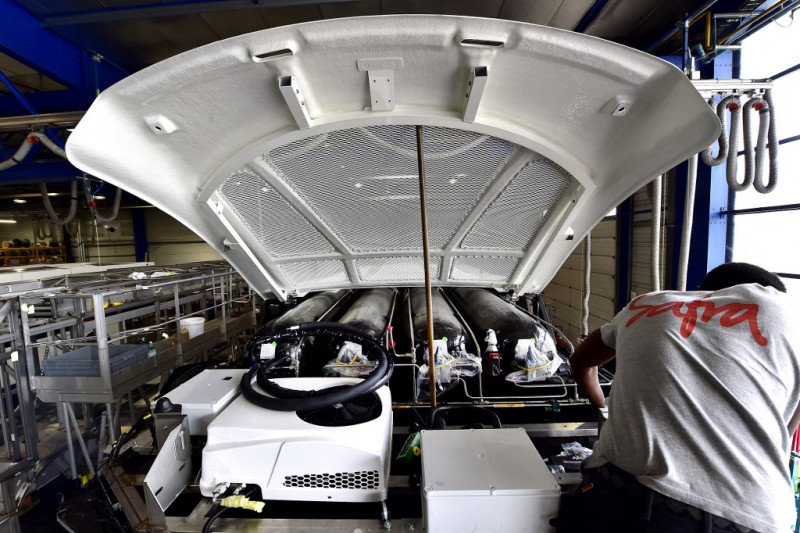
Other hurdles are a lack of recharging stations and the need for large reservoirs that eat up seating space.
Several automakers and equipment manufacturers have nonetheless unveiled substantial investment plans to improve the vehicles and develop race cars as well.
A likely place to start is with freight transport, where hydrogen could replace diesel fuel.
Vehicles can be refilled quickly, they have substantial autonomy, weight is not a problem and they are allowed in urban centres that might otherwise be off-limits to heavy trucks.
Hyundai has already rolled out prototypes, and GM, Traton (Volkswagen) and Toyota are accelerating the development of their own models.
US start-up Nikola created a short-lived buzz with its promise of a hydrogen-fuelled truck before acknowledging it still had a long way to go.
Several companies propose buses that run on hydrogen fuel cells, but the sector is still at the experimental stage.
Train prototypes
Hydrogen-fuelled trains are tipped as a good alternative to diesel for trains that cannot run on electricity.
They will need a dedicated refueling network however.
French manufacturer Alstom has been testing such a train in Germany since late 2018, and is ready to build rolling stock.
SNCF and four French regions are expected to sign a contract for the trains this week, with a goal of putting a prototype on the rails in 2023, followed by pilot programmes in 2024-25.
Airplanes: 2035
The air transport sector is betting on hydrogen to cut 2005 pollution emission levels in half by 2050.
Two main paths are being explored at present, the first being directly as a fuel for jet engines, which will mean overcoming serious technical obstacles and modifying the design of aircraft.
Even at -253 degrees C, hydrogen takes up four times as much space as kerosene, which is what planes use at present.
A second possibility is to combine hydrogen with carbon dioxide (CO2) to produce a synthetic fuel that can be used by itself or with kerosene without major engine modifications.
The European aircraft manufacturer Airbus has made hydrogen-fuelled planes a strategic priority, and is targeting 2035 as the date for at least one of three concepts to come to fruition.
German aerospatial research group DLR and Boeing are interested in the hybrid fuel concept, but the sector does not have the luxury of putting all its eggs in one basket, notes Sheila Remes, head of sustainable development at the US planemaker.
Heavy industry
Heavy industry also has climate targets to meet by 2050, and hydrogen appears to have an edge in the cement, chemical and steel sectors.
According to the Hydrogen Economy outlook published by BloombergNEF, a financial information company, so-called green hydrogen produced from water and sustainable electricity could cost between US$0.80 and US$1.60 per kilo by 2050.
That would make it competitive with natural gas in most countries.
Hydrogen is already widely used in the process of making fertilizer.
French industrial gas group Air Liquide estimates that between 2030 and 2040, more than half its hydrogen sales will be to the industrial sector, with another 40% going to transportation and 10% used for "diverse activities".
Steel giant ArcelorMittal, which aims to curb global emissions by 30% in less than 10 years, has launched a project with Air Liquide at a plant in Dunkirk, northern France, that is already an experimental leader in Europe.
The northern German cities of Bremen and Hamburg also have plans to test hydrogen in the steel-making process.
In La Mede, southern France, energy companies Total and Engie are working on a solar-powered bio-refinery that is projected to produce five tonnes of green hydrogen a day to be used to make agrofuels.
Air Liquide has other energy projects under development in Normandy and Canada. – AFP, March 31, 2021