THE most essential item in aircraft engineer Tao Rui's possession during a recent outing in Shanghai was the Alipay smartphone app from Ant Group, a company little known outside China until it unfurled plans for the biggest IPO in history.
As Tao and a friend strolled the city at the weekend, he used Alipay to buy a cup of milk tea, a deep-fried octopus snack and a box of candy. He also used it to play a basketball game at an arcade, make a small donation to a street musician, and produce a health code signalling he was coronavirus-free before entering a Buddhist temple.
They topped the day off with bowls of Japanese ramen noodles, also purchased with a scan of an Alipay code.
Tao's day underscores why the planned US$34 billion stock listing of Ant Group, the financial arm of Chinese e-commerce giant Alibaba, is such a big deal.
Like hundreds of millions of Chinese consumers, the 22-year-old admits he simply cannot survive without Alipay, the crown jewel of the Alibaba empire.
"I use Alipay to order a cab, to buy things, to shop on (Alibaba e-commerce platform) Taobao, to buy clothes, and air and train tickets," said Tao.
"It's indispensable for getting around in China."
Economy of the future
The raw numbers and growth potential of Ant Group have investors salivating over the world-record IPO.
Alipay boasts in excess of 700 million active users – half of China's population and more than double that of the United States. Along with the WeChat Wallet function of Alibaba's chief tech rival Tencent, it has helped propel China forward into what may represent the economy of the future.
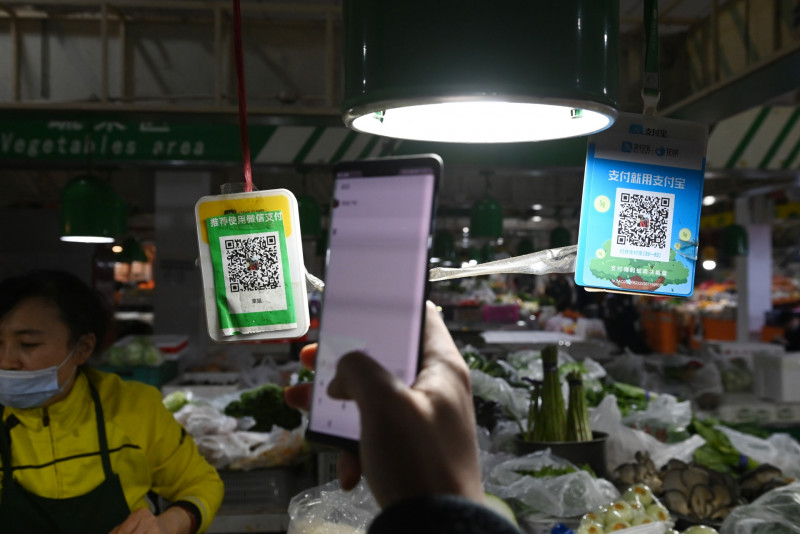
At restaurants, grocery stores and cafes, at subway turnstiles, train stations and airports, and when buying fruits and vegetables from a streetside peddler, purchases across China are routinely made by consumers old and young with a quick QR code scan.
Even the occasional beggar is on board, sprawled on a sidewalk next to a neatly laminated printout of a QR code.
Tao said that in China's paper-money olden days, his family would have to hail a cab to get to a distant government office just to pay the household water and electricity bills - in cash.
"Now, we pay all our utility bills through Alipay, which directly deducts the amount online," he said.
"We don't have to go out at all. You can do it from home."
It's revolutionary
But direct point-of-sale payments are only part of the Alipay picture.
Ant Group has built an ecosystem around Alipay in which third-party vendors – for everything from meal deliveries to travel services or taking out a loan – are housed under its umbrella.
Smartphone users need only open Alipay to find the service they want and place an order.
Payment, of course, is processed via Alipay.
Ant Group, spun off from Alibaba in 2011, says about half its revenue is derived from such providers.
But its super-sized ambitions also include forays into personal finance that have put traditional Chinese banks on notice by offering easy access to a range of financial services including consumer credit, small-business loans and money-market funds.
"It's revolutionary, what they're doing," said Jeffrey Towson, a private equity investor and lecturer at Beijing University.
"We are going to see digital finance do things we never thought it could do, and go into businesses everywhere that we never saw coming."
'Big Brother' fears
The Chinese consumer buy-in is so complete that many merchants today only grudgingly accept cash.
That's fine with Communist Party policy-makers.
They have long fretted that despite decades of amazing growth, China's economy was built on a shaky foundation relying too much on manufacturing and government investment, like a chair missing a leg.
The party wanted to unleash China's growing consumer spending power as another pillar, and the e-commerce revolution ushered in by the likes of Alibaba and Tencent has helped pave the way.
Ant Group's attraction to investors, Towson says, is that the consumers and businesses captured in its embrace will only grow and potential rivals may find Alipay's success "impossible to replicate".
But Alipay's growing profile in Chinese daily life has led to some concerns.
Ant was forced to apologise in 2018 after users said they felt misled into allowing Alipay to share data on their spending habits with Ant's credit-scoring arm and other third-party services.
And "Big Brother" fears surround an ill-defined "social credit" system being rolled out in China and facilitated by Alipay in which data on undesirable behaviour is captured digitally and compiled in a "credit score" that could affect a person's access to jobs or various services.
But Tao's main complaint is that Alipay has become too central to his life. He has been stranded at times when his phone died and his pockets were otherwise empty.
"I won't completely rely on Alipay," he said.
"I'll still bring some cash with me for those special situations." – ETX Studio, October 31, 2020