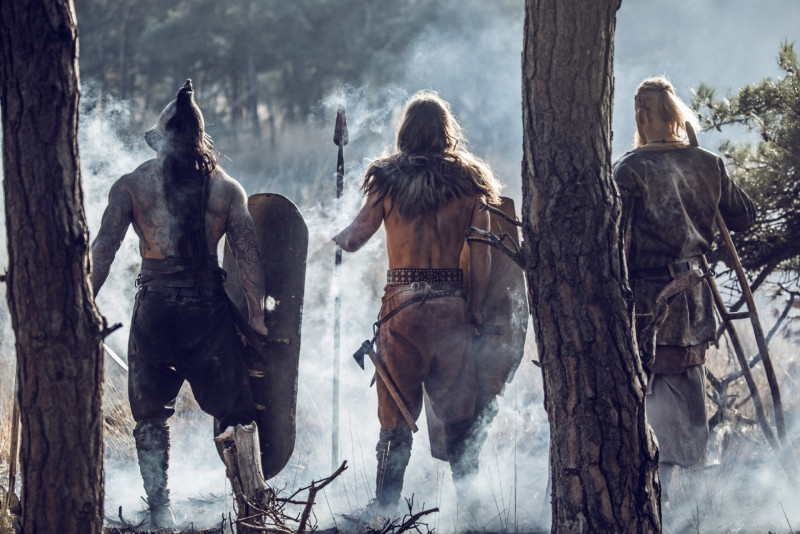
IN popular culture they're depicted as ruthless warriors who pillaged and plundered. That reputation is not totally undeserved, but is only part of the picture. Here are five things to know about Vikings.
Where does their name come from?
Like many things about them, the etymology of the word "viking" is uncertain.
In Old Norse, an old Scandinavian language, the word appears as "vikingr", which designates a person, while "viking" designates a practice.
"The Scandinavians never spoke of themselves as Vikings, as an identity for anybody Scandinavian. The word rather meant an activity, to go raiding, or a person who was doing that," explains Jan Bill, a professor of Viking archaeology and curator of Oslo's Viking Ship Museum.
"But today, practice is to use 'Viking' to describe anybody Scandinavian from the Viking period," he adds, referring to the period from around the mid-eighth to mid-11th centuries.
Exposed to cannabis and Buddha
Apart from their pillaging, the Vikings were big tradesmen who forged a vast network of contacts from the Caspian Sea to Greenland.
It has been debated for years, but it is very likely that Vikings landed in America around the year 1,000, or five centuries before Christopher Columbus.
Some objects recovered from ship graves – three such ships are on display in very good condition at the Oslo museum – bear witness to the rich and varied nature of their contacts.
Among the numerous objects is a small leather bag containing cannabis, found on one of the two women buried with the longship dug up at Oseberg.
"The seeds may have been for recreational or medicinal purposes, or to grow hemp plants whose fibres were used for textiles and rope," says Jan Bill.
Other finds at various Viking sites include textiles and beads from the Orient, as well as coins from the Arab world – often broken into pieces as the Vikings didn't use them for currency but rather for their weight in silver and other precious metals.
A bronze Buddha dating back to this period was also found on the Swedish island of Helgo.
'Drakkar' or not 'drakkar'?
The word "drakkar" is sometimes purported to be a Viking-era word for a longship, which occasionally featured an ornamental dragon on the bow.
But some historians insist that the term is as recent as the 19th century, inspired by the modern Swedish word for dragon, "drake" in singular and "drakar" in plural.
That word is similar, but not exactly the same, as the word used in Old Norse.
"There are actually seven instances of ships being called 'dreki', or 'drekar' in plural, in poems from the Viking Age," says Jan Bill.
"It was not a technical term, though, rather poetic."
Historians do however agree that light longships, powered by oars and/or sails, were known for their speed and flexibility, capable of crossing oceans and, thanks to their shallow draught, sailing upriver.
The anti-Hagar
The famous American comic strip Hagar the Horrible depicts a heavy red-bearded Viking with a horned helmet and shaggy tunic.
But according to experts, the Vikings were more glamorous than that.
"Their clothing was very colourful. They loved jewellery and bling," says archaeologist Camilla Cecilie Wenn of the University of Oslo's Museum of Cultural History.
"Far from the drab style in which they're portrayed, they spent a lot of time on their appearance. They washed and brushed their hair and beards regularly," she says.
And the horned helmet? "A modern invention from the Romantic period," Jan Bill says dismissively.
"None of the few helmets found from the Viking Age, or the preceding centuries, have horns."
The "mistake" is attributed to costume designer Carl Emil Doepler, who in 1876 added horns to the warriors' helmets in a performance of Richard Wagner's Ring Cycle opera, inspired by Nordic mythology.
Clinking to toast?
Urban legend also attributes the modern act of clinking drinking glasses to the Vikings.
They purportedly clinked their mugs so violently that some of their beer or mead would slosh into the other person's mug, thereby ensuring that their drink wasn't poisoned.
But there's no evidence to support that theory.
And contrary to popular belief, Vikings did not drink out of their enemies' skulls either. – AFP, November 15, 2020