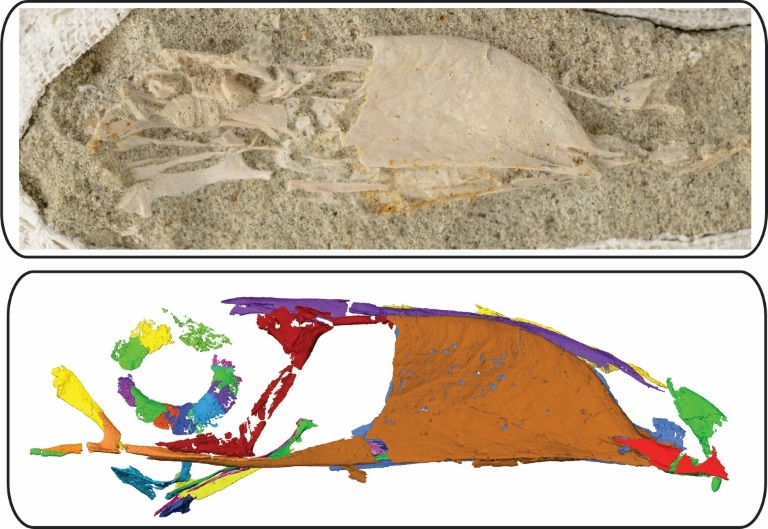
THE discovery of a creature described as resembling a "buck-toothed toucan" that lived some 68 million years ago has upended assumptions about diversity in the birds that lived alongside dinosaurs.
The discovery of a creature described as resembling a "buck-toothed toucan" that lived some 68 million years ago has upended assumptions about diversity in the birds that lived alongside dinosaurs.
At less than nine centimetres long, the delicate skull of the bird scientists have dubbed Falcatakely forsterae might be easily overlooked.
In fact, it almost was, sitting in a backlog of excavated fossils for years before CT scanning suggested the specimen deserved more attention.
It turns out that its tall, scythe-like beak, while resembling the toucan, is something never before seen in the fossil record.
Birds in the Mesozoic era – between 250 million and 65 million years ago – had "relatively unspecialised snouts", Patrick O'Connor, lead author of a study on the new creature, told AFP.
"Falcatakely just changed the game completely, documenting a long, high beak unlike anything known in the Mesozoic," added O'Connor, professor of anatomy and neuroscience at Ohio University.
The skull, described in a study published on Wednesday in the journal Nature, offered other surprises.
While Falcatakely would have had a face quite familiar to us from such modern birds as toucans and hornbills, the bones that made up its face bear little resemblance to those modern creatures.
"Despite an overall face shape similar to modern birds like toucans, the underlying skeleton is much more similar to non-avian theropod dinosaurs like Deinonychus and Velociraptor," O'Connor said.
That "turns what we know about Mesozoic bird anatomy upside-down."
'An almost comical profile'
Revealing these features was no easy task.
The fossil was originally collected in 2010 in northwestern Madagascar.
When researchers finally turned their attention to it seven years later, they faced a problem: the skull and beak were far too fragile to extract for examination.
So the team used a form of high-resolution imaging and digital modelling to "virtually dissect" the bones.
They then used 3D printers to rebuild the skull and compare it with other known species.
What they found was an almost touchingly improbable animal, according to Daniel Field, of Cambridge University's department of earth sciences, who reviewed the study for Nature.
It is not just the unexpected bill, but the fact that the beak in the fossil is tipped with a single preserved tooth, possibly one of many the bird would have had.
"These features give the skull of Falcatakely an almost comical profile – imagine a creature resembling a tiny, buck-toothed toucan," Field wrote.
None of the approximately 200 bird species known from the period "has a skull resembling anything like Falcatakely", he added.
For O'Connor, the discovery is evidence of the potentially enormous gaps that remain in our knowledge of the birds that lived alongside dinosaurs.
"There is a span exceeding 50 million years where we know next to nothing about avian evolutionary history," he said.
Finding intact fossils of birds from the period is comparatively rare because their lightweight skeletons were generally too delicate to be well preserved.
The research team, which has been working in the area of Madagascar where Falcatakely was found since the mid-1990s, is continuing excavations, and O'Connor is excited about what else might be discovered.
He also hopes to explore just why Falcatakely had the beak it did.
"Did it relate to processing food? Acquiring prey? Was it used as a signal by other members of the species? There are many questions left," O'Connor said. – AFP, November 26, 200